
Listen to a raw audio version of this story, read by Michael in one take.
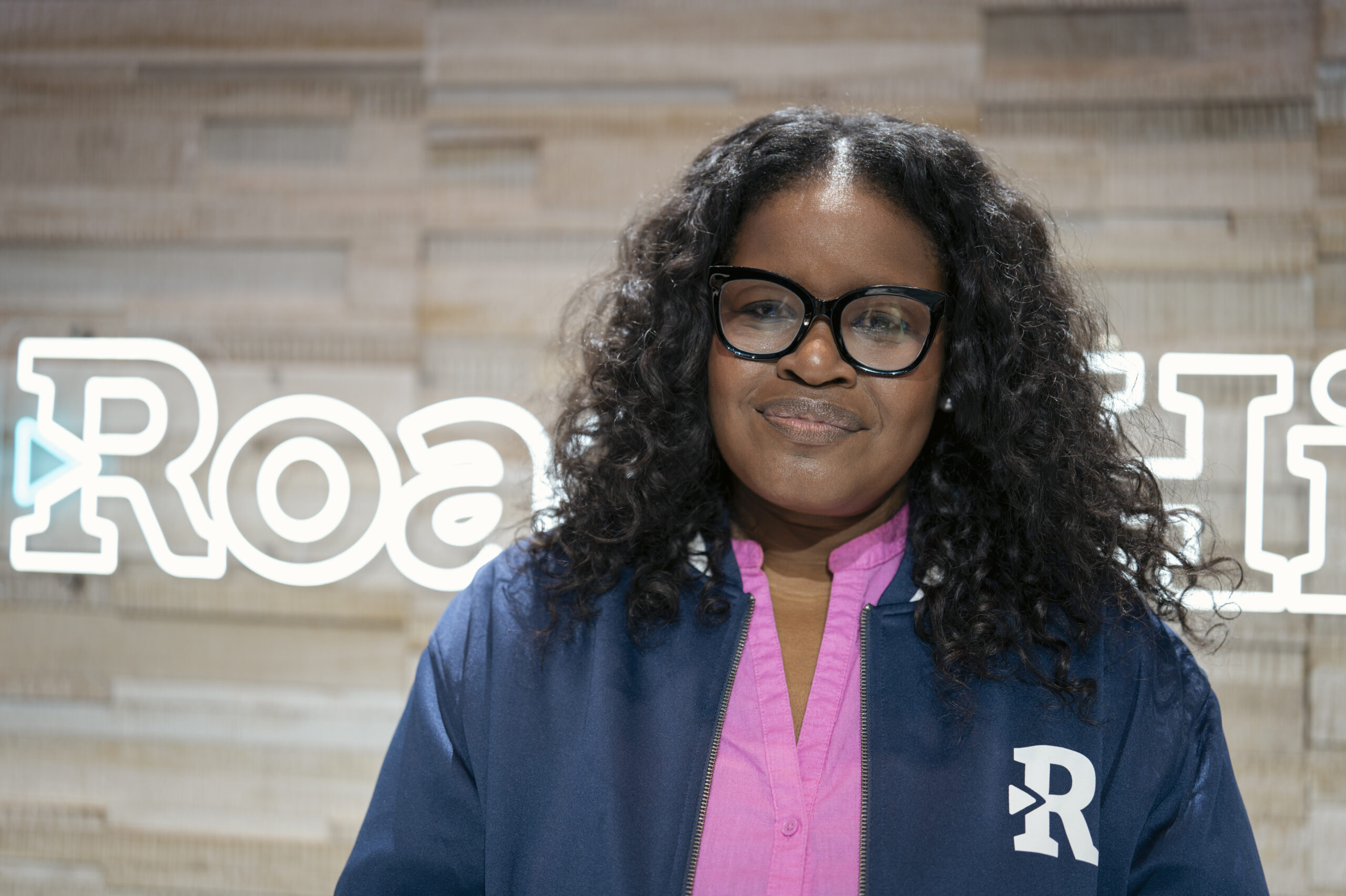
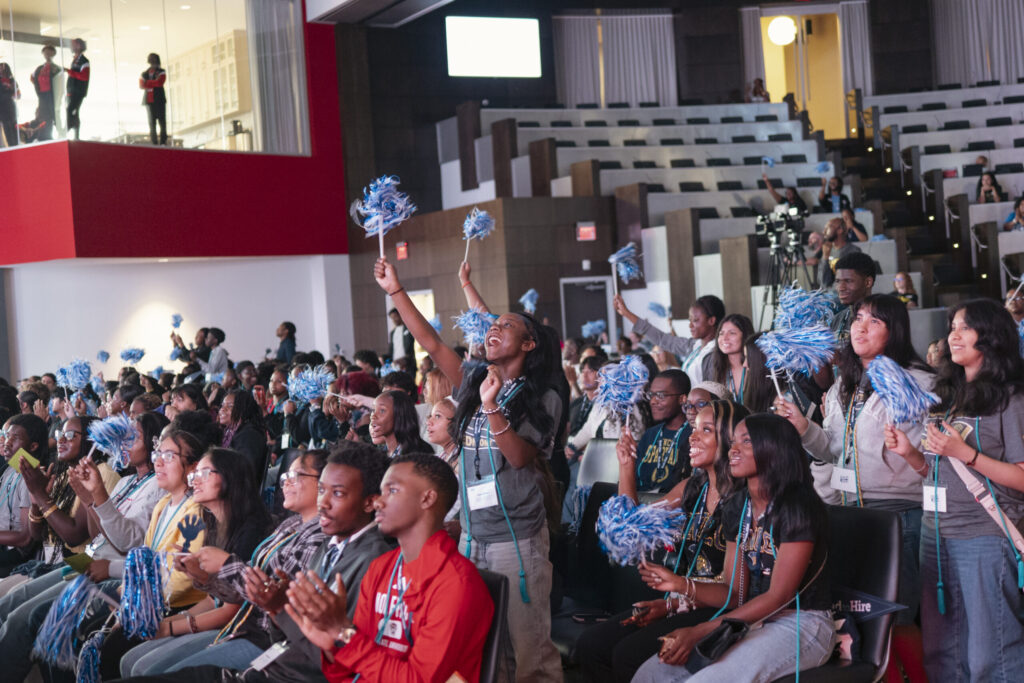
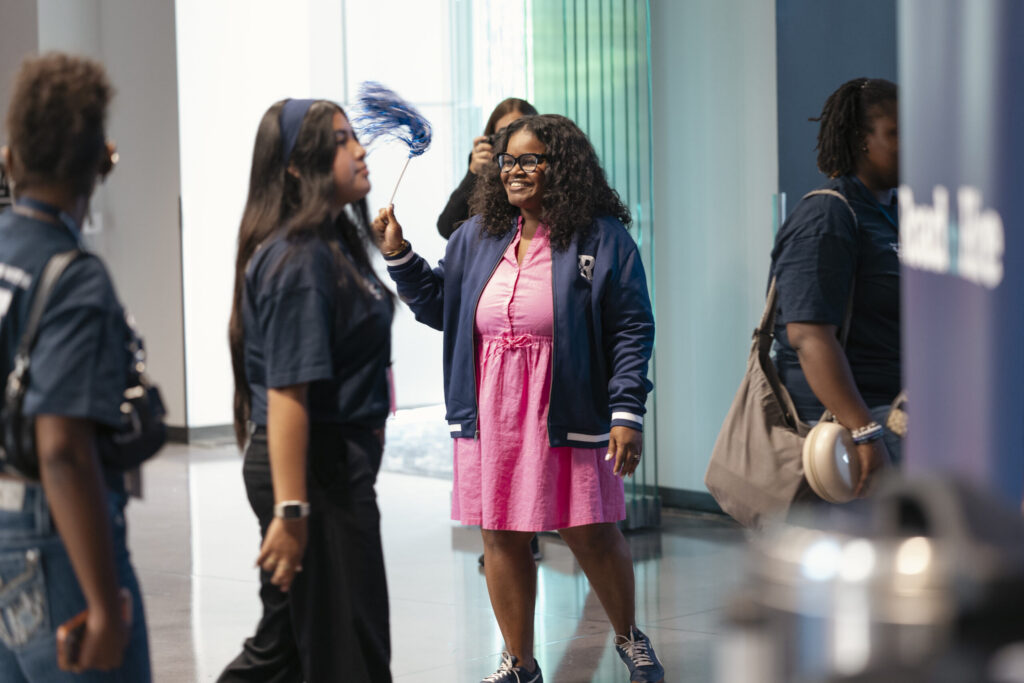
She took the stage Thursday with Petey Pablo’s “Raise Up” bopping as her walkup song, and 450 teenagers and young adults followed her lead, rising to their feet, waving pompoms and clacking clappers.
“Big energy, big energy,” Monique Perry-Graves opened. “What’s up, y’all?!?”
They were here to celebrate completing an intense summer-learning program with Road to Hire, the nonprofit organization Perry-Graves leads as CEO. The students all come from Title I schools in Mecklenburg County, and a majority of them began their Road to Hire journey with middle-of-the-road grade point averages. Now they’d just finished a four-week program that trained them in artificial intelligence and public speaking, had them hold debates on AI ethics, and gave them networking opportunities with leaders from some of Charlotte’s largest corporations.
Founded in 2014, Road to Hire has reoriented the life stories of more than 3,000 young people in our region. The only prerequisites are a 2.5 GPA or better, some inkling that they might go to college, and a guidance counselor’s recommendation. These are the students in the middle, students who could go one way or another, and Road to Hire finds them and wraps its resources around them … then doesn’t let them go until after they’ve graduated from college and found a job. The organization has partnerships with multiple corporations in Charlotte, and by its own count, its apprenticeship arm has a job-placement rate of 95%, most with salaries of $70,000 or better.
Road to Hire started small, with coding training for young professionals and scholarships for high school kids. For years it was a feel-good story in a city plagued by economic mobility issues. But it’s exploded over the past half-decade. This year it will serve more than 1,500 young people.
Program upon program has been built to help with economic mobility in Charlotte over the past decade, and most do good work. But Road to Hire has become an example of what fully formed infrastructure for teenagers might look like, if we want to take the teetering ones and send them up the economic gondola.
Ah, teenagers.
You’ve probably heard a lot about them this summer! Depending on your media diet, you might find stories about them as the most anxious generation ever, or the most troublemaking, or the most disengaged and rebellious. A driving storyline in Charlotte last week was “teen takeovers,” in which kids circulate flyers for impromptu gatherings through social media. Hundreds show up, creating a flash mob atmosphere. Several business districts, from Birkdale to Camp North End, have imposed curfews for teens after dark. CMPD Chief Estella Patterson last week asked the city council’s public-safety committee to institute a blanket 9 p.m. curfew for any person under the age of 18. The committee agreed, and council will take it up for a vote in August.
It’s not just here. “Believe the Hype About Teen Takeovers” was a headline in The Atlantic a week ago. The term “teen takeover” has surged 1,300% on Google search this summer. And to be sure, some have turned dangerous: A 16-year-old was arrested in connection with a shooting at Romare Bearden Park in Uptown, and 12 teens were arrested during a takeover in University City, as Queen City Nerve noted.
The incidents, though, have fed a much larger and less-genuine national narrative that American cities are under siege by young people. So in reality, how are “the teens” doing? The Road to Hire room on Thursday provided a compelling counterpoint.
Here were 450 young people, mostly from marginalized backgrounds, who would be a natural target audience for troublemaking, and instead they woke up early every morning for four weeks and went to work — some on college campuses at Central Piedmont and Johnson C. Smith, others at Road to Hire’s offices inside Red Ventures. While the city conversation and headlines presented teenagers as a problem to be contained, Thursday’s celebration was an emphatic reminder of what can happen when you construct a community around the same kids.
Perry-Graves said she’d spent much of last week reflecting on the distance between the two paths and storylines. It’s one reason she chose “Raise Up” as her walkup song.
“For one, it’s like the unofficial North Carolina anthem,” she said with a laugh, before getting serious. “And I feel like, as I’ve visited with them, we need them to raise up and feel that. Take some of the power back. Take some of the narrative back.”
***

Perry-Graves keeps a picture in her home office of Devon Clement, who was 20 years old in 2010 when he was shot and killed at the Cook Out on Sugar Creek Road. But to understand why she’s held that photo for 16 years, we have to start about a decade before that.
Perry-Graves is a Raleigh native whose family goes back generations in eastern North Carolina. She has an aversion to people embellishing their hardship-to-triumph stories, because it’s an insult to those who started in true hardship. She was raised in a good family, with a strong support system. Her grandfather — who was a farmer, janitor, and exterminator in Nash County — had only an eighth-grade education, but strategically decided when to sell livestock and crops so that he could ensure his own kids had an education.
But during her senior year of high school, Monique learned she was pregnant. She’d already been accepted to North Carolina Central, and her parents stepped in to help raise her son in those early years so she could attend school, too.
“To the naked eye, I was a perfect stereotype,” Perry-Graves wrote in a personal essay for EdNC. “But things are never that simple. I wasn’t just a young, pregnant Black girl. I was the daughter of two college-educated, middle-class parents.”
In her freshman year at N.C. Central, she was selected to participate in INROADS, a national program that placed high-performing minority students into internships at Fortune 100 companies. A similar mission, in some ways, to Road to Hire. She took an internship at SAS, and by the time she graduated she was already leading a team of people. She moved to Charlotte and worked in corporate communications, managing a contract with Wachovia. When the recession hit in 2008, and Wells Fargo acquired Wachovia, the contract wasn’t renewed, and she was laid off.
A few months earlier, a friend had suggested she become an adjunct professor. She landed at ECPI, teaching communication skills on a part-time basis.
One year, she had a student named Devon Clement. He was an Independence High grad who, like her, had a child at a young age. He’d enrolled at ECPI to try to “get out of some challenging circumstances,” Perry-Graves says. At the end of the course, she invited students to be creative and share their lessons from the year. Clement wrote a song about how the class, and Perry-Graves specifically, had changed his life for the better.
A few months later, he was at the Cook Out on a Saturday night when other young people started shooting. Clement was hit and died later at the hospital.
At his funeral, his family members spoke about how he kept graded papers on his desk at home. In the stack was one that included a note from Perry-Graves that told him how proud she was of him, and how far he’d come.
She decided then that she wouldn’t go back into the corporate world. She got into higher ed and never looked back. She earned her doctorate from the University of Florida. She worked for 11 years at York Technical College, rising through the ranks from faculty member and adviser, to director of communications, to COO. She figured she’d become a college president, but in 2021, Teach For America hired her as the statewide director for North Carolina. Nearly four years into that job, a recruiter called her in the winter of 2024 to ask her about her interest in Road to Hire’s open position. She was hired early in 2025, and started that June.
“It just showed the power of that level of transformation,” she said of her memories of Devon Clement. “I didn’t come from those circumstances. I’m very nuanced, in particular about that, because I think sometimes people try to make it out that they come from worse circumstances than they do. But [I know] the power of education. And if he had finished, he would have totally changed the trajectory of his family.”
***

Charlotte no doubt has thousands of young people like Devon Clement today, and they’ve been on Perry-Graves’ mind during this unsettling summer.
I’ve been talking to her off and on for several months, following along as she settled into her first year with Road to Hire. When I saw her Thursday, I brought up the broader conversations around teenagers in Charlotte, and mentioned that I was thinking about including them in this story about her and Road to Hire. I asked if that was fair, or if I was reaching for the connection. She nodded immediately and said yes, it’s fair. She’d been texting with a Road to Hire board member about the “takeover” conversation, in fact.
The discussion has, like so many other complex issues that meet the context-grinder of internet discourse, devolved into a two-sided argument. On one side are those who blame bad parents for not knowing where their children are late at night — and if those kids get arrested, well, that’s on the parents. On the other are those who say the city needs more “third places,” where children can gather and do more productive activities. Neither side is completely wrong, and neither is wholly correct, Perry-Graves said.
“I think multiple things can be truthful,” she said. “There’s definitely something we need to look at and address, but I don’t think there’s one solution.”
As it happens, on Wednesday of last week, two high school fellows in the City of Hobbies program interviewed me for a project they’re working on. I wound up flipping the questions back around to them at one point. One of them, 16-year-old Rory Vallimont of East Mecklenburg High, said she knows about the takeovers and has known people who attend them, but she doesn’t go herself. I told her about the curfew conversation before the city council, and she said, “That seems not good.” She said that something as simple as providing a blank wall and spray paint can keep some kids from getting into trouble.
She said the rules can be simple: “You can spray the wall. Just don’t spray each other.”
CMPD has said that a few “bad apples” or “bad actors” are responsible for the trouble lately, and it’s difficult to police them because of the crowd sizes. The meetups generally start light-hearted and fun, but then turn dangerous when they get too large. Curfews aren’t new, either. Former Mayor Pat McCrory instituted a midnight curfew in the 1990s, and it did lead to several pickups. But as Andrew Dunn’s new book on McCrory noted, most of them were in the affluent Arboretum area.
Point is, the subject is more complicated than a headline. Yes, some kids may need more third places, and some need their parents to be more attentive, and some may also need the punishment of the law.
What all kids need, though, more than any of that, is a purpose.
And that’s where programs like Road to Hire start. Perry-Graves carries a saying with her. She’s not sure who said it first but it goes like this: Talent is prevalent. Opportunity is not. Road to Hire’s model is manufacturing the second half.
“We pour hope into them. We pour encouragement into them,” she said. “We give them a place, the structure, and expectations. And I think anybody can thrive in that.”
“I think we need to broaden the conversation,” she added. “They do need a third place. But it has to be anchored in something.”
Charlotte, for what it’s worth, has already bought into the idea. In the recently adopted budgets for this year, the city and county each committed $1.5 million to Road to Hire to help it scale. It was the first ask of that size the organization’s made, and Perry-Graves calls it “historic.” In other words, the same governments now debating how to keep teenagers off the streets after 9 p.m. just invested $3 million in a program that gives them a reason to get up early.
***
Perry-Graves’ hiring process at Road to Hire was, to put it mildly, abnormal. The first-round phone screening wasn’t with a recruiter or an HR rep, but with Road to Hire founder and Red Ventures CEO Ric Elias.
It was a rapid-fire conversation that she barely remembers, but she knows it was fairly straightforward without much in the way of jokes or smiles. She thought it went “ok.” The next morning she woke up to an email from him, telling her to think about when she might like to come in for an in-person interview. One of the dates the team threw out was January 20 — her late mother’s birthday, less than a year after she’d died, and a day Perry-Graves had blocked off on the calendar. She prayed on it, and went in anyway, spending a full day with the team and CEOs from across the Red Ventures umbrella. She had an offer within a few weeks, but waited several months to start.
Hiring her was a bit of a coup. Perry-Graves’ reputation across the Carolinas is sterling. She was on a path to becoming a community college president when Teach For America recruited her away. And when she left that job for Road to Hire, Teach For America threw her a big going-away ceremony at The Umstead in Cary. A representative from Congresswoman Deborah Ross’s office gifted her an American flag, with a certificate that verified it had flown over the U.S. Capitol. And Governor Josh Stein’s office gave her a North Carolina flag that had flown over the state capitol.
Full disclosure: I’m closer to this story than most I write. Elias and Kacey Grantham, who was Road to Hire’s CEO before Perry-Graves, are friends of mine and helped me get Optimist off the ground. Neither of them, nor Perry-Graves, suggested this story. The idea was mine. I’ve been following the organization since I wrote about its workforce-training program in 2020, back when it was a feel-good story about 58 new software engineers.
Still, when those 450 students walked into the room Thursday, and I thought about how much it’s grown and where Perry-Graves is taking it, I got goosebumps. They came back all morning. Every one of the SummerU participants’ names was printed on the back of a closing-ceremony T-shirt, and an emcee said, “That is not a design choice. That is actually the point.”
“I had the chance to connect with people from different schools, backgrounds, and walks of life — people I may never have crossed paths with otherwise,” said Saishah Charlot, a 2026 Julius Chambers High grad who’ll be a freshman at CPCC this fall. “For a while, we became one big family, and that’s something I’ll never forget. I’m taking with me a more open mind, more gratitude, and a deeper appreciation for opportunities that come simply from showing up and being present.”
“To my fellow peers,” Charlot added, “as we each begin this next chapter and go our separate ways, remember that where you start doesn’t determine where you finish.”
In late May, I attended Road to Hire’s “Commitment Day” celebration for graduating seniors. Phillip O. Berry’s marching band, the Marching Cardinals, serenaded the seniors as they walked into the building. And the big moment was when the screen lit up with the dozens of colleges, universities, branches of the military, or workplaces that will receive the seniors this summer and fall.
(Many of those students, by the way, participated in the summer program, during which they built an AI agent that will help them navigate their future campus.)
At that Commitment Day celebration, Elias asked the students to write a letter with their goals for the next four years, and asked them to open it after they graduated from college, then send him a note to tell him how the expectations met the reality.
About a week later, a Road to Hire team member approached Perry-Graves with two envelopes with letters, one for her and one for Elias. Perry-Graves opened it and read.
It was a note of gratitude from a senior who’s college-bound in the fall. The letter-writer apologized for writing four years early, but wanted Perry-Graves and Elias to know immediately what the year-long program meant to them. The student has some family struggles, with a younger sibling who needs help. There were times, the student wrote, that they wanted to give up. But they didn’t, they said, because they wanted to set a good example for their family.
Then, at the bottom of the letter, the student wrote with a piece of information they’d kept under wraps: They’d spent most of their senior year homeless.
Perry-Graves broke down in tears. She called Elias and said, “This is what it’s about. Not the fact that [the student] was homeless, but this is why we have to get this right.”