
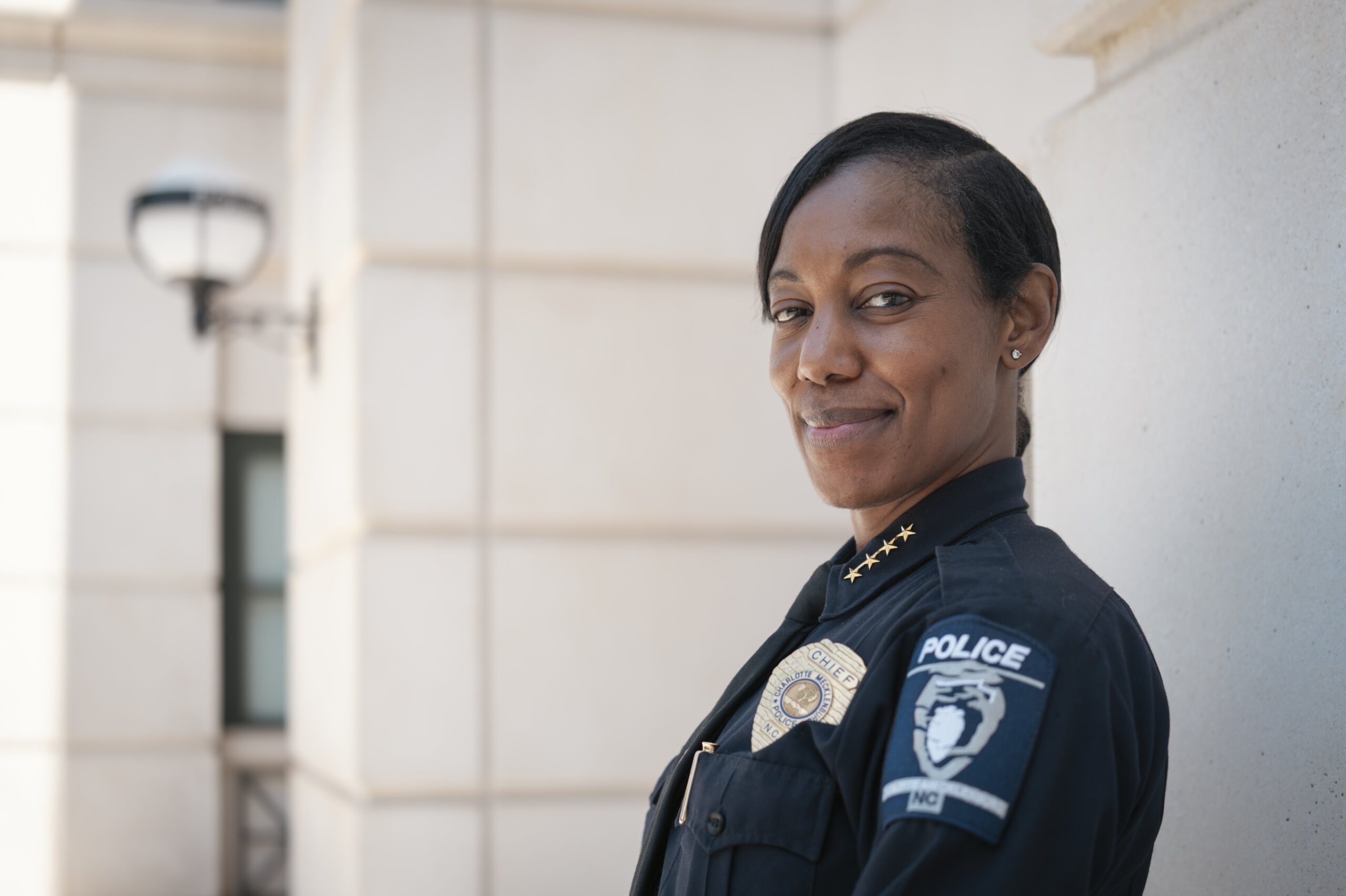
Estella Patterson didn’t need more trouble. She’d returned to Charlotte this past December to become our police chief after four years as Raleigh’s, and her schedule filled up like a Tetris board. Reporters wanted to ask her about being Charlotte’s first woman chief. Her employees wanted a strategy to fill a 200-officer staffing shortage. The business community wanted her ideas for addressing crime in uptown. And the city’s immigrant corridors were shaken by November’s erratic border patrol raids.
Then came Dante Anderson, chair of the city council’s safety committee, with something else: Anderson wanted Patterson’s help with a persistent petri dish for crime — the hotels along I-85 and Sugar Creek Road.
For at least a decade, the area’s been a hub for trafficking drugs and weapons and sex. Several neighborhood groups, nonprofits, and business owners have exhausted themselves trying to improve the quality of life there. In 2023, the city purchased the old Economy Inn along Reagan Drive, which had devolved into an open-air drug market, and demolished it for affordable housing.
After the Economy Inn went down, though, the issues moved a half-mile away to the Garden Inn. CMPD responded to 240 calls at the property in 2025.
“We have children who are catching the bus while all of these drug transactions are going on,” Anderson told Patterson. “It’s not safe.”
Anderson half-expected Patterson to say she already had enough to deal with, or that she didn’t have the manpower to initiate a large-scale bust. Instead, the chief made calls.
Working with U.S. Attorney Russ Ferguson, Patterson mapped out a six-month operation with the FBI and other law enforcement partners. Agents and officers went undercover to understand the hallways, rooms, and main players. They found that the hotel’s own security team was allegedly part of the crime ring, and that the property owner was, at minimum, allowing it.
Early Wednesday last week, hundreds of CMPD officers and federal agents flooded Reagan Drive and entered the Garden Inn. They heard toilets flushing as people tried to ditch drugs, and officers found weapons hidden in the toilets’ tanks, WSOC’s Hunter Saenz reported. Ten people were arrested that day, about half on federal charges and half on state-level charges. Ferguson’s office filed a civil forfeiture action against the hotel.
Patterson stood at a press conference later that day and praised Ferguson and the other agencies. It was one of her signature moments in her first half-year as police chief, and the complexity of the operation underscored some emerging hallmarks of her administration: communication, collaboration, and a deep well of relationships.
“Teamwork always wins,” Patterson said. “We pulled our intelligence together. We pulled our resources. We synchronized our tactics. … To the criminals who think they can act with impunity in our neighborhoods: We have the will, we have the partnerships, and we have the resources.”
Anderson stood next to Patterson, and when I talked to the council member on Friday, her mind went back to that first one-on-one meeting around the new year.
“Any other person could have very easily and rightfully have said, ‘We can’t do an operation of this size because I don’t have the manpower,’” Anderson told me. But Patterson, Anderson said, “she’s focused on outcomes.”
***
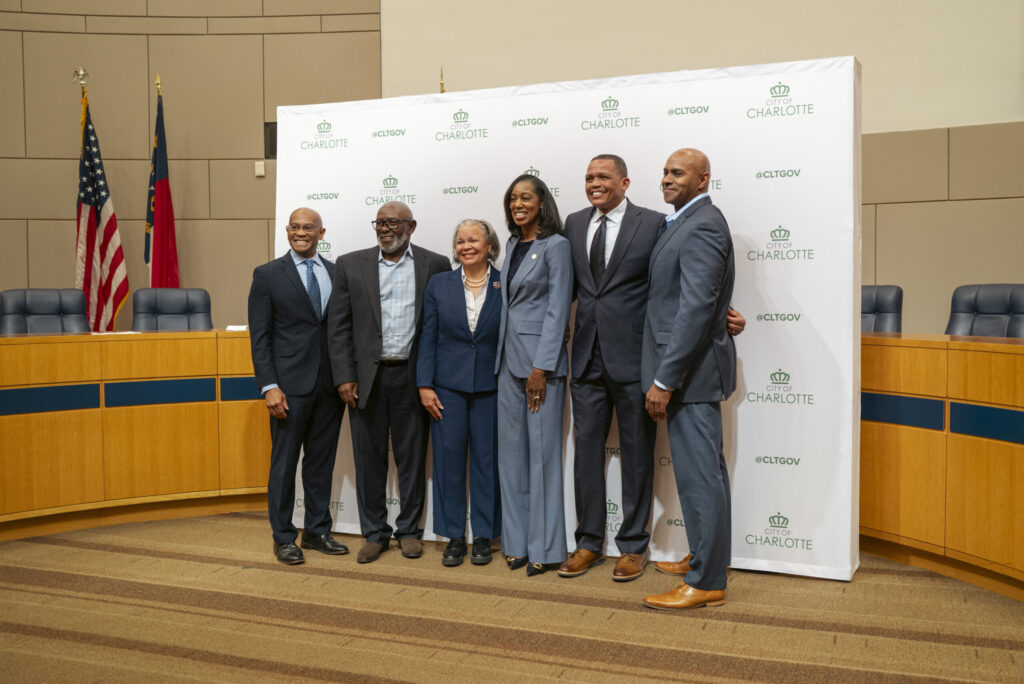
Charlotte leadership has a bunch of wobbly legs these days. The mayor’s resigning. City council members are crawling all over each other like hamsters to raise their profiles. Their abrupt rescission of the I-77 toll lanes project is one of local government’s most stunning developments in recent decades.
One department that conspicuously isn’t contributing to the chaos is CMPD. That’s a big shift from one year ago, when former chief Johnny Jennings’ severance package dominated headlines throughout May.
From the top of the government center to the C-suites to the Fraternal Order of Police, though, leaders share high praise for the new chief. City manager Marcus Jones included 10 percent raises for all CMPD officers in his budget proposal, to be paid for by property taxes, and not one resident spoke against the raises at a May 11 public forum.
Meanwhile, Patterson told me that CMPD has two classes of 50 recruits going through the academy now. And if they keep up that pace, she hopes to fulfill her promise of eliminating the vacancy issue within the next few years.
I sat with Patterson, who will cross 180 days on the job this week, for more than an hour earlier this month. When I mentioned that the vibes around CMPD seem to be good these days, she started looking around for wood to knock.
“One incident can change that,” she told me.
***

Over the past few months, I’ve watched Patterson speak to a room of women business leaders, to a thousand people at a ballroom in Uptown, and to me in her office, and she’s been steady in every setting.
She’s been a welcome ear to center city’s executives, who put public safety atop their list of civic priorities in the wake of a crime surge in uptown last summer and the killing of Iryna Zarutska on the light rail last August. They’ve consistently said they want Charlotte to be the “safest city in America.” When a Bank of America employee was killed outside of a branch in northwest Charlotte in February, Patterson made immediate contact with the bank’s leadership and provided constant updates on the case.
The main underlying concern I hear is that the city may overcorrect on public safety, while shifting away from funding softer things that make cities safe, like investments in arts and culture and things to do for teens.
Patterson, though, believes that CMPD’s community policing philosophy, which it adopted in the early 1990s and prioritizes relationships in neighborhoods over enforcement, serves as a safeguard to overpolicing.
Still, she’s yet to face the kind of “one incident” that defined her predecessors. Rodney Monroe had the 2013 police killing of Jonathan Ferrell, an unarmed Black man. Monroe charged his own officer with murder, fracturing the department, and the officer went free in 2015 after a hung jury.
The next year, Kerr Putney was thrust into the national spotlight after the police killing of Keith Lamont Scott. A week of protests followed, the National Guard was deployed, and Putney faced calls to resign. It caused a public split between Mayor Jennifer Roberts, who faulted CMPD’s transparency on video footage, and a city council that issued its own letter of support for the chief.
Patterson, then CMPD’s head of internal affairs, watched and took lessons from the Scott experience that she believes will help her navigate any similar future situations.
“The big takeaway from Keith Lamont Scott was there was too much division between the police department and city hall,” she told me. “We saw the disconnect. … You’ve got to work with the manager and the mayor.”
Putney’s successor, Jennings, took over in the summer of 2020, mid-George Floyd protests. He was about to retire in spring 2024 when four officers were killed by a man firing a rifle from a second-story window in east Charlotte, the deadliest day in local law enforcement history. Jennings postponed his retirement for a year, only to field more controversies.
The one potential cloud over Patterson’s arrival was personal. Her husband, a former Charlotte firefighter, settled a racial discrimination claim against the city for $99,999 — one dollar below the maximum the city can approve without council’s authorization — just a couple of weeks before she was announced as chief. Lance Patterson received $40,000 of the settlement, while his lawyers received the rest. His case was just one of several suits filed by high-ranking Black fire department officials in 2018. He’d accepted a settlement offer previously, but the case dragged on because there was a disagreement over how his sick leave would be calculated, the Observer reported. The city attorney told WBTV in December that attorneys in her office and the outside counsel that negotiated the settlement were “not aware that Chief Patterson was a finalist for Chief of Police” when the settlement was made. The state auditor is investigating the payments as part of a broader audit of the city’s finances.
If Patterson does find herself landing in a more contentious situation regarding the work of her officers — what chief doesn’t? — her strongest tool may be her public speaking. She proved she could hold a room the day the city announced her hiring in November, when she delivered a direct six-minute address without hiccups or ums or likes.
“She has a tremendous speaking ability,” Anderson, the city council member, told me. “I’ve listened to several of her speeches, and I’m thinking, She is masterful at this.”
***
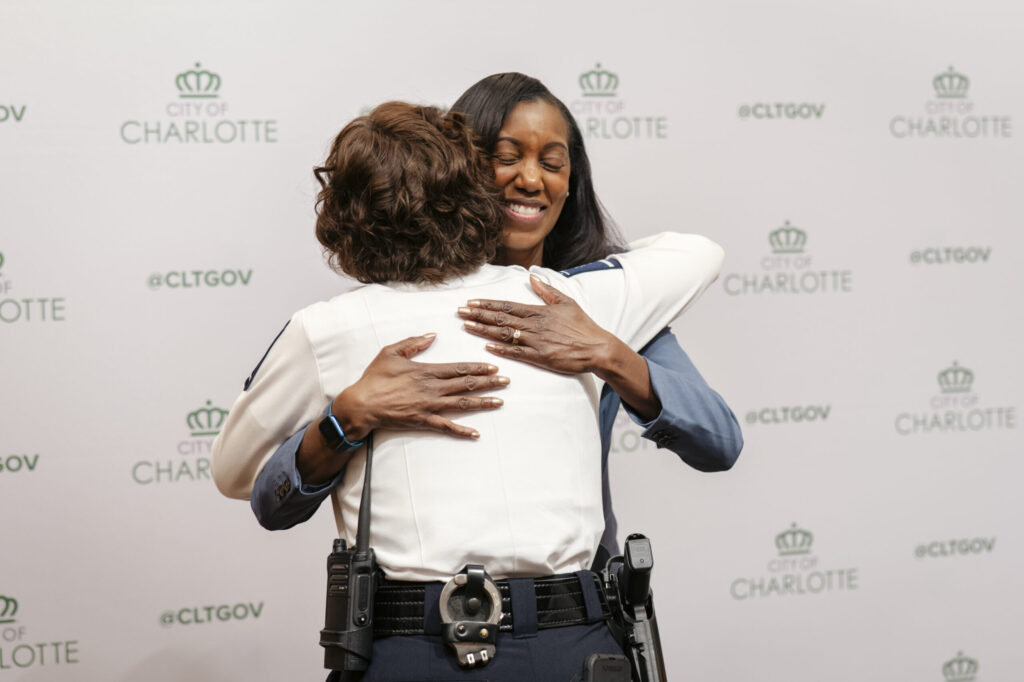
When Patterson joined CMPD, her first supervisor told her, “There’s no place for women in policing.”
Patterson shared that story with a room of about 50 women business leaders in early March. She may be Charlotte’s first female police chief, but she doesn’t want to be defined by that. In fact, just ahead of our conversation, I talked to several people who know her and they all told me: She doesn’t really like talking about that.
But in that room at the Charlotte Regional Business Alliance in March, it was hard to not see what her presence means. The women in attendance worked for some of Charlotte’s biggest corporations, and after she was done, they formed a line to meet her about a dozen deep.
She left them three pieces of advice:
- Always strive for excellence: “People are expecting — I’m going to be honest — with women (that) we can’t handle it.”
- Be selfless: “It has to be about your people, your team.”
- Competition is healthy: “We should compete, but we shouldn’t cheat. I think the most enemies that I have had, people who have tried to sabotage me, have been women. That is so unfortunate, because we know how difficult it is to strive and climb in the ranks. So I always encourage women to support one another. … There’s enough sky for all of us.”
Patterson wouldn’t be a police officer without the influence of a woman.
She was raised in an Army family, and she never had a settled hometown. She was born in Panama, then moved to Fort Benning in Georgia when she was five or so, then to Fort Bragg in Fayetteville during adolescence, then to California for a couple of years, before the family shipped off to Germany. That’s where she graduated from high school.
Her dad served in Vietnam and then Operation Desert Storm in 1991. Some of her friends on base lost parents in the Gulf War. She was a teenager then, so I asked her how that affected her. Her jaw didn’t even tremble, as if it was just part of life. So I pressed a little.
“But teenaged brains aren’t fully formed,” I said.
She responded with a laugh and heel-turned the conversation: “We see that every single day here. The things they do. It’s like, ‘What are you doing?’”
I share that anecdote because, of all the people I’ve interviewed in Charlotte, Patterson was one of the easiest and toughest. She’s a sharp communicator, but she’s a risk manager when it comes to words. And while she’s proven her first supervisor wrong — there is indeed a place for women in policing — she knows that if she lets her guard down publicly, even about what it was like to be a teen with a dad at war, it could come back to haunt her.
***
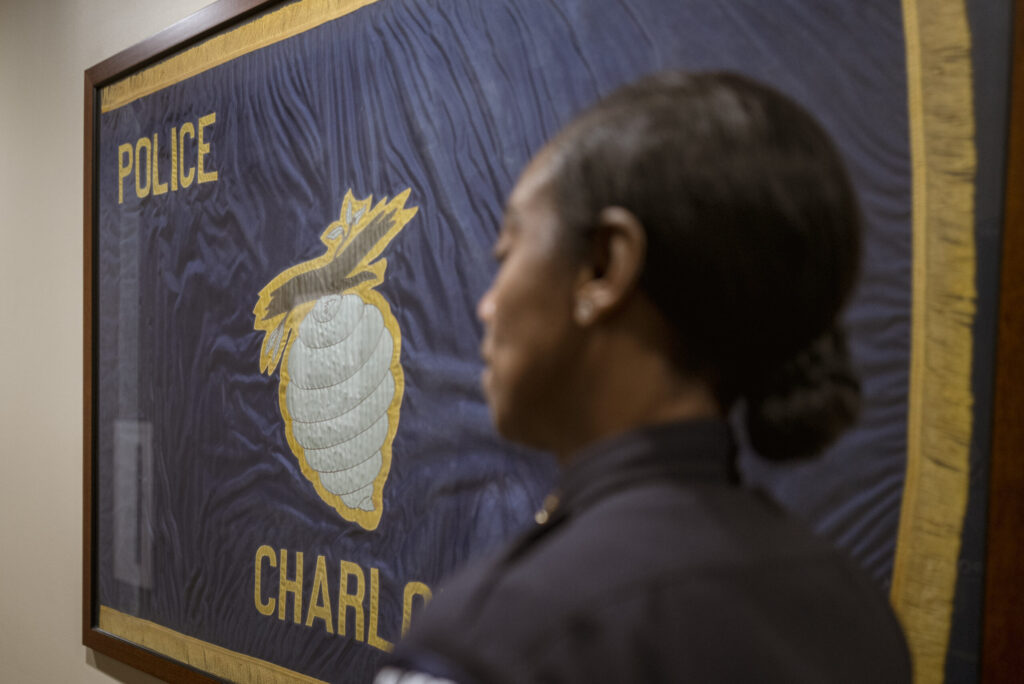
Also, she just likes the action.
She told me that her favorite assignments as an officer were in the Eastway and Westover divisions, because she was always busy. The east side was flush with robberies at the time, largely because immigrants made for easy targets, she said. And on the west side, as a captain, Patterson once led a raid of a high-stakes, late-night gambling haunt known as “The Club,” seizing about $40,000 in cash.
“I think that’s all I know, actually — staying busy,” she said.
She attended UNC Charlotte on an ROTC scholarship and joined the Army Reserves after graduation. Shortly after completing her training in the police academy, the Army deployed her to Kosovo, where she spent about seven months.
She returned in late 2000, and was assigned to the police academy to help train new recruits. She remembers being in a classroom on September 11, 2001, hearing news of the terrorist attacks. Her unit was mobilized later that year, and she deployed in 2002, first to Kuwait and then to Baghdad in Iraq.
After that deployment, she was back at the academy when then-chief Darrel Stephens visited her to thank her for her service to the country. The fact that he even knew her name stuck with her.
Probably the most visible manifestation of that interaction shows up in the uniform she wears today. Charlotte’s police chiefs and executive team members for years have worn white uniforms, setting them apart. Kerr Putney often wore suits. But when Patterson went to Raleigh in 2021, the leadership team there wore blue to match the rank and file officers. She liked that, and she brought it here.
“It’s a one team mentality,” she told me. She’s also joked with the women business leaders that she “learned in the military that if people at the top looked different, we became a target.”
She gathered lessons from each chief following Stephens. The most influential, she said, was Monroe. He was an outsider who came here from the Washington, D.C. area, and his top initiative was overseeing the decentralization of CMPD, taking it from a headquarters-heavy department to one that put its resources in the various divisions. He helped secure funding for new division headquarters.
On Putney, Patterson’s description is most fitting: “I always thought he disliked me,” she said, laughing. “But he promoted me twice: to major and then to deputy chief. He is so hard on his leaders. Oh my gosh. He was just so hard on me, all the time. But he taught me toughness, resilience.”
After Jennings took the chief’s job in 2020, Patterson got tapped to be the police chief in Raleigh, taking over a department in turmoil after George Floyd’s protests in the capital city. She saw the department through a mass shooting and helped reduce the department’s vacancies from 150 to about 40.
She retired in 2025, but as soon as Jennings announced his retirement from CMPD later that year, her phone started ringing with people urging her to come home.
***
A little more than a week after Patterson was announced as chief, border patrol agents descended upon the same east Charlotte neighborhoods she once patrolled. She soon got on the phone with Ferguson, the U.S. Attorney, who called for a closed-door, clear-the-air meeting with leaders from several federal agencies.
Nearly half of the people detained during the raids had no prior criminal record. And in my view as someone who covered them, the feds’ overall operation trampled all over CMPD’s core strategies of community collaboration and professional accountability. As it happens, at the public protests against the raids along Central Avenue, demonstrators welcomed CMPD officers’ presence, in part because they knew their faces, unlike the masked federal agents.
At the meeting Ferguson called, Patterson looked around the table at people she knew mostly by their broader acronyms — ICE, DHS, HSI — and her goal was to leave with their names and phone numbers.
“If something’s going on, can I call you and get a heads up and you can share information, whatever you can share?” Patterson remembers asking the feds during the meeting. She wasn’t there to talk politics or condemn them, but to simply say that local officers need to know what’s coming to the neighborhoods they patrol and the people they serve.
“It kind of brokered those conversations that were not had before,” she said. “We hashed out some things in that room. Like, how do we keep each other informed?”
I told her that Charlotte community members will likely be comforted to know that the chief of police has a direct line to the federal agencies, should they return.
“I’m not gonna be trying to figure it out in the moment,” she told me. “Like, ‘Who can I call? Who can help me navigate through this?’ No.”
We were in her office on the top floor of CMPD headquarters for the conversation. On the wall behind her was a framed picture of her smiling with the venerable monks who walked through the city in January.
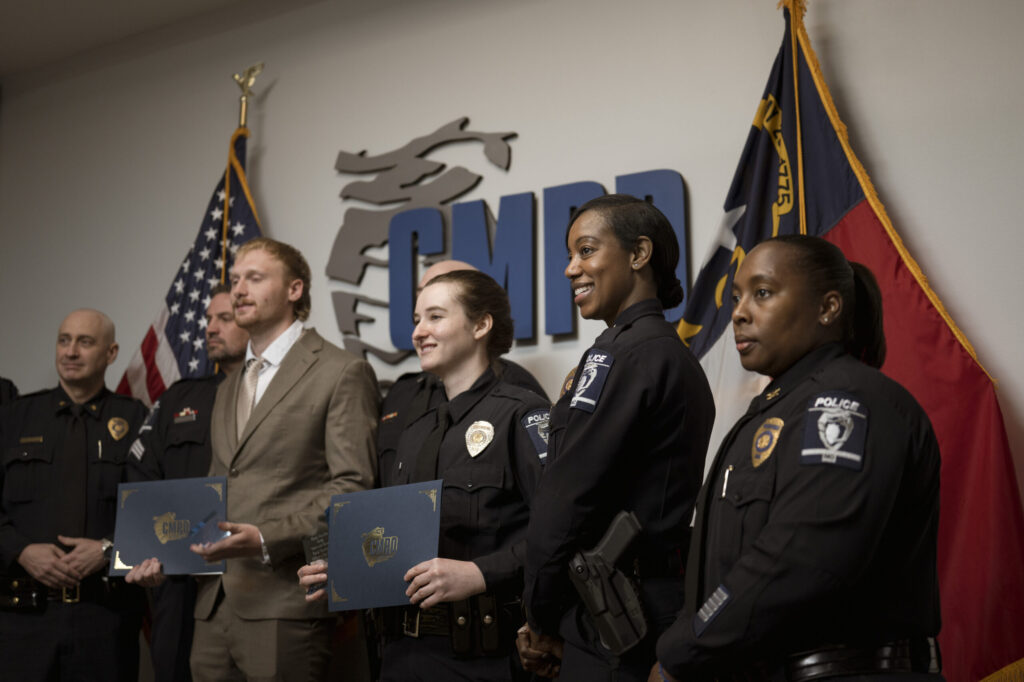
Earlier that morning, I stood in the back of CMPD’s control room while Patterson and her leadership team gave out officer of the month awards for CMPD’s various service areas. One was a detective who led the investigation into the random stabbing of a pregnant woman at the Cotswold Harris Teeter in March. Another investigated a street takeover in which an officer was hit, leading to several arrests.
Patterson smiled for pictures with the officers. But she didn’t try to own the room; instead she let the officers’ superiors give remarks. Which brings me to one last thing. Not only does Patterson wear the blue uniform like all of her officers, she stopped using the term “executive team” altogether. She changed it to “leadership team.”
A small thing. But it’s clear that to Patterson, being an “executive” means having a title. Leading, on the other hand, is an action.