
The day after he was elected mayor in 1995, Pat McCrory took his dying father up to the top of the government center. Rollin “Mac” McCrory had been one of the most important figures in Pat’s story, and even though lymphoma would take his life two weeks later, Mac wanted to see how far his son had risen.
Former CMPD detective Garry McFadden, who’s now Mecklenburg’s sheriff, opened the doors and wheeled Mac to the windows overlooking the city. Mac stared for a few minutes, but then asked his son to come closer.
“Keep your damn zipper up,” Mac told Pat.
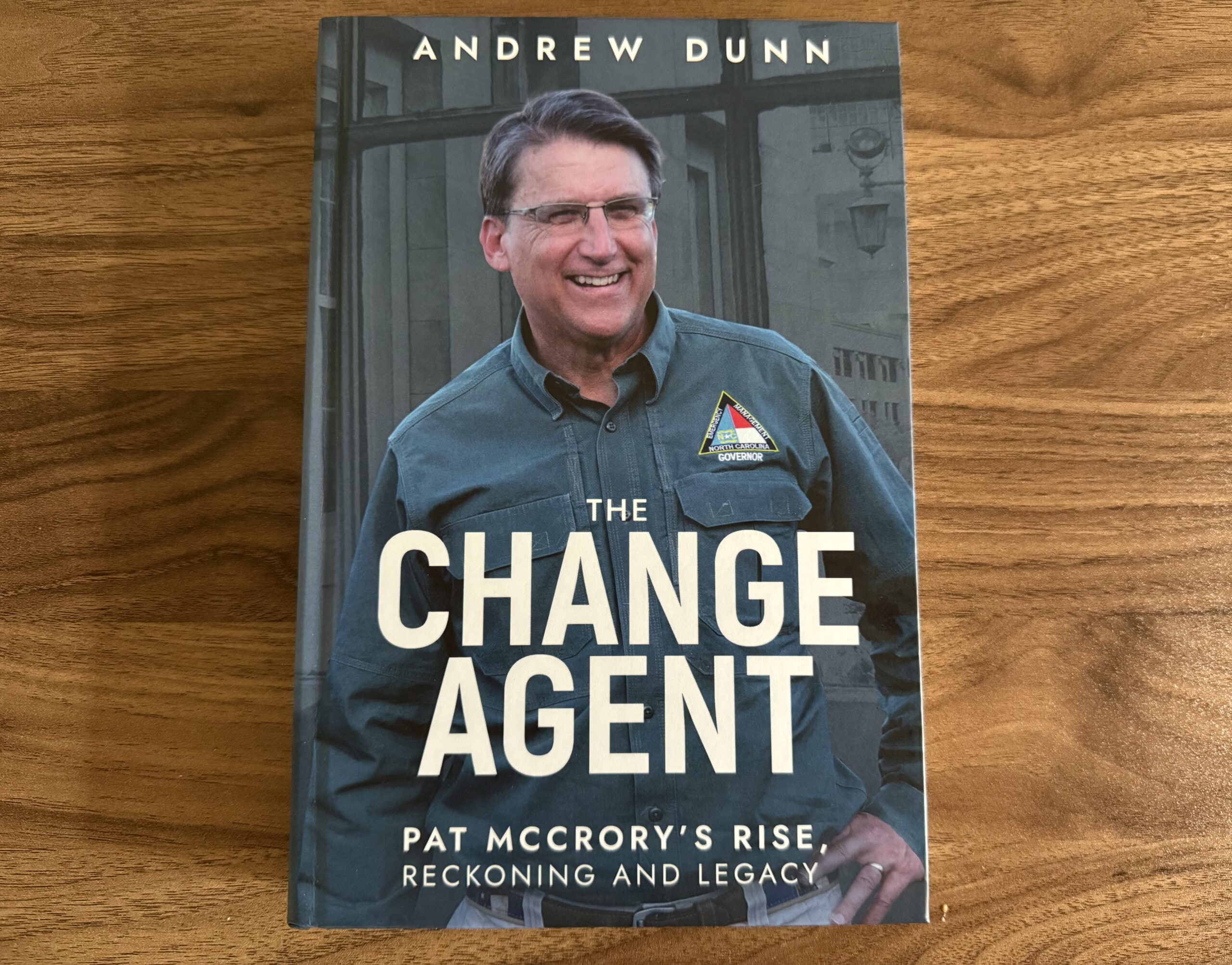
That story joins hundreds of other human anecdotes to make up a new book about McCrory’s life and work in politics. The Change Agent, by longtime writer, political analyst, and North Carolina obsessive Andrew Dunn, was published this past Tuesday.
The book was born from a simple question Dunn couldn’t escape. McCrory spent 14 years as Charlotte’s mayor, longer than any other, and then he swept into the governor’s mansion as a “rockstar Republican” in 2012, Dunn writes, winning deep-blue Wake and Mecklenburg counties in that election.
“How do you go from there to a complete political outcast in four years?” Dunn told me of the book’s central question last week.
If you’re one of the tens of thousands of people who’ve moved to Charlotte and North Carolina over the past eight years, you might easily not know the role McCrory played here. And if you do know of him, you may only recall that he was at the center of the contentious HB2 law that in 2016 overturned Charlotte’s nondiscrimination ordinance and led to boycotts of the state by large companies, artists, and sports leagues. Over the course of the year he not only drew the ire of Democrats, but lost his edge in rooms with Republicans to other leaders like Phil Berger and Tim Moore. McCrory ran for Senate in 2022, but lost by 34 percentage points to Ted Budd in the primary.
Dunn’s book takes a close look at 2016, and how McCrory still gets frustrated by how the year went.
But when I read an early copy of Dunn’s manuscript last month, I couldn’t help but think of it as a necessary read for the parts that come long before McCrory was governor. The Charlotte parts.
McCrory was born in Ohio and moved to Jamestown, near Greensboro, as a kid. He collected baseball cards and campaign posters from prominent politicians like Lyndon Johnson and JFK. He went on to become student-body president in high school, then again in college. He intended to go into teaching after college, but a job at Duke Energy offered him $50 more a month, so he took that.
He rose to gain the trust of CEO Bill Lee, one of the city’s most consequential figures, who eventually made the connections McCrory needed to run for political office.
McCrory won the last at-large seat on council in 1988. And in his time on the body, he made a lot of people mad. He once pushed for a seat-use tax to help fund the Panthers stadium. Dunn writes of how that effort caused a powerful businessman to call Bill Lee and say, “You need to control your guy.”
In some ways, the stories from his earliest political days remind me of the young politicians who’ve come into Charlotte’s politics since McCrory left. Folks like Braxton Winston, Tariq Bokhari, and now, J.D. Mazuera Arias, all have different political bents — but they disrupted the government center by making bold and uncomfortable proposals early in their terms. And all have been met with some sort of “wait your turn” response that McCrory encountered 40 years ago.
Some issues rhyme today, too. McCrory focused heavily on crime in his time on council and early in his tenure as mayor, launching a “Target 100” campaign that focused on the people who’d been arrested the most times for the most serious offenses. Soon he realized that the city could only play a part in crime reduction, because the state runs the courts. So he helped organize a caravan to Raleigh — including police officers, pastors, neighborhood leaders, and business leaders — to walk the halls of the legislature asking for help on that side.
McCrory’s most memorable accomplishment, of course, was pushing for transportation infrastructure, eventually opening the light rail from Uptown to Pineville. Almost any conversation about transportation since has stood on that foundation.
Who writes a book about McCrory is its own question. And Dunn, a south Charlotte resident and father of four, is an interesting answer. He’s a Republican, like McCrory. He worked on Dan Forest’s 2020 gubernatorial campaign, and now works at State Policy Network, which describes itself as nonpartisan but leans center-right. The book is friendly to McCrory, but it’s more reportorial than partisan.
Dunn started his career as a journalist. At UNC in the 2000s, he was the editor of the Daily Tar Heel, which in the college newspaper hierarchy is like being editor of the Wall Street Journal or New York Times. He came to Charlotte to work at the Observer in 2012, then spent three years at the startup Charlotte Agenda. His Longleaf Politics newsletter reaches political insiders around the state.
I sat down with Dunn at a SouthPark coffee shop on Friday morning. He wore a well-worn ball cap with a North Carolina flag on it. I asked about the tension of pursuing this project as a journalist, political consultant, and former campaign worker all at once.
“I don’t really get caught up in the distinction between who is a journalist and who is not a journalist,” Dunn says. “100 years ago, 200 years ago, there was none of that discussion. You had people who would write. … The main reason why I do what I do is because I want my children to inherit a small and growing and improved North Carolina.”
He published the book under his own Longleaf Politics Press and says it’ll be a win if it breaks even. But he believes — and so do I — that regardless of your opinion on McCrory, a consequential political career deserves a permanent printed account, HB2 and light rail and all.
Dunn spent about 200 hours with McCrory for the book. It’s worthy of a Charlotte citizen’s time, especially for those of us who didn’t live here then.