
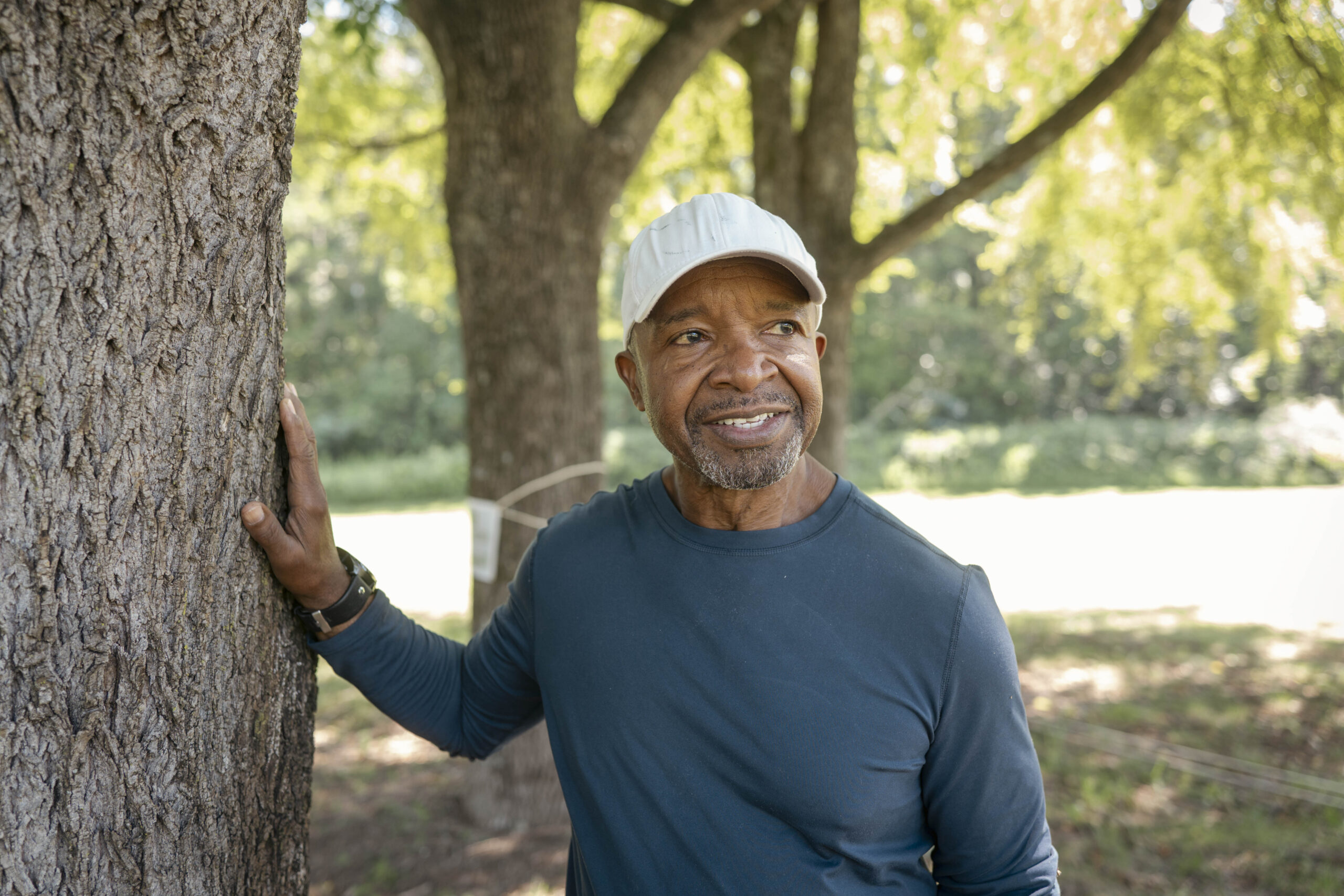
Rickey Hall is no longer next to me.
We’re walking through a shopping center that Harris Teeter abandoned a half-century ago, when housing projects went up and white residents moved out. A police security camera serenades us with piercing beeps. Cars and big rigs growl along West Boulevard, all in a hurry to zoom through a neighborhood that’s been Rickey’s home for 69 years.
He calls this the gateway to the world. I’ve come here so he can walk me through all of it. He starts by talking about a $3 billion section of the Silver Line light rail that will run just over the hill to our north, and the $4 billion Destination District being built around the airport just to our west.
He has a soft-spoken gentleness about him, and it takes me a second to realize he’s stopped walking mid-sentence. I look back to see him bent over and plucking something off the sidewalk.
“A penny!” he says. “Gonna be a rare jewel soon.”
He slips it into his pocket, then looks out toward the intersection of West Boulevard and Remount Road, a corner with a gas station, a fast-food joint, a cell phone store, and a vape shop, and he says, “It is a place of significance.”
He’s tried to get the rest of Charlotte to understand that significance for most of his adult life. Rickey is the caretaker of West Boulevard’s story, carrying the torch from several generations of Black leaders who taught him what community means.
Over the past year, he’s been studying a decision that would shape the neighborhood for the generations coming up behind him: the Interstate 77 toll lanes project. The $3.2 billion expansion of the road has been the defining issue of 2026 in Charlotte, and it’s heating up again with a crucial vote on the horizon.
At times the conversation has devolved into a cage match clash of business interests, political aspirations, activist narratives, and neighborhood priorities.
City council retracted its support of the project in May in a stunning 6-5 vote. The regional transportation board, which includes surrounding municipalities and has the ultimate say, did the same just 10 days later. But over the summer, the state legislature gave the region an ultimatum — build the damn lanes, or pay back the $70 million the state’s already spent in preliminary design work. The state did add a sizable sweetener, though, in the form of a proposed $300 million in community benefits that, if used wisely, could lead to meaningful life improvements for this historically skipped-over corridor.
The regional board will vote again later this month, on September 23. Some towns that opposed the project in May say they’ll reverse their position to avoid the penalty. Still, the city of Charlotte likely will be the make-or-break vote. And it’s hard to tell which way our unpredictable council, which seems to relish last-minute drama, will go.
In this cacophony of voices with mixed motivations, Rickey Hall stands out as one of the most sincere.
He lives in the Reid Park house his grandmother built in 1952, the same house where 13 people shared two bedrooms during his childhood. He’s lived through public-policy decisions that wrecked West Boulevard — from the original construction of I-77, which cut West Boulevard off from neighborhoods like Wilmore and what’s now South End; to the decision to cluster public housing along the corridor in the 1960s and ’70s; to the decision to turn the road into a busy and polluted connection to the airport.
Which makes this next line a significant development in the Great 77 Saga of 2026: Rickey Hall, the lifelong advocate for West Boulevard, wants to see the I-77 toll lanes project put back on the table.
The day after our walk, in fact, he sent a four-page letter to the West Boulevard Neighborhood Coalition, where he’s a board member, that starts, “It is with a sense of urgency that I request that WBNC not join groups, advocates, and agencies urging residents to oppose the I-77 Expansion project.”
The rest of the letter, which Rickey hasn’t made public but shared with me, urges the neighborhood coalition to establish itself as a lead partner in the project, to ensure that their interests are centered in negotiations. He believes that, if you add the I-77 investments to the public and private dollars that already will pour into the light rail and the airport, West Boulevard could position itself as a multimodal hub that sees up to $750 million in improvements over the next 20 to 25 years. His letter calls for between $150 million and $200 million to establish an anti-displacement and community land fund, and up to $125 million to protect legacy homeowners.
Others remain skeptical. Action NC’s Robert Dawkins, who told me last month that he and Rickey had a tense conversation over the issue, sent out two blasts over the weekend. In a text message Saturday night, Robert said sarcastically: “Sure, the toll lane is expensive, unpopular, and tied to a long-term contract — but don’t worry. The toll operator might build you a grocery store, a recreation center, or some other ‘community benefit’ through a public‑private partnership. It’s a classic move: Turn a toll lane into a lifestyle package.”
As is his way, Rickey had a softer description of his conversations with Dawkins. “I wouldn’t call it heated,” he said. “We just disagree.” He wrote in his letter to the board: “The traditional formulation of sidewalks, landscaping, a recreation center, a grocery store and relocation assistance — is much too narrow at this scale.”
Rickey’s reached a counterintuitive conclusion: The I-77 project would actually help stop displacement of longtime residents of West Boulevard, rather than drive more of it.
His reasoning, built over months of examination: With or without the I-77 expansion, billions of dollars will be invested into areas all around West Boulevard — including the Iron District to the east, the light rail to the north, and the airport to the west. With the I-77 benefits, Rickey believes, West Boulevard will have a larger voice in its future. Without those benefits, the people here will likely be treated as a pass-through, once again.
“We’re not looking at it from the standpoint of one-dimensional checkers,” Rickey tells me. “We’re seeing the future through a larger lens as opposed to looking through it myopically.”
***
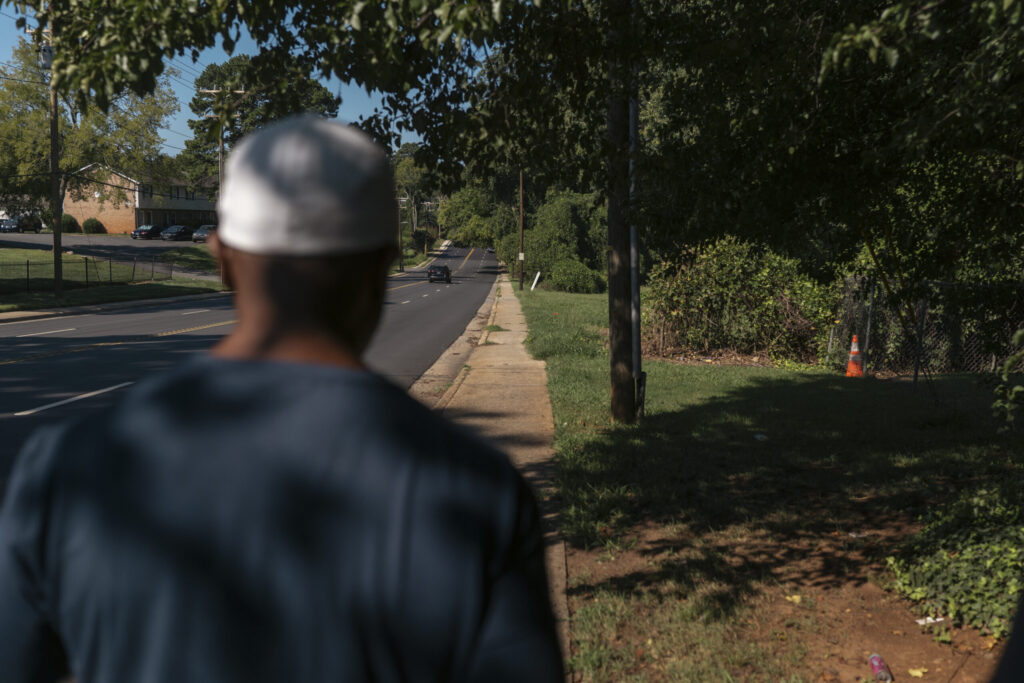
We cross Remount and walk the narrow sidewalk that lines West Boulevard. A wooded area along a stream is littered with beer cans and losing scratch-off tickets.
Historian J. Michael Moore joins us for the walk. He’s a white guy who lives in Dilworth and looks a lot like Mark Twain. Michael and Rickey met at a history presentation several years ago, where Michael had deeds and documents and Rickey had stories. “It’s almost a brotherly feel,” Rickey tells me.
Michael and Rickey both want you to understand a simple fact that goes unnoticed every day: East Boulevard, the tree-lined street through the wealthy Dilworth neighborhood, is maintained by the city. West Boulevard, the loud thoroughfare lined with litter, is a state road.
Michael says that’s not an accident. Up until the 1950s, West Boulevard was largely an unpaved two-lane road. But in 1964, the airport extended its north-south runway, which required reconfiguring the roads around it. The main artery to the airport at the time, N.C. 160, was rerouted onto West Boulevard. The road was widened to four lanes in 1967, largely to please the chamber of commerce.
“It is a frustrating experience to spend hours of available time in ground travel to and from Douglas Municipal due to inadequate streets and circuitous routes,” the chamber’s traffic committee chair at the time said, according to the Observer’s archives.
Today, West Boulevard stops being a state road at its intersection with South Tryon Street, where the original Bojangles stands. West Boulevard’s speed limit is 45mph; East Boulevard’s is 35mph. The stretch we’re walking has long been one of the most deadly roads for pedestrians in Charlotte.
“That’s a direct result of a public-policy decision,” Michael says, “to make this road more important as access to the airport than its role as a community artery.”
Rickey picks up where Michael leaves off.
“For the longest of time,” he says, “East Boulevard versus West Boulevard has been the tale of two cities.”
***
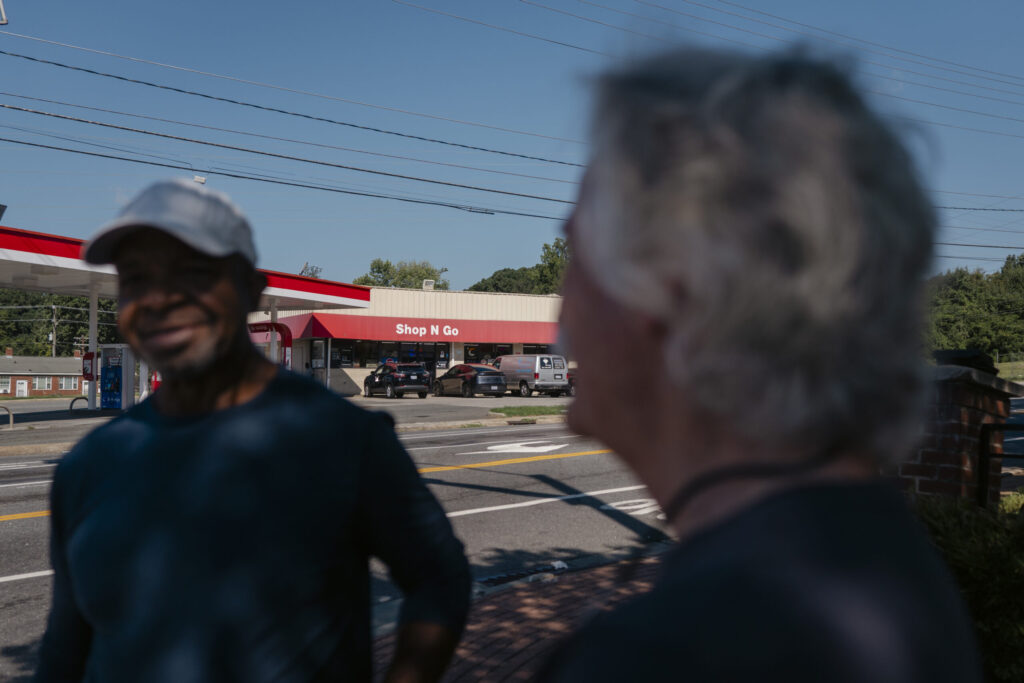
What you notice walking West Boulevard that you don’t notice driving it: the hills. I start to feel them in my thighs about an hour into our walk with Rickey.
“I just love the beauty of the terrain,” he says. “You’ve got rolling hills, a tree canopy, and all along here you’ve got so many different water sources.”
When Rickey was a boy, growing up in that two-bedroom house his grandmother had built in Reid Park, this part of Charlotte was outside of the city limits. The streams were the reason people settled here in the first place. Back in the 1830s, ore from the biggest gold mines in the county came to this area to be processed, Michael says.
Rickey remembers when his family got their water for drinking, cleaning, and cooking from natural springs. When he wasn’t helping around the house, he was playing in the woods. The kids’ favorite toy was a rope swing that carried them over a ravine. If they mistimed their jumps, they’d tumble down the banks.
“We were, I guess, in the sense, poor,” Rickey says. “But it was the richest experience you could have growing up.”
At the crest of one hill, West Boulevard is where Donald Ross Road stops and Clanton Road begins. It’s one of the most consequential intersections in Rickey’s life.
To his right is Carolina Golf Club, a private course designed by Donald Ross, the legendary architect who created the famous Pinehurst No. 2 course that’s played host to several major championships.
Black kids from West Boulevard worked as caddies at Carolina Golf Club. One of the earliest was Charlie Sifford, who went on to be the first Black member of the PGA Tour. Sifford, known as the Jackie Robinson of golf, was honored with a Presidential Medal of Freedom just before he died in 2015. He’s buried about a mile from the course, in the back corner of the cemetery at Moore’s Sanctuary AME Zion Church, under a small and easy-to-miss slab that’s shaded by scraggly pines. He was a hero to kids from west Charlotte.
But Rickey Hall idolized another one of Carolina Golf Club’s caddies, his oldest brother Michael. One Sunday morning when Rickey was 9, Michael missed church to make a little scratch on the golf course. He got into an argument with another 13-year-old boy. When Michael was walking away, the boy hit him from behind with a board. Michael died from head wounds at just 13 years old. The other boy was convicted of the crime, but couldn’t be charged with a felony because he was under 14, according to old Observer stories. Rickey shakes his head now, thinking about how his brother lost his life and nobody — not the other boy, or the golf club — was ever held accountable.
“I miss him every day,” Rickey says.
To the left of this storied intersection, where Clanton Road begins, is a stretch of land that’s critical to West Boulevard’s history and future.
In September 1968, a little more than two years after Rickey’s brother was murdered on the north side of West Boulevard, a barn fire broke out at a popular horse-riding operation on the southern side. Thirteen horses died. A few years later, three Black men — James Grant, TJ Reddy, and Charles Parker — were tried and convicted of setting the fire. They became known as the Charlotte Three, and were sentenced to 25, 20, and 10 years in prison, respectively. But after the trial, two witnesses admitted that the Nixon-era federal government paid them to testify against the men, and their sentences were commuted. The New York Times later called it a “miscarriage of justice.”
Reddy, a poet and artist, died in 2019. His artwork hangs in the convention center, and his memory lives on through people like Rickey.
On our walk, we stop under three trees near where the Lazy B Stables stood. Down the hill is a library. The scent of fresh-cut grass gives off the sense that we’re in the country.
It’s here, on this 4.2-acre parcel, where the West Boulevard Neighborhood Coalition is planning to build a grocery co-op called Three Sisters Market.
There hasn’t been a full-service grocery store here since the mid-1970s. The Harris Teeter opened in 1961 for the new white subdivisions going up around it in Clanton Park. But in 1967, a proposed housing project on Pressley Road, just to the south of Clanton Park, triggered an exodus. Michael researched deeds from that period, and found that within two years, Clanton Park went from 100% white to 90% Black.
Harris Teeter walked away after its lease expired in the mid-’70s. A Wayne’s grocery store took over the location for more than a decade, but Rickey says the prices were high and the quality low. It shut down in the 1990s.
Neighborhood leaders tried for years to recruit a supermarket of any name. Two chains looked at it but backed off, saying there weren’t enough rooftops. Around 2014 or ’15, Rickey says, “we got tired of chasing that dream” and started to build their own. The Charlotte Housing Authority, now Inlivian, which owns the 4.2-acre property, granted the West Boulevard Neighborhood Coalition a 99-year lease. Rickey says the coalition has raised about $8.7 million to build the grocery store — including $3 million from Mecklenburg County, $1.5 million from the city, and $1.5 million in federal funds. They’re about $1 million short, and Rickey’s confident they can raise it by the end of autumn.
Some money could come from the “community benefits” promised by the state for the I-77 project, if it’s revived. But Rickey insists that’s not the reason he’s urging his neighbors not to oppose the toll lanes, no matter how others frame it.
“I don’t even want to bring the Three Sisters Market into this conversation,” he told me this past Thursday, nearly three weeks after our walk. “Three Sisters is part of that larger strategy, yes, because it plants a stake for economic development and market-driven development. But I’m looking at the whole quadrant [with regard to 77].
“This is not a go along to get along.”
The Three Sisters name has multiple meanings. It honors the three crops Native Americans grew on the land before it was the city — corn, beans, squash. It’s also a nod to the African staples of cowpeas, millet, and sorghum. It’s also for three prominent women from West Boulevard’s past: Amay Martin James, Lucille McNeil, and Dorothy Waddy.
Rickey talks about the women who shaped this neighborhood with reverence. The first elementary school he attended was the all-Black Amay James Elementary. “I had educators who were determined we were going to learn,” he says. “Though we had inferior books, we did not have inferior minds.”
He went on to work for 34 years at Mecklenburg County, sometimes driving a bus to deliver meals to elderly residents. One elderly woman, Olivia Parker Sims, would sit in the seat behind him and teach him about the neighborhood. Olivia was the daughter of Charles H. Parker, who was born into slavery in 1844 and helped found Moore’s Sanctuary, and now has an elementary school named after him. He’s also buried at the Moore’s Sanctuary cemetery, not far from where Sifford and fellow neighborhood icon Ross Reid rest.
Think about that: One of west Charlotte’s most prominent leaders in 2026 learned from the daughter of a prominent west Charlotte leader who born into slavery.
As an adult, Rickey would sometimes ride around with Lucille McNeil delivering meals. One day, he remembers rattling off the changes he wanted to see in the neighborhood, and McNeil turned to him and said, “Rickey, why don’t you stop talking and do something?” That started his career as a neighborhood advocate. McNeil took him all around the corridor, into “every nook and cranny,” he says, so that he knew who lived where, and who they came from.
All this to say, when Rickey Hall has an opinion on what’s best for West Boulevard, he’s listening to the whispers of generations of community leaders who came before him.
“My story and family’s story is part and parcel of the legacy of community self-help,” he says.
***
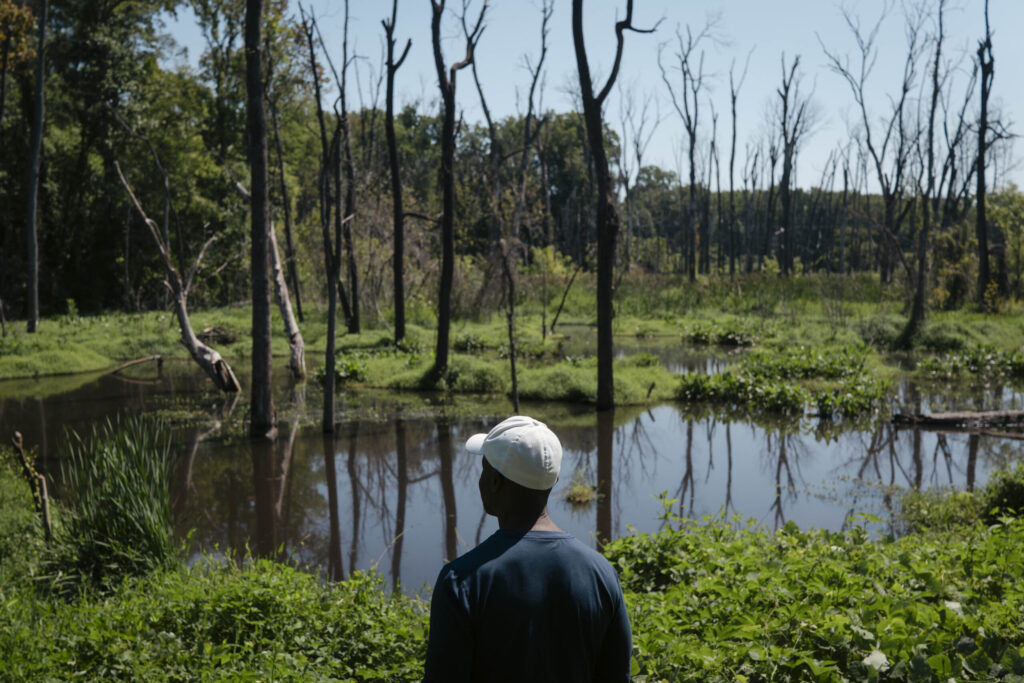
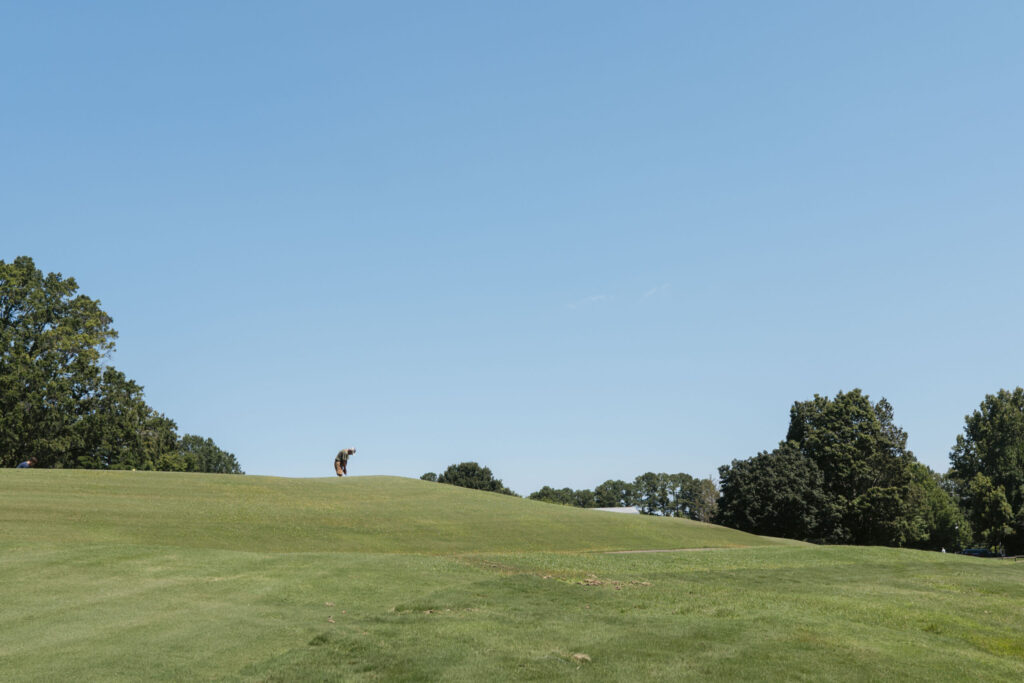
The last stretch of our walk, completing a circle, is along the Irwin Creek Greenway. We pick it up at the Arbor Glen Outreach center and head toward the public golf course named for the most famous man to ever come out of West Boulevard, Sifford.
This section of the greenway is one of the rare places you can go in the city to feel like you’re not in the city. No longer do we hear the cars and 18-wheelers growling. All’s quiet here, except for the birds and dragonflies surrounding a beaver pond.
Before the greenway was here, Rickey and his friends walked through these woods on their way to school or the community pool. They’d cross the creek using a drainage pipe as a balance beam.
When we reach the Sifford course, Rickey and Michael laugh with me about all the lies that have been told here. The pro shop is one of Charlotte’s last great hubs for old men telling tall tales. One of its most well-known regulars is James (Slim) Bouler, who’s famous for going to prison for money laundering, after getting tangled up in a gambling scandal involving Michael Jordan. Rickey and Slim are neighbors.
A community pool used to sit where the pro shop now stands. Rickey remembers how the Wilson Pickett hit “Funky Broadway” played on repeat one summer in the ’60s.
We can hear I-77 now, whooshing with traffic on the other side of the golf course, its future looming over everything in Charlotte.
Rickey’s letter to his board members says they should view N.C. DOT’s $300 million community benefits offer as “a floor for negotiations, not an aspirational ceiling.” He has reason to believe that. Last month, Tennessee picked a private partnership group to build a $9.2 billion toll-lane project outside Nashville. In exchange for the right to collect tolls, the private partners will deliver an estimated $24.8 billion in “concession value” to the state, which can then use that money for other improvements. (It’s worth noting that a lead firm on that project, Ferrovial, had its stock downgraded by an international bank earlier this month, raising “a huge red flag,” according to one lawmaker there.)
Regardless, that kind of money can only surface through a negotiation process, in which private road developers compete for the job. That competition can’t happen unless the state issues a request for proposals, which can’t happen unless the regional board goes back on its May vote. Rickey’s argument is that this time, unlike numerous other moments in local history, West Boulevard can be part of the negotiations, and that the neighborhood should see investments not just for new development, but to keep longtime residents in place.
He says in his letter, “The communities that absorbed the negative consequences of Charlotte’s previous transportation system should receive an ownership stake in the economic upside of the next one.”
As we head toward Remount Road for one last turn back to the shopping center where we started, Michael says he might need a break. The historian fell off a ladder in April, resulting in a concussion and a broken back. Our walk is his first outing since the accident.
Rickey tells his friend to take a break in the pro shop. “I’ll go get the car,” he says.
Rickey picks up his pace. When we reach West Boulevard, I notice something. Two hours earlier, we’d used the crosswalk to cross West. This time, he doesn’t. He waits for a car to pass from our left, then steps off the curb in the middle of the block.
“Now you’re showing us the real way to walk around here,” I say.
“Done this thousands of times,” he says.
He then looks right and waits for a break in traffic, reading West Boulevard like some people read the weather, and charges across.
Now Rickey Hall, penny still in his pocket, is ahead of me.