
It had elements of cinema, or at least reality television.
At 9:50 p.m. last Monday, nearly six hours into Charlotte city council’s highest-stakes meeting in years, mayor Vi Lyles tried to put a quick bow on the agenda’s final items. A soft voice in the corner interrupted.
“Madam Mayor,” council member Renee Johnson said. Every head turned. “May I make a motion?”
Lyles held her mouth open for a few ticks. “A motion for? Give me, give me something.”
“I’d like to make a motion to rescind the approval for I-77,” Johnson said.
Chests got tighter around the chamber, and from here to Raleigh.
Here we were in a city that added more people last year than any other in the U.S. — more than 20,000 new residents, bucking every urban trend. And here Johnson was suggesting Charlotte should cancel a $3 to $4 billion procedure for its gridlocked and dangerous lower spine.
The I-77 project is more than a decade in the making, and it’s the largest road project in North Carolina history. It would unlock $600 million in state funding plus another $100 million in bonus funds, along with more than $2 billion in private dollars that would be recouped over time through toll lanes.
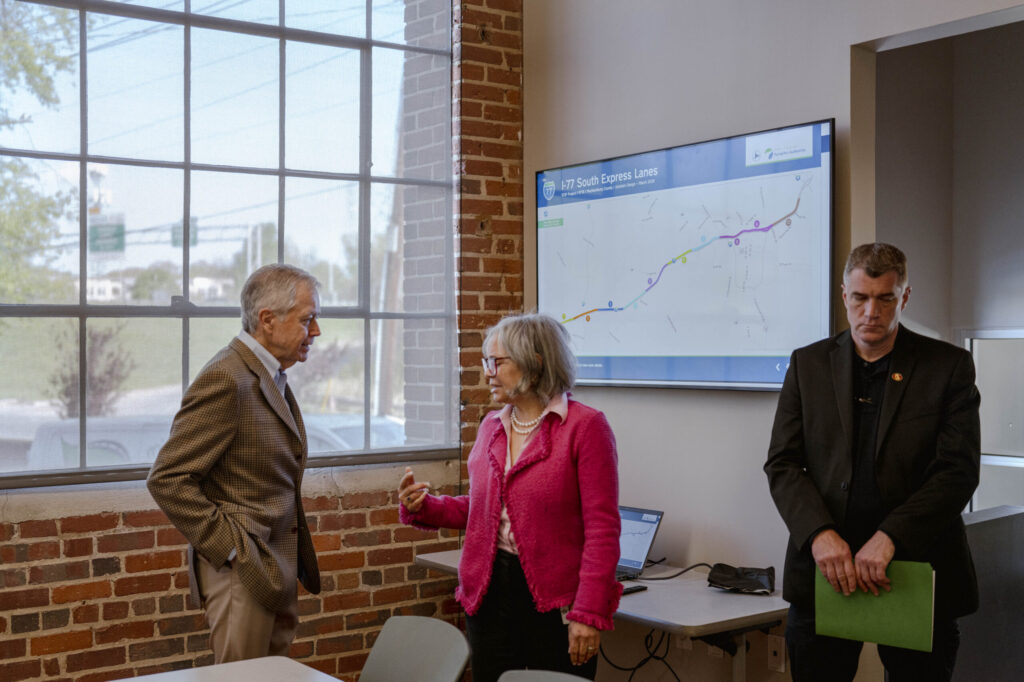
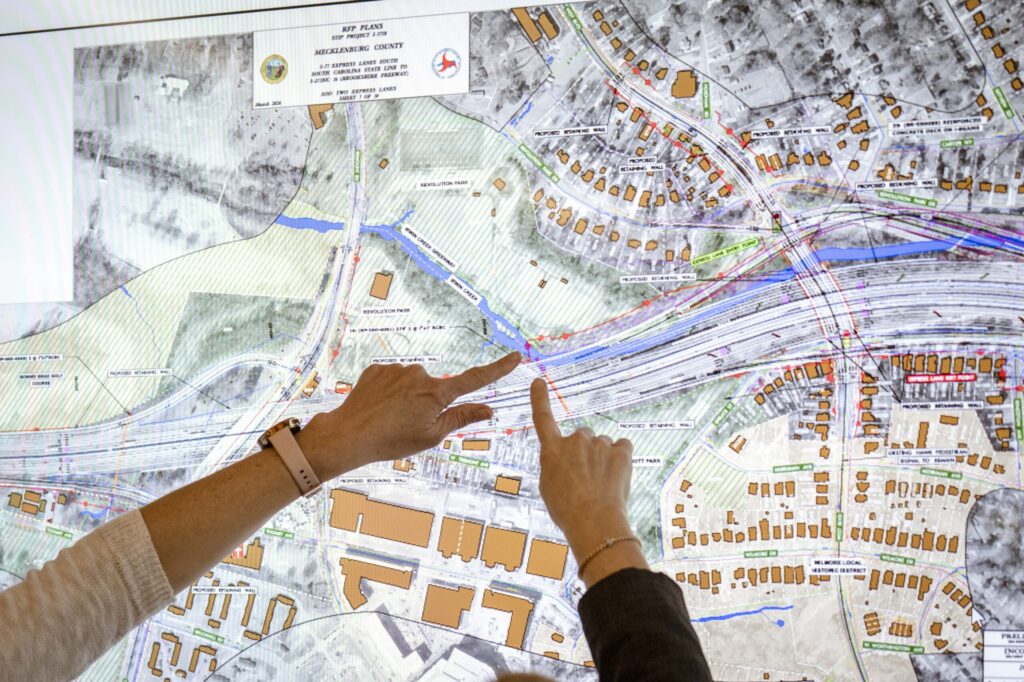
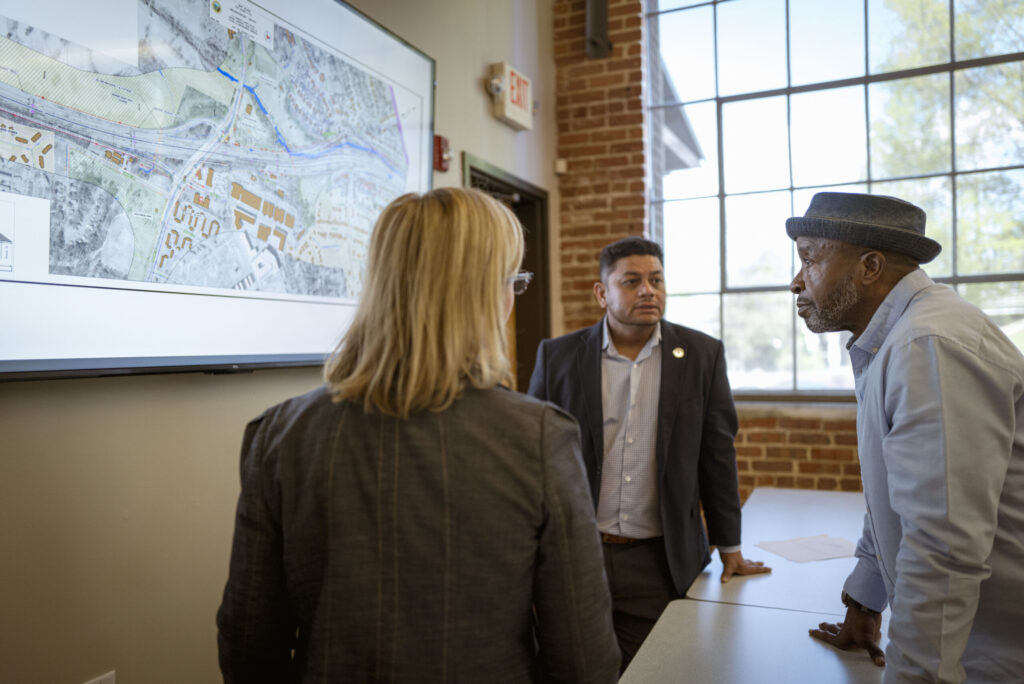
For the past three months, residents and activists have panned the project, based on early designs that would have taken gashes out of neighborhoods, including the historically Black McCrorey Heights. Transportation officials have scrambled to regain trust since the messy release of those designs, revising them to reduce intrusions on people just living their lives. They set up an information center for residents to see the maps up close.
Still, as 10 p.m. Monday approached and the council meeting entered its seventh hour, people in the crowd held signs like, “NCDOT can keep their $600 million.”
Johnson’s motion got a second, and then Lyles called the vote.
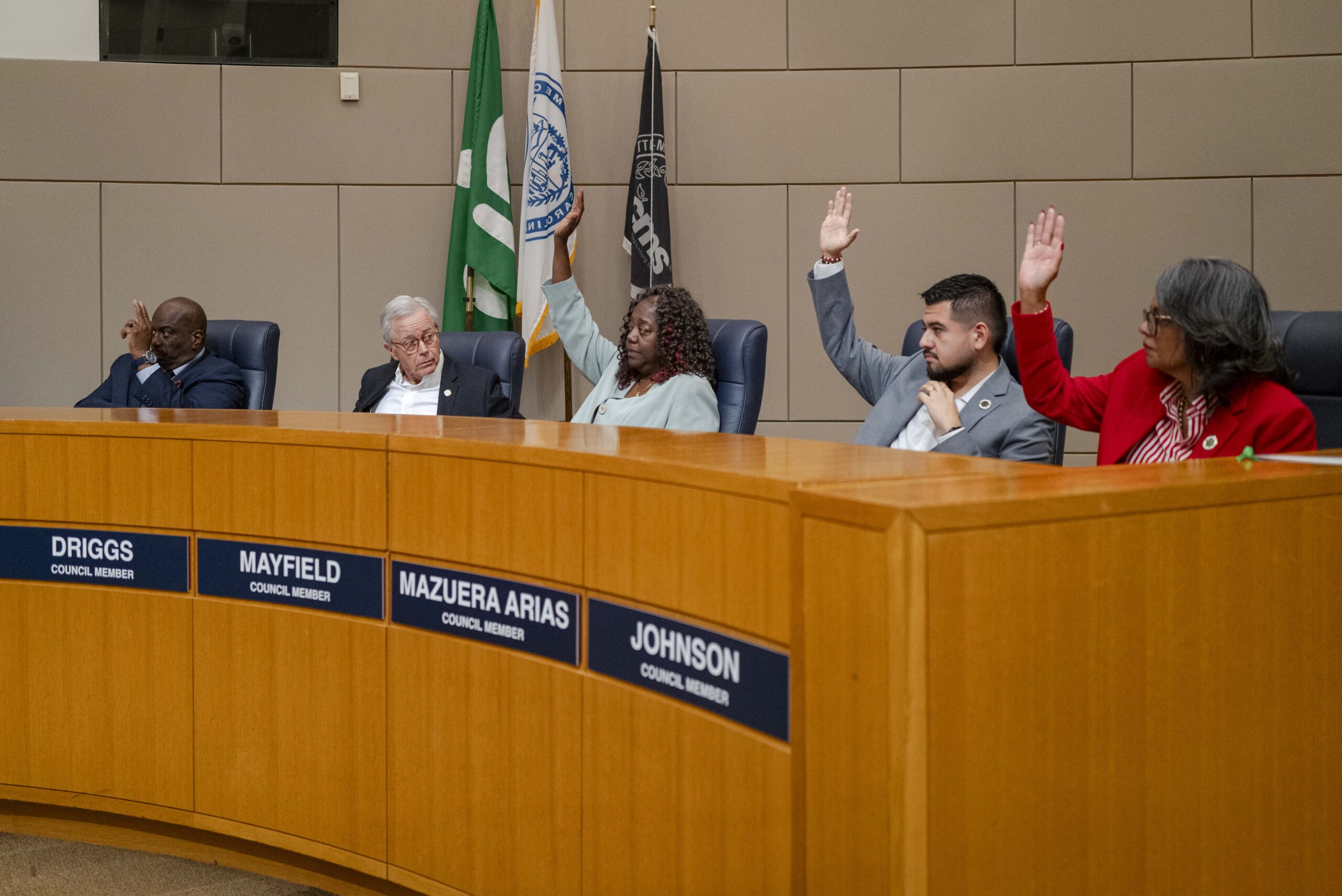
From my seat in the balcony, I saw five hands go up — Johnson, Joi Mayo, Victoria Watlington, LaWana Mayfield, and J.D. Mazuera Arias. I thought the motion failed. Then someone said, “Is that six?”
And then, “That’s six, with Malcolm.”
Council member Malcolm Graham, his back to me, had two fingers up in front of his chest. He’d just given prepared remarks saying council should continue to work with NCDOT, but then cast the sixth and decisive vote.
I’d love to see a heat map of text messages regarding I-77 in the seconds that followed.
I spent the rest of the week talking to people on either side of the I-77 argument, trying to figure out what the vote meant. Best I can tell, it was a moral decision dressed as a policy decision dressed as a political one. Or maybe, for some, vice-versa. Either way, it was the emotional and contentious opening move of the 2027 race for mayor. And if there was a loser, it may turn out to be the pragmatic and nuanced style of government that’s dominated the past decade.
I still don’t have a strong stance on whether rescission was completely right or completely wrong. But I do have a better perspective of what actually happened the night of the vote, and it may be more important than the road itself.
***
Pressures on all sides
Drama is a production carried out by people, full of personal ambitions and grudges and outside pressures. To understand why six hands went up, you have to understand the characters who were inside the chamber, and outside of it, who were pressing buttons during the build-up to the vote.
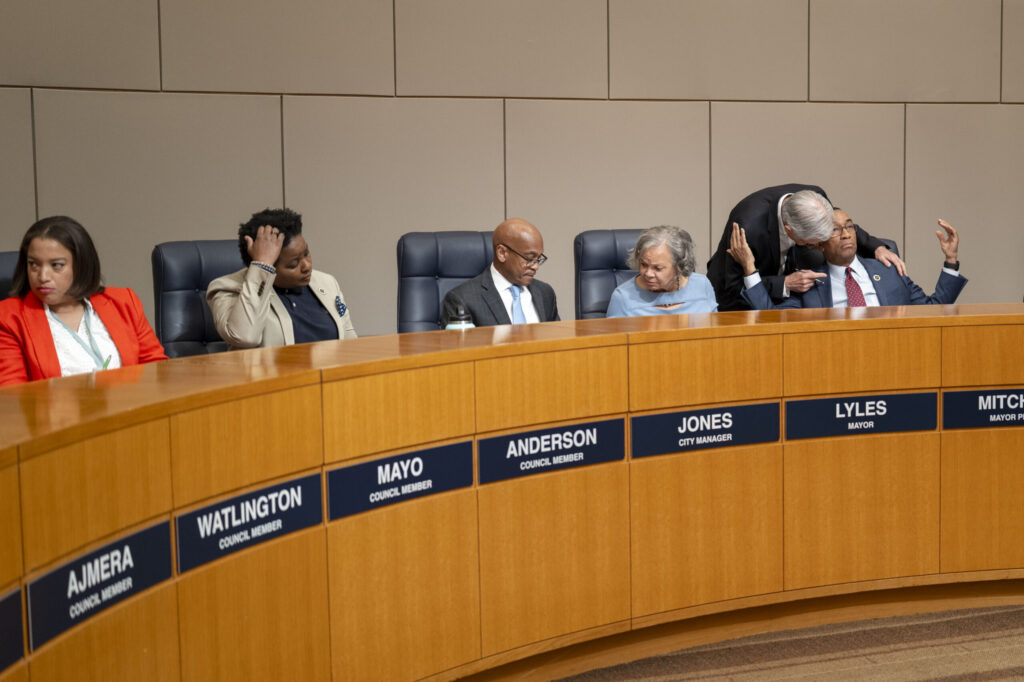
Lyles, of course, announced only four days earlier that she planned to resign as mayor on June 30. That instantly turned the knob on the gumball machine of potential replacements, interim or otherwise. Sitting around the dais with her that night were at least five people who’ve considered running to succeed her in 2027. Most would likely need an endorsement from the influential Black Political Caucus to survive a Democratic primary.
The BPC has been clear about its position on I-77. “Rescission is what we’re looking for. Rescission is what we’ve asked for for the last three months. And rescission is what we’re still asking for,” BPC transportation chair Raki McGregor said Monday night during public comment.
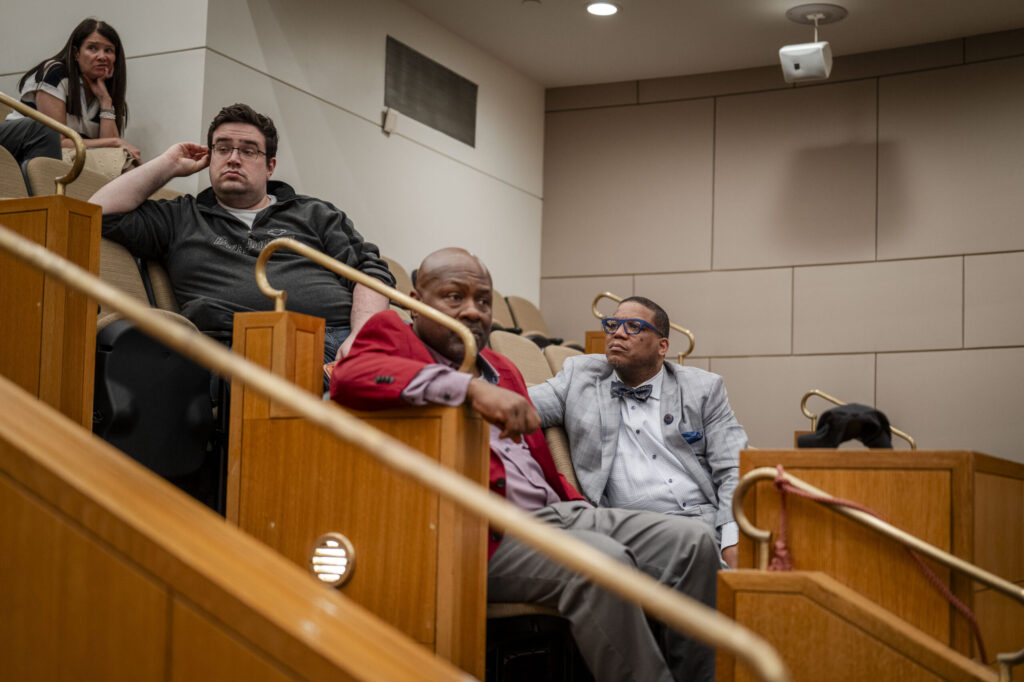
McGregor is a character in his own right. He’s a longtime businessperson who’s worked for some of Charlotte’s largest companies, and he’s influential in rooms across the city. On Monday, he spent about three hours sitting in a seat in the corner of the chamber. Then, when the I-77 discussion came up, he moved to the front row, where he was impossible to miss for council members with mayoral aspirations.
Seven or eight rows behind McGregor was Brett Canipe, an engineer with NCDOT, who’s been tweaking the project and answering concerns for three months. He sat with colleagues and advisers who slumped deeper into their chairs as the discussion turned toward blowing up their work. Ed Driggs, the lone Republican on council, has spent years working with them not only on this project, but on a larger effort to rebuild the city’s relationship with the state’s GOP-led legislature. At every step of the I-77 fallout, Driggs has cautioned against taking scissors to that tie.
A dozen or so seats to the right of Canipe was an empty chair. Robert Dawkins of Action NC has been an activist in Charlotte for 30 years and can tell you in great detail all the debates he’s won and lost. He’s also one of the more provocative toll-lane opponents. But he’d left the meeting early in frustration, convinced council would back down from rescission.
“Charlotte has become a kind of civic cowardly lion,” Dawkins said in an email yesterday, “a city with enormous economic power but a deep, self‑defeating fear of using it.”
Dawkins was merging onto Independence Boulevard, headed home to Matthews, when the mayor called the vote.
Moments earlier, council had passed a resolution asking the state to halt “irreversible actions” on the project, and to bring in a third-party analysis of the corridor and alternative options. Many council members saw this as a step toward renovating the highway proposal they were handed. Johnson wanted to bulldoze it and build a new one.
When her hand went up, along with Watlington’s and Mayfield’s and Mayo’s and Mazuera Arias’s — and Graham’s fingers joined in — Driggs looked around in disbelief.
Dawkins nearly wrecked on Independence. McGregor walked up the stairs with a smile. Canipe and the NCDOT reps huddled and whispered. Lyles was up and out of her chair before the motion to adjourn was even made. City staff scrambled and tossed wide-eyed stares at each other.
And former city council member Tiawana Brown, who lost her re-election bid last year, stood up in the crowd and praised Johnson: “You a bad woman, Renee.”
It was a lot.
***
The case for not hanging up
To be clear: Charlotte’s vote to rescind doesn’t mean rescission will happen.
It directs Driggs, council’s representative on the larger regional transportation board, to vote against it. Charlotte controls 31 of 74 votes on the CRTPO board, according to WFAE’s Inside Politics newsletter.
I called Driggs on Wednesday, and he said he’d been “getting pounded” over I-77, but still believes rescinding was the wrong decision. Or at the very least a premature one.
“Any even-handed assessment of this thing realizes that, while we will continue to advocate for the citizens and the affected parties, if we hang up the phone now, it would be detrimental,” Driggs said.
One argument, in his mind, is money. Charlotte would be turning away $700 million that it spent more than a decade courting. In 2007, council voted to use express toll lanes as a long-term strategy to reduce congestion. And it approved moving forward with those lanes in 2014 and again in 2024. To back out now, Driggs and others believe, sends a message to Raleigh that Charlotte isn’t a reliable partner.
But based on my conversations last week, I don’t believe Charlotte will face harsh repercussions from the legislature, like it did during the HB2 mess of 2016, when the legislature retaliated against Charlotte’s nondiscrimination ordinance. Sure, some lawmakers from other areas were chuckling at Charlotte’s vote the other night, but they won’t be angry that it would free up money for projects in their districts. It could have political ramifications, though, even in the U.S. Senate race, because Charlotte and its Democratic leadership make for easy and newsworthy targets.
I mentioned this to Dawkins, the Action NC activist, and he responded without hesitation. “Sometimes we want to bring on the fight, because that’s how change happens,” he said. It’s also, plainly, his job: “My wife is like, ‘You better go out and fight for folks because you don’t make much money.’ … But somebody has to do this. If you think you’re doing what’s right for the community, then you shouldn’t give a damn if they’re slapping your hand.”
Driggs also tried to center what the revised project actually does. For many Charlotteans who can’t keep up with the news, the downside that’s resonated most is this: the project will repeat an awful and egregious history of paving through Black neighborhoods. I-77’s legacy, after all, is that it cut McCrorey Heights off from Greenville, Lincoln Heights from Double Oaks, and destroyed the value of Black-owned homes in the process.
But federal laws have added protections against that over the past half century. Under current designs, no homes in McCrorey Heights, Biddleville, or Wesley Heights would be razed or relocated, as CBJ’s Erik Spanberg reported.
However, there are 36 or so homes in Wilmore, along Spruce Street, that would be erased under current plans. Laws now require that the homeowners be made whole, with a purchase of the home and the buying-down of interest rates for their next purchase. Renters would receive a subsidy that covers another rental unit for several years. Also, many of the homes on Spruce endure the roar of I-77 traffic in their front yard each day.
Money is only part of a home’s value. The families raised there and memories created there make them treasures. But the reality is that, unlike historical highway projects, NCDOT’s vision for I-77 South is not a large-scale land-grab that singles out and displaces Black families.
It’s a telling statement, though, that this narrative is the easiest to believe and comprehend. Charlotte leaders spent a decade raising awareness and training citizens to recognize past harms in future policy-making. That’s good. It also raised the trust hurdle for governments and private companies to clear. In this case, NCDOT’s chaotic design rollout this winter opened the door for spring skepticism, and activists walked right in.
It’s harder to communicate upside. The revised designs include millions in upgraded bike lanes and sidewalks along West Boulevard near I-77, one of the deadliest pedestrian roads in our city. The roads around Revolution Park may actually make sense. Overhauled ramps on Trade Street and 5th Street could unlock land that’s trapped in the current cloverleaves, helping to reconnect 5 Points and Uptown.
Driggs’s point is that what NCDOT is now offering is not what many opponents are arguing against. The early designs were the villain, but they’ve been improved. And they could continue to be improved, he says, if the project isn’t slammed shut.
***
The case for an orange instead of an apple
Trust, though, can’t be restored with modest revisions and even-handed reasoning. Opponents want transformational pivots. You can see this in the ambitious community designs from Sustain Charlotte. And in the comments from council members who say it’s time to start over.
McGregor’s disagreement with I-77 South centers less on the displacement question and more on whether the project actually solves congestion. Adding lanes can provide temporary relief, but a growing city eventually clogs up the new lanes, too.
McGregor points to the northern toll lanes, from Charlotte to Mooresville. Yes, the paid lanes often flow without trouble. But the regular lanes still bottleneck around Huntersville each morning and evening. Cintra is the private developer of those lanes, which cost about $650 million to build. Between their opening in 2019 and this past November, the lanes had brought in more than $370 million in revenue, according to WFAE’s Steve Harrison.
“At every turn there’s smoke and mirrors,” McGregor told me Wednesday. “What matters is, is this going to reduce congestion? And I can tell you that I-77 north is a parking lot. … Why don’t you want to amend the contract (with Cintra)? Don’t tell me that contracts can’t be amended, because I don’t believe it. I’ve done $250 million contracts. I’ve worked for Teachers Insurance and Annuity, Coca-Cola, Pillowtex, Fieldcrest Cannon, Novant, the Charlotte Executive Leadership Council. I know how contracts can be amended. Why can’t we amend that so that it doesn’t cost me $30 to go from uptown to Davidson?”
Then there’s the “corridor cap.” The state caps how much public money can be spent on a single project. I-77’s cap is $600 million. Meanwhile, NCDOT is widening 10 miles of I-85 in Gaston County for a total cost of $1.5 billion, but they’ve managed to do that because the Gaston-Cleveland-Lincoln Planning Organization split the project into three sections, and they’re tapping the corridor cap three times.
McGregor and Dawkins both told me that of course they’d love to see the improvements for West Boulevard and Revolution Park and other positives from the I-77 design. And they wonder why the project can’t be split up into multiple parts, like the Gaston project.
“We’ve been told that comparing the two projects is like comparing apples to oranges,” McGregor told me. “Well, if Gaston is the orange and we’re the apple, maybe we should get an orange.”
Dawkins had his own metaphor, after I brought up the I-77 investments that would benefit west side residents: “For years, they didn’t even pretend to offer community benefits. Now they package basic obligations — things they already owe the public — as if they’re gifts. … It’s the political equivalent of trying to convince communities they’re finally getting ‘40 acres and a mule,’ when in reality they’re being handed scraps dressed up as generosity.”
Their points highlight how difficult it would be for NCDOT to regain trust.
McGregor wouldn’t be considered an activist the way Dawkins is. He’s spent his career inside rooms where Charlotte’s future gets decided, as a member of corporate boards, leadership councils, and civic committees. He knows how things get amended, and he knows who typically gets to amend them.
“Why is it that for some reason the working members of our community keep being pushed to the margins?” he said. “I believe the measure of a city is not what it builds, but who is still able to live in the city that’s been built.”
That last line lands pretty hard, especially in the modern political arena, and particularly with the Black Political Caucus, whose endorsement the mayoral hopefuls covet.
And that brings us back to Monday night.
***
“The People”
Five hours before the I-77 vote, city council unanimously approved moving toward a 150-day moratorium on data centers. It was a sign of things to come.
During the longest portion of Monday’s meeting — public comment on the city manager’s proposed budget — more than 200 people filled the chamber to ask for more public investments. They were firefighters and city workers and advocates for victims of domestic violence. Perhaps most notably, of the more than 40 people who spoke on the budget, not one voiced resistance to the proposed 1.89-cent property tax increase.
National political winds are part of this. The current administration has a slumping approval rating, and things like AI and data centers have left ordinary citizens feeling powerless against large tech companies and the governments that permit them. Decisions like I-77, then, become easier for politicians who want to sell themselves as being on the side of “the people.”
In a city of nearly a million, “the people” is complicated. There’s no single “Black vote.” And there’s no single “business community.” Executives come from different backgrounds and bring different perspectives. Case in point, in this story, is McGregor himself.
Still, something is shifting. Monday’s meeting was Lyles’s first since announcing her resignation. She didn’t resist or veto the vote to rescind.
Which brings us back to Malcolm Graham. In his prepared remarks, Graham seemed to lean toward sticking with the resolution. Then he raised his fingers anyway, which didn’t make him popular with either side. By Wednesday, I-77 opponents like Action NC and longtime organizer Colette Forrest were blasting Graham for what they believed was waffling on his vote.
I talked to Graham on Thursday, and he said the charges were “ridiculous.”
“I’m not changing my vote,” he said. Then he laughed, “I’m not used to giving people what they want and then getting attacked for it.
“We needed to reset. … Everybody needs to take a deep breath and go in their respective corners. And come back with the community in mind at the beginning and not at the end.”
After talking to Graham, I’m not sure his vote was extreme capitulation or extreme courage. It was more of a recognition by a politician with 30 years of experience that the temperature’s changed.
The biggest political “loser” of the night, if you can call it that, may be James “Smuggie” Mitchell. He’s been rumored to have mayoral ambitions and would no doubt court a BPC endorsement. He voted against the rescission. But he didn’t seem conflicted; he wanted more time and the third-party study.
Mitchell’s approach has historically been the way of Charlotte in negotiations with the state or private companies. To pause, study, understand, and eventually present a coherent tune. Dimple Ajmera and Dante Anderson, also potential mayoral candidates, sided with Mitchell and voted against rescission. They may be proven right on the policy in the long run, but they read the room differently than Graham did. (Ajmera, it’s worth noting, has won elections without BPC support, and has built a strong base of independent voters over the years.)
Either way, Monday’s meeting was a taste of what the next 18 months will look like. It’s a less patient environment, a louder environment, and people are paying close attention.
***
“Wide, handsome, and toll-free”
North Carolinians have been arguing about Interstate 77 for nearly 70 years.
At the project’s inception in the 1950s, Charlotte and Greensboro and Raleigh were all about the same size, and folks used the term “crescent” to describe the route that connected them, along what would become Interstates 40 and 85. The federal government added 77, an Ohio-to-Charlotte superhighway that charged through the West Virginia mountains, later in the process.
“Interstate 77 is the proposed new interstate highway that will open the midwest to the crescent. From Canton, Ohio, it will wind its way to Charlotte,” the Observer wrote on February 4, 1959. “Private investors were enthralled by the idea of a toll road to link the two areas. Interstate 77, however, dashed dreams for a profit-making operation. It’ll be wide, handsome and toll-free.”
Wide, handsome and toll-free.
What’s that saying about how you can pick any two, but never three?
Anyhow, the first stretch in North Carolina opened around Statesville in October 1965. Another opened around Elkin shortly after. Mooresville to Cornelius was rushed because Duke Energy was building Cowans Ford Dam, which would create Lake Norman. Developers proposed an amusement park called “Carowinds” in 1970, and it opened in 1973, two years before the highway through Mecklenburg was complete. By New Year’s Eve 1975, the road was stitched together from South Carolina to Virginia.
The question of displacement didn’t surface among those in power until too late. This was, of course, during the time of urban renewal, when the city government and the dominant media outlets championed the razing of the Black neighborhood of Brooklyn in center city. Many Brooklyn residents relocated to areas along Beatties Ford Road, and McCrorey Heights emerged as the center of civil rights leadership.
In 1969, the Observer’s editorial staff began to acknowledge the displacement of Black people when it came to the Interstate 77 discussion: “The plans don’t really come home to the average citizen until he realizes that he is about to lose the corner of the playground which serves his child’s school, or that he will have to cross a busy intersection on his way to work.”
By March 1975, the conversation had shifted again. An Observer headline that month read, “Getting To, From Charlotte Easy; Moving Inside is Problem.” In other words, the highway made it a breeze for people in Cornelius to get to the city, but that led to cramped roads during the week.
No doubt, if today’s proposed I-77 toll lanes do come to pass, South Carolinians with disposable income would benefit first. The commute from Rock Hill to uptown would become more reliable, and could lead to more growth — and property tax revenue — to our neighbors to the south. It makes sense, then, that the Charlotte Regional Business Alliance, which covers 15 counties across North and South Carolina, is advocating strongly for the project. Contrary to popular criticism of the “business community,” which is hardly a monolith of thought, it’s reasonable for a regional body to support easing traffic flow across the region.
In fact, it’s part of I-77’s DNA. Here’s a quote from that 1959 Observer story, when the highway was born: “So far as the crescent in general and Charlotte in particular are concerned, you can have ‘Route 66’ and the tune it inspired. They’ll take ‘Route 77’ and the hum of commerce.”
CRTPO will meet on Wednesday of this week, but a vote on I-77 is not on the agenda. So it won’t come up for discussion until June at the earliest. NCDOT is continuing work on the project, and the information center on Morehead Street was still open this past week.
So the arguments continue to collide. The hum of commerce, the voices of the people, the lure of power, and the complexities of being human. The toll lanes and the 2027 mayoral race will play out amid all of those forces. Somewhere down the line our children will receive the results as inheritance.