
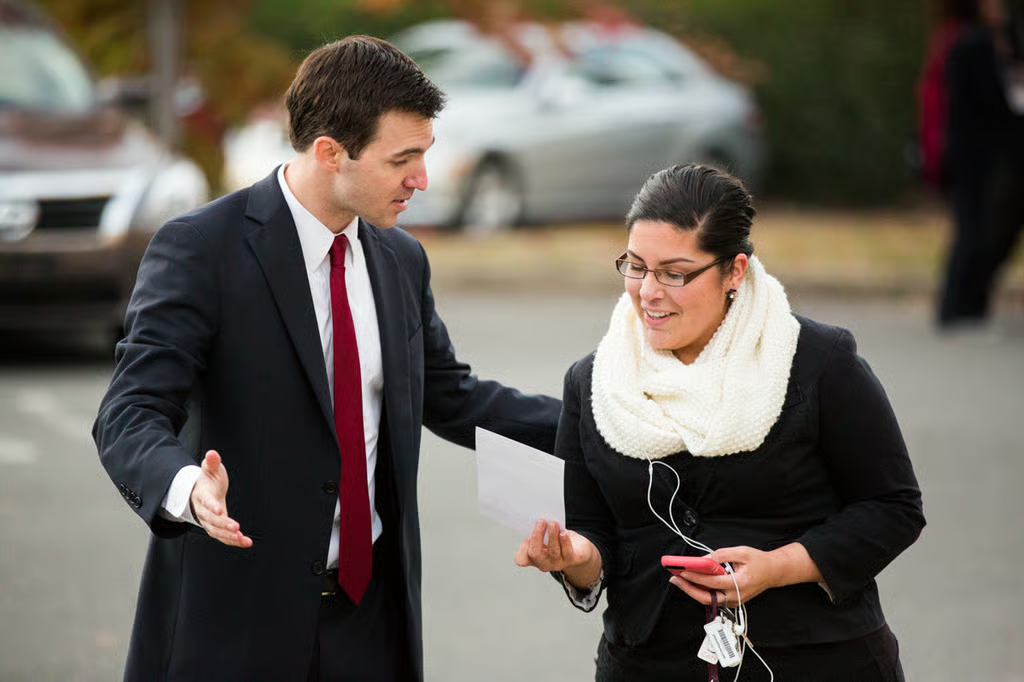
Ten years ago, just after sunrise on Election Day, a Ford Fusion swerved into a paid parking lot across the street from a polling place in uptown, and out hopped the young state senator Jeff Jackson.
“I’m parked illegally!” Jackson, who’s now North Carolina’s attorney general, said as he jogged across the street. “That’s something we millennials are comfortable with. I tell people that I’m going to write my version of Obama’s book and call it The Audacity of Illegal Parking.”
My editor at POLITICO had assigned me to find young and interesting Charlotte characters who could help tell the story of the 2016 election in America. They had writers in other key states, following bellwether characters, like a Black pastor in Philadelphia or a factory worker in Indiana. The North Carolina angle was youth, a snapshot of life in the city that was consistently ranked among the top places for millennials, who were between 20 and 35 at the time.
Jackson was about the Most Millennial Charlotte Guy you could get at the time. He was very online — mostly Twitter then, long before his TikTok fame. He was a dad of a newborn. A National Guardsman. Privately, his fellow Democrats, most all of them older, whispered about him as “Baby Jesus.” The old Charlotte Agenda and Charlotte Five newsletters, built to reach younger readers, seemed to mention him every day.
I spent nearly the whole day with him, bouncing from precinct to precinct. He wolfed down McDonald’s. He talked about memes. He took pictures with school children and quizzed them with questions like, “How many bones are in the human body?”
But mostly, he talked about the coming demographic wave.
“We’re about to make obsolete a whole category of politicians,” Jackson told me that morning. “The Ted Cruzes of the world have an expiration date on them. My generation is simply going to suck all the oxygen out of the room for politicians who are incapable of authenticity.”
“All I have to do is eat my vegetables,” he added. “I’m 34, so I’m basically the oldest millennial. For my entire life, all we’ve seen from politicians, in general, is total garbage. Politicians have done a great job of erecting a sea wall between themselves and the electorate. But millennials are the rising tide and that wall’s going to come down fast.”
That night, just after 11 p.m., the networks called North Carolina for Trump.
This week, the state House, the U.S. House delegation, and a U.S. Senate seat all went from red to blue in North Carolina. Jackson is now 44 and, in 2024, became the state’s attorney general. It would be easy to say that his wave finally arrived, a decade later.
But I don’t think that’s what happened.
Jackson’s prediction was that his generation would eventually turn out in higher numbers, replacing the old guard. Census figures show millennial participation has held pretty steady — 61% in 2020 and 61% again in 2024. Turnout almost always rises as a generation ages; theirs didn’t.
What changed Tuesday, though, was how they voted.
Consider this: From 2016 to 2024, almost every cohort of voters under 50 shifted to the right. This year, North Carolina as a whole shifted about 23 points to the left, when comparing the 2024 presidential results and the 2026 Senate-race results. Most striking is the youth vote. A New York Times analysis shows that North Carolina’s millennials (people ages 30 to 44) shifted 35 points to the left. Gen Z is even more dramatic, moving 44 points.
Rather than this being a story of the largest generation in America taking over, I think it’s the story of frustration moving their needle. Now in their 30s and 40s, millennials are the first modern American generation that hasn’t exceeded their parents’ standard of living. About 90% of people born in the 1940s earned more than their parents did at age 30; only about 50% of people born in the 1980s can say the same, according to a Raj Chetty report. They’re parents now, paying daycare bills larger than their mortgages. Add in inflation, the unpopular Iran War, and immigration raids, and the story is more simple: Young people, from both Gen Z and Y, are unhappy.
That much is confirmed in recent research from UNC Charlotte, which shows lower life satisfaction scores for people 40 and younger in our region than older generations.
Governor Josh Stein described Tuesday by saying that voters “want us to work for them and not be focused on reflecting pools or ballrooms or triumphal arches. They want a government that is worrying about them.”
You could read that as a concession to the new reality of politics, going forward. Our younger generations are not loyal to institutions or parties, because they’ve been given every reason to not be. They want the authenticity Jackson talked about. They want a government that works for them, and it really doesn’t matter what color hat you wear.
North Carolina’s Democrats were a mess three years ago, after a 2022 midterm in which Republicans won a Senate seat, gained a majority on the state Supreme Court, a supermajority in the state Senate and a near-supermajority in the state House.
In February 2023, though, they elected 25-year-old Anderson Clayton from rural Person County as the youngest state party chair in the country. On Wednesday, the now 28-year-old Clayton was being praised for helping Democrats flip at least five U.S. House seats, with two more too close to call, despite the fact that Republicans had redrawn the state’s 14 districts to create at least 10 “safe” seats for themselves. Heck, Clayton’s home county elected its first Black sheriff, a Democrat.
Clayton told The Assembly that now that the party has some power, it will work to “boost the $7.25 hourly minimum wage and make Republicans defend their economic positions and increase support for public schools.”
Clayton is from a generation that knows, very well, that political promises are just promises. The future of our state’s politics will be determined by whether Democrats deliver.
Because those voters from Gen Z and Y are predicted to be the majority of eligible voters, for the first time, in 2028.
And if they’ve proven anything, it’s that when they don’t see the results they’ve been promised, they aren’t afraid to change their minds.
Other election reads …
Want to know more about Richard Ojeda, the veteran who defeated Richard Hudson in the 9th Congressional District? Here’s the great writer Michael Kruse’s profile of him from 2018.
The Times’ deep look inside the president’s administration in the final days before the election. Gift link.
One organization worth your support is the Economic Hardship Reporting Project. I’ve written for EHRP in the past, and their editorial director, Alissa Quart, is a wonderful soul who pairs human stories with data to highlight inequality. She wrote an op-ed in late October, building on a staggering new stat: about one-third of America’s middle class can’t afford essentials.