
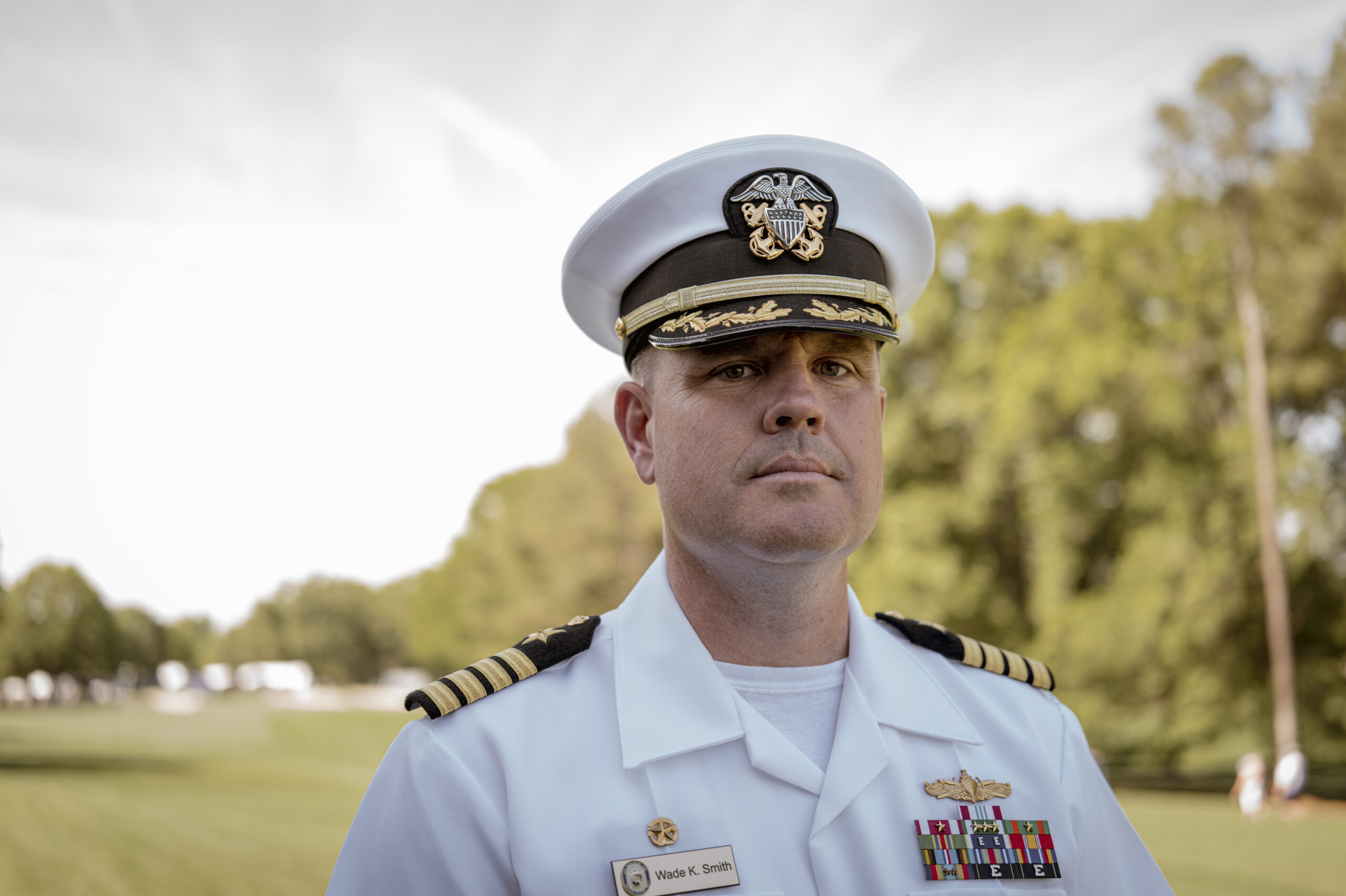
U.S. Navy Capt. Wade Smith stood at the door of room 130 at Sun Valley High School recently and laughed to himself as he pointed to the sign that read, “JROTC.”
His mom, Joan, a former home economics teacher at Sun Valley, looked at the number and said, “That was my room.”
“This is blowing my mind,” Capt. Smith said.
Smith spent the first week of May experiencing a true homecoming during Navy Week. He was one of dozens of Navy personnel traveling around the city and region in white uniforms, spreading the word about service. As the top-ranked official visiting, he received the golden treatment — drivers took him around the city, and he spent time in rooms with some of our most powerful and influential leaders.
I hung out with him on Thursday and Friday, and watched how he processed a metro area that’s exploded since he moved away in 2001. He visited with the Charlotte Executive Leadership Council, the Foundation For the Carolinas, Bojangles leadership, and stood inside the ropes during Friday’s round at the PGA event.
The most stirring moment, for him, was his return to Sun Valley, where he played quarterback on the football team until his 1996 graduation. He met with the JROTC students and shared his story of how he was a class clown who nearly flunked out of college during his freshman year, but now stands as one of the highest-ranking officers in the Navy.
“I hope for those kids doing JROTC, that seeing me in uniform in front of them is like, Wow, I could be this in 25 years if I do this,” Smith told me.
Smith is one of only 10 Navy commodores. He oversees the Caribbean fleet of captains, with 1,080 sailors on ships, plus about 400 people on shore, serving under him. He always has two ships deployed and two readying themselves for deployment.
“I was just a kid from Union County, right?” Smith told me. “And 25 years later, I’m at one of the pinnacle surface warfare jobs you can have. And so to be back in that high school and see those classrooms like, I wouldn’t have believed it.”
Smith’s Navy story began the day he graduated from Sun Valley. He enlisted and planned to go to boot camp, but the medicine he took for his acne caused fluctuations in his red blood cell count, and he failed the physical. The Navy sent him home and told him to come back in 90 days.
That summer, he saw his friends preparing to go off to college and changed course. He enrolled at N.C. State that fall and let loose during his first semester. When he came home for the holidays, the home phone rang with an automated message sharing his grades. All Ds. His father told him he could only go back to State if he treated it like a last chance and straightened up.
The next semester, a lieutenant with N.C. State’s ROTC program told him that if he improved his grades, he could receive a scholarship that paid for the rest of college. He did, then went home for the summer, when his world flipped. He was working as a camp counselor when he got a call that his father had died.
He spiraled into anger while his mom worried about how to pay for his college. He returned to State determined to earn the ROTC scholarship for her, and did.
He graduated in spring 2001 and was commissioned as an officer that afternoon. His grandfather, a WWII gunner’s mate, drove to Raleigh to be the recipient of Smith’s ceremonial first salute.
Smith moved to Newport, Rhode Island, the next day. The following January, about three months after the September 11 terrorist attacks, he reported to his first ship, the USS Kauffman in Norfolk. The base hummed with activity while the country was on edge. He soon deployed with the Kauffman, a guided-missile frigate, to the Mediterranean and then to the Middle East.
He got home around the holidays in 2002, and as soon as he touched land, he proposed to his college sweetheart, Karen. They were married in Raleigh in 2003. She was pregnant with their first child when the Navy offered him a chance to earn a master’s degree. They drove across the country and he enrolled in the Navy’s Postgraduate School in Monterey, California.
For the first time, he let himself imagine commanding a ship of his own. One step after another, one deployment after another, he climbed. And his family grew; his son was born while he was in the Middle East, and even now as a teenager, the boy never lets him forget it.
Smith became captain of the USS Sioux City in 2019. He began devouring leadership books. He held “coffee with the captain” office hours, so that young seamen could understand that no matter their role — senior officer, engine mechanic, or cook — they knew its importance to the overall mission.
“That’s where I learned that leadership was me trying to listen instead of me already formulating what I want to tell you about,” he says. “That’s been huge for me, is to just shut up and listen.”
At 47, Smith lives in northeast Florida now. His next promotion would be to rear admiral, but he’ll likely retire before that. He spent some of his week in Charlotte wondering whether this is where he could land next.
“As I’ve walked around the city this week, I’m trying to figure out, is there some way I can come back here and plug in?” he said. “Or do I take the easy button and do some type of, you know, Navy-related job in Northeast Florida?”
The timing of the question was hard to miss. I was sitting with him when news broke that mayor Vi Lyles planned to resign. Conversations about the future of leadership have dominated text threads and op-eds and backroom discussions around town ever since. And here’s a Navy captain from Union County with 25 years of leadership experience in real conflicts, openly asking whether our city and region would be compatible for him.
About 50,000 service veterans live in Mecklenburg County, and Veterans Bridge Home is a long-running nonprofit that connects them with employers. Three county commissioners — Mark Jerrell, Arthur Griffin, and George Dunlap — have military backgrounds, while Ed Driggs is the only city council member who served. Others settle here and live a quieter life, including some who reached the top of their branch — like retired Marine Corps Gen. James Amos, who greeted Capt. Smith on the first hole at Quail Hollow last Friday.
Whether Smith returns to the Charlotte area and joins them is mostly his decision, but it’s also partly up to the rest of us to make sure people like him have rooms where they can continue to lead.