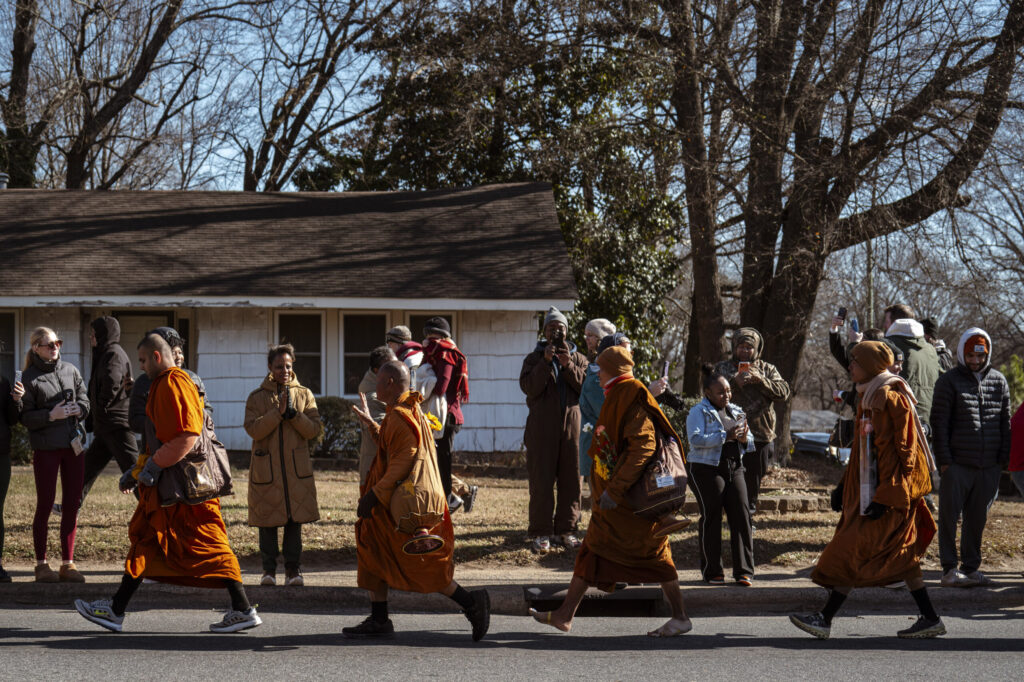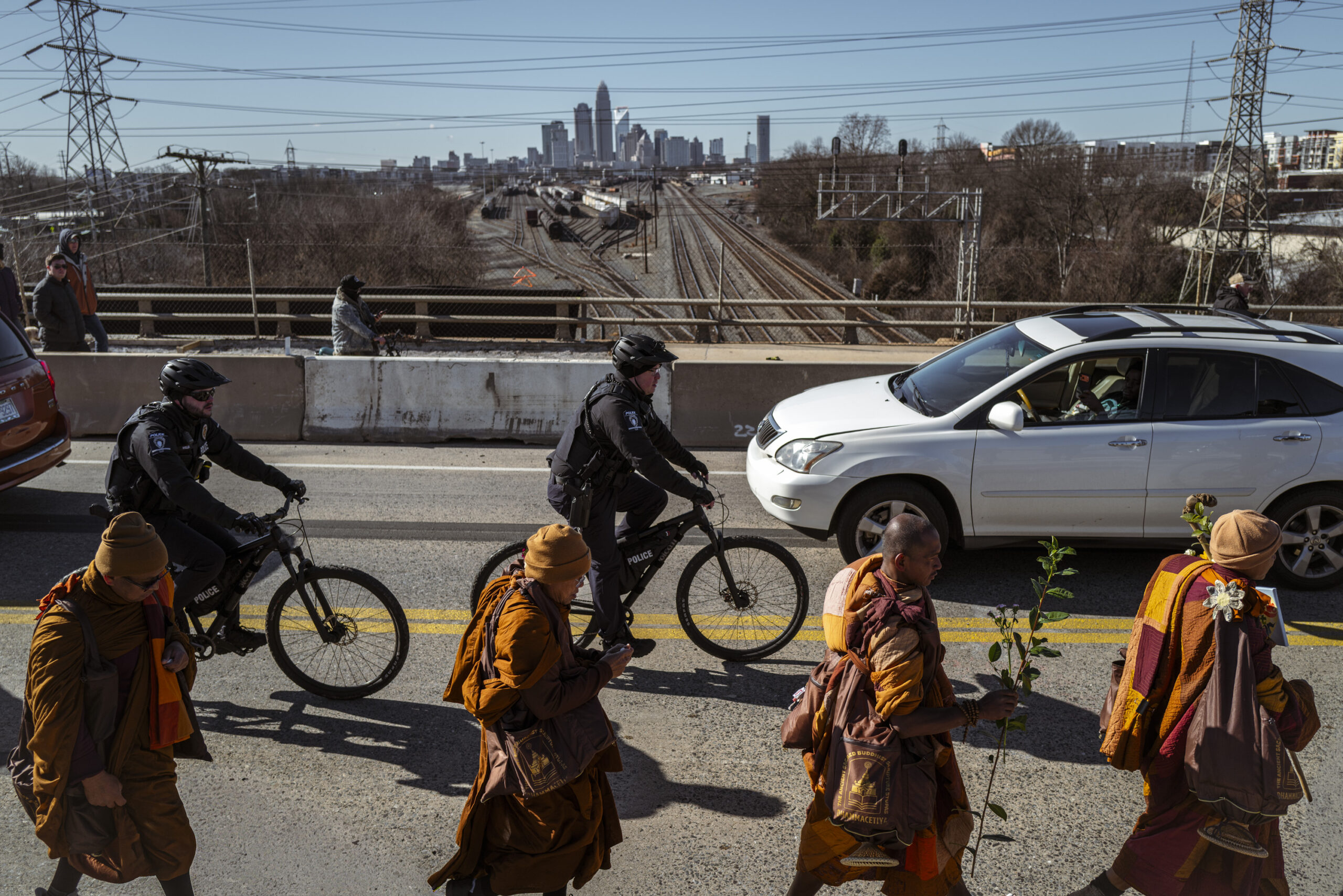
They entered a city that’s birthed a few other spiritual movements right around rush hour. Their saffron robes waved in the cold wind as they tried to point the rest of us toward a warmer world.
Some scuffed bare feet across pavement that traces an old Native American trading path. Behind them was a South Carolina gas station advertising raw milk, and in front of them, on the North Carolina side of the state line, was a mile-long Amazon fulfillment center. But the Buddhist monks didn’t seem to notice the trappings of today’s Nations Ford Road. They simply made deep eye contact with the people who came to see them walk.
Different races and nationalities, babies and Boomers and everyone in between. Some overwhelmed with tears, some with faces shielded by cell phones, some pointing and waving. All participants in the monks’ 2,300-mile Walk for Peace.
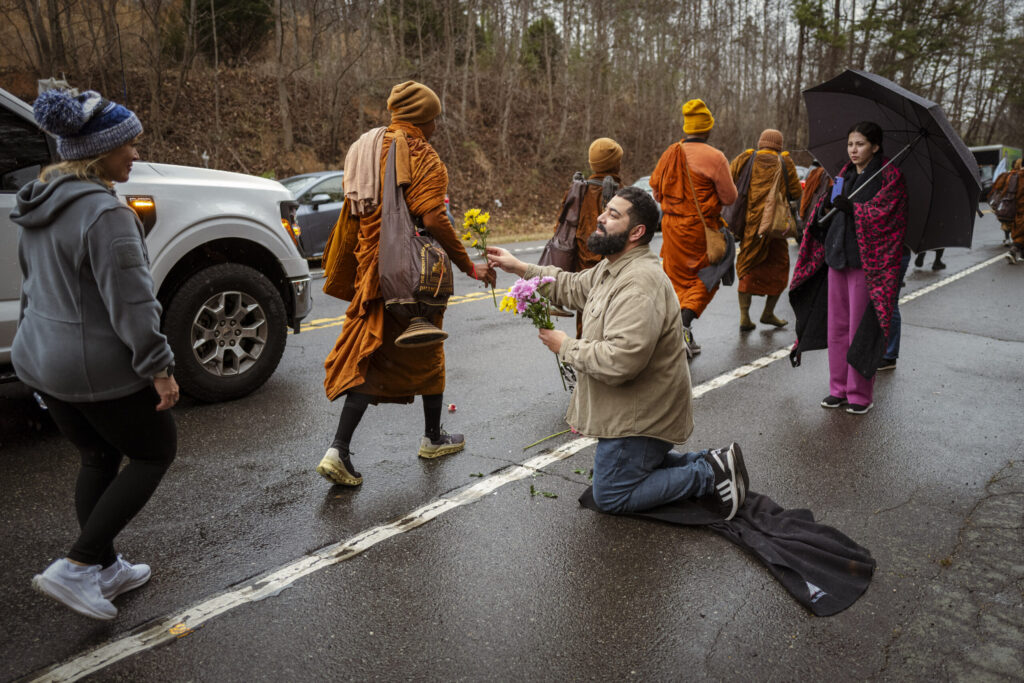
Blisters and cuts on their own feet, the mindful monks prayed with the ill or injured. They handed flowers to kids. They smiled for photos. And they repeated the message: “May you and all beings be well, happy and at peace.”
How simple.
How complex.
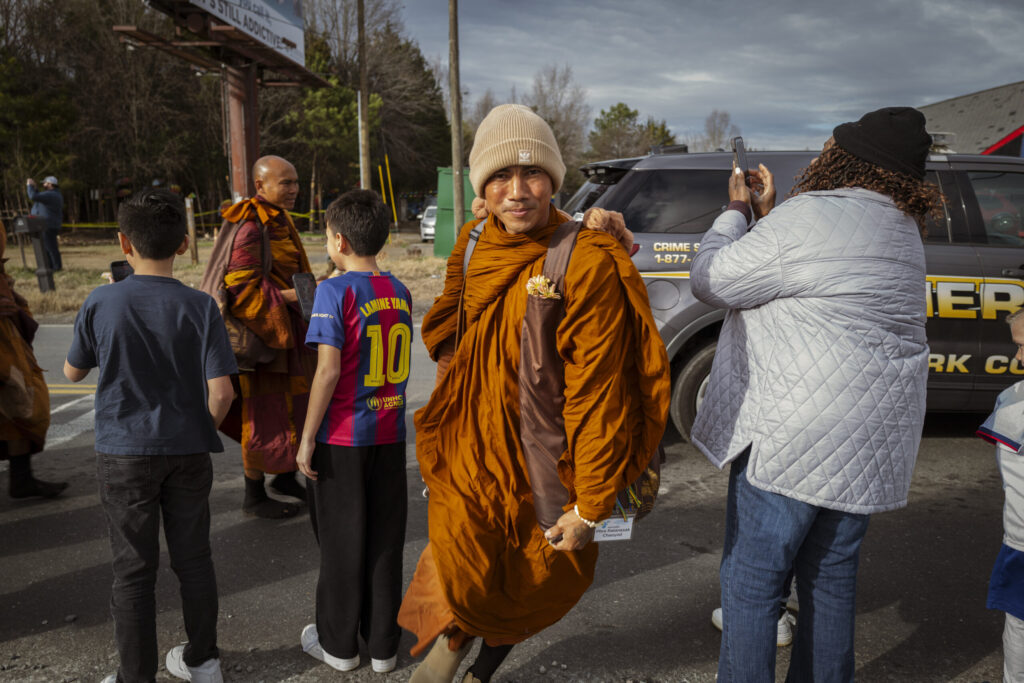
They’d walked 1,600 or so miles to get here from Texas, with 700 or so more to go to Washington. They hope to be more than a nice break in a doomscrolling era. They hope for peace as a permanent state. Peace, as a proper noun that outlasts the spectacle.
If they finish this walk and nobody else changes and nothing else is changed, lead monk Bhikkhu Pannakara told a crowd at a rec center in south Charlotte Wednesday night, “it’s not worth it.”
“Because this mission is so tough. It’s [a] very difficult journey,” he said.
One monk lost a leg in Texas after being hit by a car, Pannakara reminded the few thousand in attendance.
“But we still carry on. We’re still walking. We don’t want to stop, because it’s so beautiful. This mission is so beautiful. And look at this, how beautiful it is for all of us to come out here for the same mission, which is one word — peace.”
***
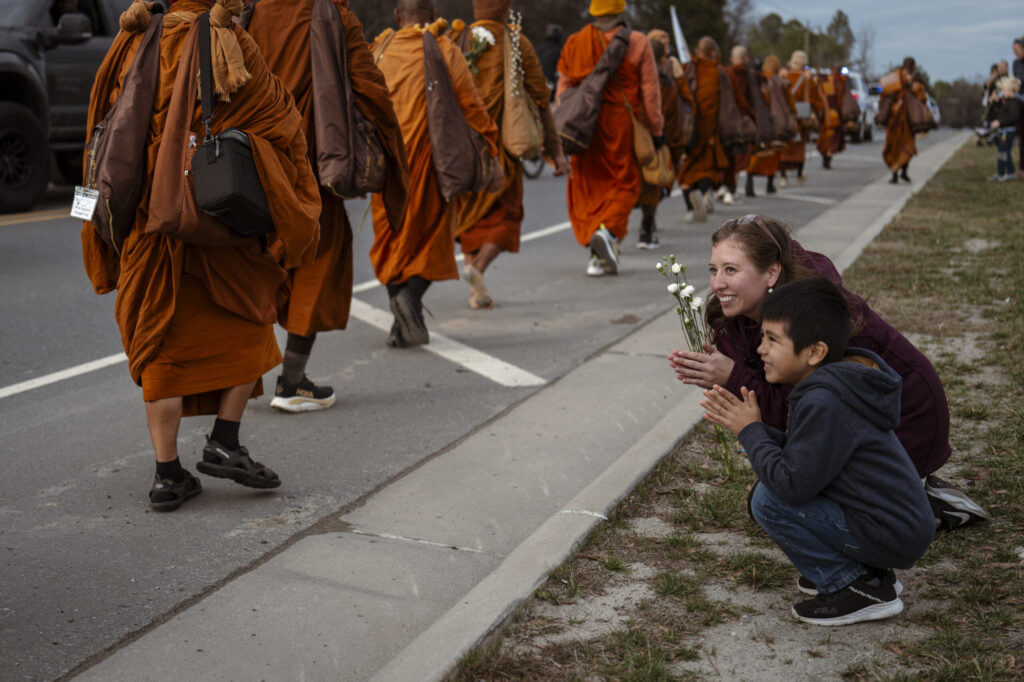
We followed the monks from Fort Mill into Charlotte on Wednesday, then through the city on Thursday, splitting up and running into each other, getting ahead of them and falling behind. Like amateur tornado chasers, except our storm moved at 3 mph and was nothing but very nice. We encountered the monks enough times to experience everything from the awe of a first glimpse, to the wisdom of a peace sharing talk, to appreciation for how they just … keep going.
As a spectacle, the Walk for Peace reminded me of a solar eclipse, impressive at any distance but most moving up close.
Charlotte was right in the monks’ path of totality. Five days after our city watched football fans go hoarse over a football game, the couple of dozen or so Theravada Buddhists hauled a different energy. Crowds of hundreds went silent when they approached. The monks said little, signed nothing, and handed out no books of faith or pressure, only flowers and peace bracelets. They turned a performance that should’ve been boring — who else on earth would you just watch walk? — and made it a shared experience.
In Fort Mill on Wednesday, near the Anne Springs Close Greenway entrance, they stopped and prayed with Crandell Close Bowles, the renowned businesswoman and oldest daughter of the park’s namesake.
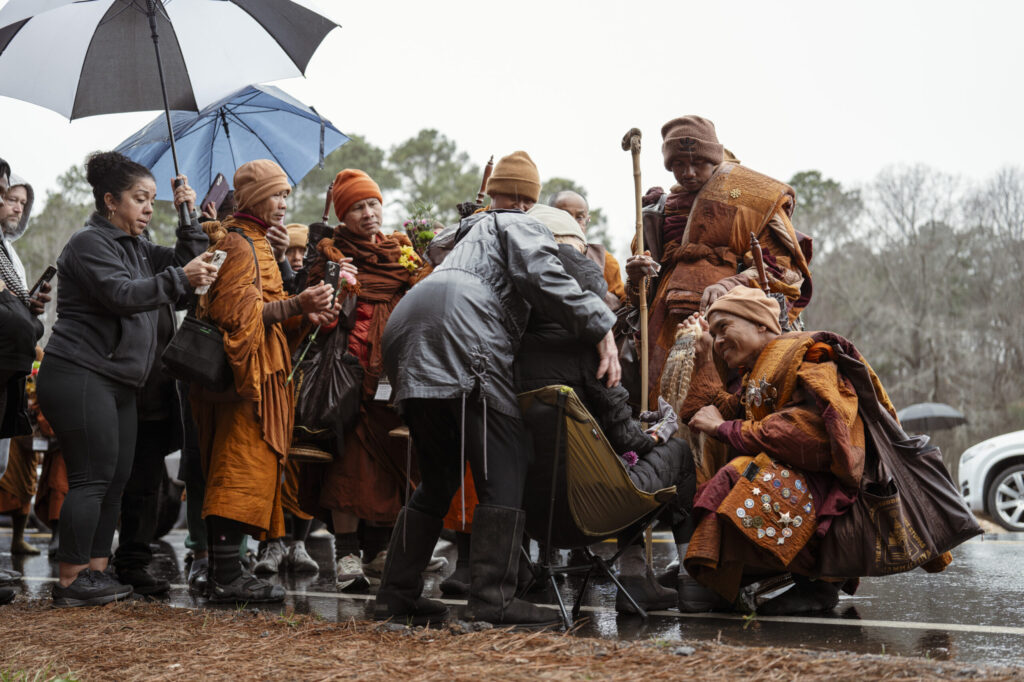
Anne Springs Close, of course, was one of our region’s most influential conservationists and naturalists. She was concerned about urban sprawl in the 1980s, so she preserved 2,100 acres for a park, and then retained 4,000 acres for development. “Most developers build first, and if there’s anything left over, they would make a green space,” she said at the time. “We did it the other way around. We made the green space first.”
She lived an incredibly full life, one that no doubt the monks would have appreciated. She traveled widely across Africa, Asia, and the Middle East. She hiked Mount Kilimanjaro three times. In 2014, she was in Switzerland when her hiking partner died of a heart attack. Mrs. Close was nearly blind from macular degeneration, but still she felt her way down the mountain alone.
Oh, and she was the last living person to have flown across the Atlantic on the Hindenburg until her death in 2021 at 95 years old. And now here were the monks, stopping for a moment with her daughter.
Symbolism was everywhere along the monks’ path through the Charlotte region. They crossed over the state line at 3:55 p.m. on Wednesday, walking along Nations Ford Road, which once was a dirt path through the Catawba Nation, and later part of the Great Wagon Road.
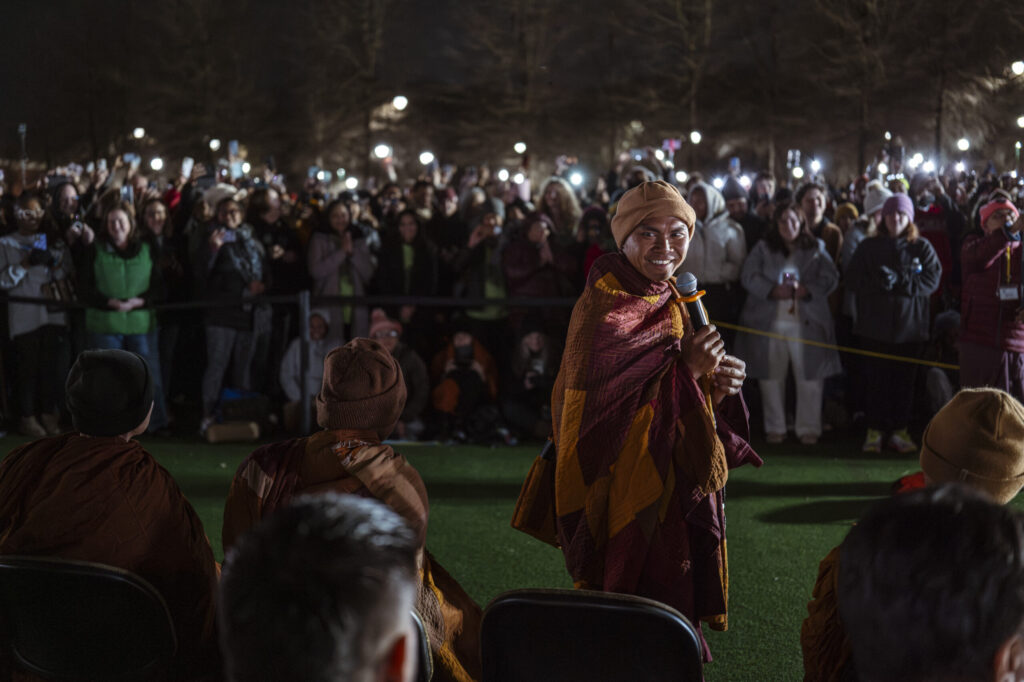
They made their way up to South Boulevard at dusk, and the sidewalks swelled as they reached the intersection of Tyvola Road, where they turned toward Marion Diehl Rec Center to camp for the night.
The center’s supervisor had learned at 8 p.m. Tuesday night that it would have to close at 2 p.m. Wednesday, to prepare for the evening. I stopped by Wednesday morning and asked how things were going, and a man behind the counter said, “Crazy day. The monks are coming.”
They pulled it off, and around 7 p.m. the monks were here. They walked down to an athletic field, followed by a horde of those sidewalk observers, creating a crowd of thousands that formed a circle around them.
Some folks helped their kids hold crayon-scratched signs for peace; others sat with their eyes closed and waited. The people around me included two elementary-age children, a younger woman who’d skipped her DoorDash shift that evening, a younger man who was hell-bent on holding conversations with the monks, an older woman from Jamaica who stood and watched quietly, and an older woman who arrived a little drunk.
This was part of the beauty, if you will, of the whole 48 hours. The monks were here for everyone, because even the sober need a buzz of peace, even the buzzed need a moment of sincerity, even the well-heeled need healing, even the poor can spare an evening, and even the most or least religious among us could use a little faith.
And laughter. When the presentation started, Pannakara showed me something unexpected: Monks have jokes.
“I have to ask this question,” he said while looking out at the growing crowd. “Are we not working at all?”
The conversationalist young man behind me said, “We’re workin’, we’re workin’,” to which Pannakara said, “Then how come, so many people here?”
“Peace,” the young man said.
“Peace is more [important] than work?” Pannakara replied.
“Yes!” the crowd said.
“OK, don’t do that,” Pannakara said. “All the businesses [are] gonna close.”
***
Charlotte has seen mass spiritual movements before.
When the monks walked up Park Road and veered onto Selwyn on Thursday morning, I couldn’t help but notice they were passing only a mile or so from where the late Billy Graham grew up on a dairy farm.
Graham became Charlotte’s most influential world figure, an evangelical minister who drew hundreds of thousands of followers to his crusades in the second half of the 20th century. Graham, a Southern Baptist who died in 2018, certainly didn’t have the same beliefs as these monks who follow Buddha’s teachings, but he did share an instinct to gather those in search of something bigger than themselves.
Graham was considered the first preacher to utilize mass media, especially television, to spread the gospel. The monks in the Walk for Peace have grown their following through the more modern instruments of social media. They’ve accumulated 1.5 million followers on Facebook, and 1.1 million on Instagram.
They sure were the most shared subjects in Charlotte this week. All along their route, people held up their phones to take videos and photos.
The monks — along with their dog Aloka, who reunited with them on Thursday after a surgery — have become a viral phenomenon over the first 82 days of their walk to Washington. They intend to use the attention to help convince Congress to recognize Vesak, Buddha’s day of birth and enlightenment, as a federal holiday, according to the AP.
A generation earlier, Graham’s influence lifted him to become the minister to 13 U.S. presidents.
In September 1996, Graham, suffering from Parkinson’s, held his historic Charlotte crusade at what was then Ericsson Stadium (now Bank of America), drawing more than 300,000 people over four days. On the final day, Graham looked out at 74,000 people and said, “We probably will never see anything like this again in the history of Charlotte,” according to an archived story by former Observer reporter Ken Garfield.
He may’ve been right. But we’ve also never seen anything like the Walk for Peace. It’s hard to estimate how many people the monks interacted with in the city, but it likely was into the hundreds of thousands, and all got a close encounter.
The other big local news stories from that 1996 Graham crusade weekend had to do with, and I kid you not: A tough Panthers loss, hope for a peace summit between the leaders of Israel and Palestine, a new record for number of billionaires on the Forbes list, and an editorial about CMS struggling to retain teachers. In other national news, the Clinton and Dole campaigns were heading into the final month of the election battling over a key demographic — “soccer moms.”
For as unprecedented as everything always is, the news still hammers the same chords.
Which brings me to the whole point of this section.
On Wednesday night at the peace gathering off Tyvola, a modern-day street-preaching evangelical stood outside the entrance and, through a microphone and speaker, he called the crowd and the monks sinners.
Still they kept walking and smiling.
Later, Pannakara kept coming back to a point, one that endures through all locations and eras and faiths: Be mindful not to toil in your frustrations with others, or blast people on social media or any other venue, because doing so reveals more about your own broken pieces than theirs.
“Tell the universe, today is going to be my peaceful day,” he said. “So that means no one else can mess it up. Only ourselves.”
***
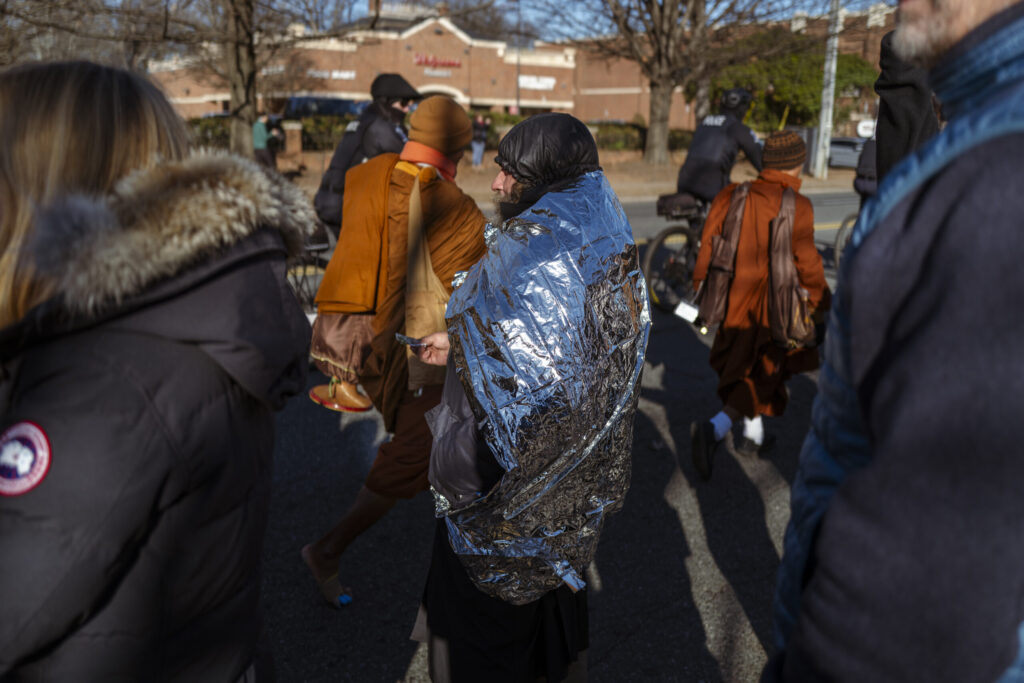
On Thursday morning, Peace moved up Queens Road and past the Hugh McManaway statue at one of Charlotte’s most well-known intersections, then by the Harris Teeter and a dozen or so small businesses in Myers Park and Eastover.
Near the Manor Theatre, here in Charlotte’s wealthiest neighborhoods, a homeless man who gave his name only as Brian showed up because he wanted to hand the monks money, right there on a road named Providence.
That Peace was then passed to Hawthorne Lane and Novant Presbyterian, and then to a daycare where my 2-year-old shouted, “I see all the people now!” Naturally this made me happy, and filled me with worry — any parent of young children knows the only path to peace at home is to make sure one isn’t jealous of the other. I rushed over to our 5-year-old’s school and checked him out of kindergarten. We caught up with Peace on the Plaza, where we accidentally left a bag of Cheetos (sorry), before Peace turned on Matheson.
Then it crossed over the Matheson bridge and the rail lines, before turning on Tryon Street, also a former Native American trading path. Tryon, by the way, was also the path Englishman John Lawson took in his famous A New Voyage to Carolina, in which he proclaimed that North Carolina was the “goodliest soile under the cope of heaven.”
Anyhow, Peace then turned left onto Sugar Creek Road at the intersection with Sugaw Creek Presbyterian, the oldest church in Mecklenburg County at 270 years old.
At the lunch gathering at Sugar Creek Rec Center, the monks then held another talk, similar to Wednesday night’s in south Charlotte. Pannakara reminded the crowd that while they want to take flowers from everyone, they can’t because, you know, they have to carry it all.
“We take your offerings within our heart already,” he said.
Then he asked people to make changes that persevere. Make time to breathe. Be mindful, and practice mindfulness. And, just like Buddha used to say, stop bringing your “lover” (your phone) into the bathroom.
“Can we walk together on this journey?” he asked the crowd at the end of the lunch talk, and they said yes.
“Can we change this world together?” he asked.
“Yes,” the followers said, and at least for the moment, Peace had a fighting chance.