

Sherri Chisholm slid a raspberry muffin across the table and handed me a plastic knife. We were in a coffee shop that employs homeless people, inside the Innovation Barn, a recycling lab that claims to turn “waste into wonder.”
We were here to talk about Charlotte’s most important civic initiative in generations — a decade-long, billion-dollar investment in economic mobility and capital-o Opportunity — and how the organization at the center of it is closing up shop.
“Conditions have changed,” Chisholm was telling me last Tuesday morning in an exit conversation, a few weeks ahead of the June 30 sunset of Leading On Opportunity, where she’s the executive director. “It’s a lot of things, but what’s most important is the local, small-p political will was no longer there.”
What I’ve long appreciated about Chisholm, a Detroit native, is that when she makes statements like that, they aren’t sharp-edged criticisms of anyone. They’re simple, if academic, observations.
She went on.
“Initiatives like Leading On Opportunity — and I think it’s fair to say for the Mayor’s Racial Equity Initiative, for Read Charlotte — are built on that old-school Charlotte model,” she said, naming three programs championed and funded by a public-private leadership engine that’s showing hairline fractures these days, due to retirements and swirling political winds.
“So what do we do now while we’re shifting? I don’t think it’s necessarily wrong, but it’s different.”
Chisholm’s views on Charlotte — specifically, this moment in Charlotte — are uniquely earned. She came here in 2020 to be the balm between board rooms and street benches, C-suites and grassroots organizers. Between rich and poor. She’d spend a morning with an outfit like the Charlotte Executive Leadership Council, and then that evening be in a small nonprofit meeting in an underserved community.
Leading On Opportunity formed in response to a now-infamous 2014 Harvard and Cal-Berkeley study that placed Charlotte 50th out of 50 in economic mobility. Known as the “Chetty study,” for researcher Raj Chetty, it meant that a child born into poverty here was less likely to climb out of it in their lifetime than in any other large urban community in America. The ranking bruised the pride of leaders who boosted Charlotte as an economic machine that lifted everyone. They rallied to fix it.
The Foundation For the Carolinas spearheaded a $400,000 study of the indicators of mobility — things like early-childhood education, less racial and economic segregation, housing stability — and presented the findings as a kind of manifesto. Now we weren’t just recognizing a problem, we were branding it with an optimistic word: Opportunity. Nonprofits, corporations, and government bodies mobilized. CEOs kept a copy of the report on their desks. Since 2017, about $1 billion in public and private dollars have flowed toward those determinants.
Leading on Opportunity was the air traffic controller and the auditor, steering organizations and funders toward what worked, while also measuring the city’s mobility progress. As its second executive director in 2020, Chisholm had the only job like hers in America: build relationships with funders and on-the-ground organizations alike, and figure out how to tell everyone how we were progressing.
She had tour guides to both rooms. Andrea Smith, the former chief administrative officer of Bank of America and initial co-chair of the Opportunity Task Force, hitched herself to Chisholm and pulled her into executive meetings and functions.
“Literally she was dragging me across the room,” Chisholm told me, laughing. “She’d say, ‘This is the CEO of such-and-such; this is Sherri. She’s really bright, she’s going to do great things for our city.’” In a town where, as Chisholm puts it, “a handful of people make things happen,” that hand on the arm was a key to a room most newcomers can’t enter.
For the other room, she had Tonya Jameson, a longtime Charlotte resident, political consultant, and former Observer reporter, with a contact list miles long. Jameson became LOO’s community engagement coordinator, and opened doors into the grassroots.
This may be one of the biggest challenges Charlotte faces now: finding, developing, and retaining leaders who can move between both rooms and speak honestly in either.
“It required a level of pragmatism that I think helped me really gain strong relationships,” Chisholm said. “I do think I lost my voice at some point, like I felt like I wasn’t sure who Sherri was, because I knew it was necessary to appeal to a wide range of audiences.”
The one thing both rooms wanted was results.
Economic mobility, or how one generation of kids fares as adults, takes 30 years to measure. But if Charlotte, the fastest-growing city in America last year, has any deficient personality trait, it’s patience. By the time Chisholm arrived, just three years after the task force’s report, people were already tapping on her window for results.
“What was communicated to the community is that in three to five [years], everybody would have a job at Bank of America, a house, a dog, and two kids,” Chisholm told me.
The progress report came in 2024. Chetty released an updated study showing that we’d climbed to 38th. People celebrated. They came to Chisholm and said, “Great job!”
She expected it, and it unsettled her. The new ranking only showed that adults in their 30s today were doing better than those who hit their 30s in 2014. The real results of all this Opportunity work and investment — which focused on kids born after 2014 — won’t be known for another two decades.
“Effectively folks were like, ‘Sherri, this is great, this is awesome. How can we do what you’ve done with economic mobility to all the other things that need to be fixed?’” she told me. “What I heard from a couple funders was that ‘economic mobility’ feels negative, like we’re trying to fix something. Folks were like, ‘We need a new vision for the city. We need another rallying force.’”
***

LOO is sunsetting during a jarring season of leadership change for Charlotte. The mayor’s retiring, and several prominent institutions — Foundation For the Carolinas, CMPD, Habitat for Humanity, The Charlotte Observer, Discovery Place, OurBRIDGE for Kids — have had or are facing leadership transitions in the past seven months or so.
This past Wednesday, Crisis Assistance Ministry announced that longtime CEO Carol Hardison, one of the steadiest voices in the city since taking the job 25 years ago, will retire early next year.
I talked to Hardison on Friday. She remembers how stunned she was a quarter century ago when she read in the newspaper that her predecessor, Caroline Myers, was retiring. She wondered whether Crisis Assistance would close, before a more level-headed part of her realized, “Oh my gosh, this is my dream job,” and applied.
“It’s a very natural part of a growing and changing city,” Hardison said. “It’s certainly rocky in the world of leadership in general. But it’s very natural, and I hope we will embrace that the leaders that got you here aren’t the leaders who will take you there.”
Charlotte knows this well. Forty years ago, a handful of men known as “The Group” — NationsBank’s Hugh McColl, First Union’s Ed Crutchfield, and a few others — drove most of the big decisions. Their looming retirements set off a run of “Who’s next?” commentary in the 1990s and 2000s. The Foundation For the Carolinas, under Michael Marsicano, took the torch, working alongside corporate leaders like Andrea Smith. Marsicano retired back in 2023, and the organization has had three leadership changes since then. Smith, meanwhile, retired from the bank in 2021 but continues to be deeply involved in community work.
Point being, the model held up because the torch kept getting passed, from The Group to the Foundation to whoever came next, and at each point the cast got even larger. What feels different now, Chisholm suspects, is that the model is changing, too.
“My entrance into Charlotte was more academic,” Chisholm told me. “How do these pieces come together? Who are the leaders? How are decisions made? The idea that corporate leaders came around the table to both make money and make change is just who Charlotte is, so that informed what our strategy looked like.”
What makes people like Chisholm and Hardison stand out — and what a rare few are capable of — is that they can stand in a room with those leaders who hold the sweeping ideas and with the people those ideas are meant to serve. Hardison sees people in financial emergencies daily; she’s also on a first-name basis with executives across town.
We can see what their absence will cost. The fights over the Interstate 77 toll lanes and data centers have hardened into a familiar story — a binary battle between the “business community” and “the people.” It’s a reductive frame. People from both “sides” are diverse in thoughts and opinions on how to best move the city forward. But it makes for a good headline, and a solid base for a two-minute speech in a public forum.
Charlotte has no shortage of people wanting to be the next generation of leaders (hell, more than 100 people applied to be interim mayor) but the rarest and most precious skill over the next decade, I believe, will be bridge-building.
And LOO sunsetting only opens another vacancy.
***

In early 2025, Chisholm met with the LOO board and told them, “We might close, or we could double in size.”
Local money was already shifting away from LOO’s work, but she’d had promising conversations with several national organizations, including the Gates Foundation, about multimillion-dollar grants. At LOO’s October 2025 summit, Chisholm announced a $5.4 million campaign to keep going. It was a bold statement, and she had reasonable doubts.
After the new presidential administration closed USAID amid the DOGE cuts, the Gates Foundation redirected its money to foreign aid, Chisholm said. Other national funders scrambled to fill gaps left by the government cuts. Meanwhile, the administration’s push to defund anything touching DEI had corporations and big nonprofits scrubbing their websites. “Economic mobility” wasn’t a flagged term, but because the Opportunity report named segregation and structural racism as drivers of the mobility gap, LOO became a difficult sell for corporate dollars.
So over the winter, Chisholm called Andrea Smith, the woman who’d showed her around the city, and said she believed she needed to recommend sunsetting LOO. Smith was supportive, Chisholm said. The board was, too. In March, LOO made it public.
Just as Hardison’s retirement won’t mean Crisis Assistance Ministry stops being a lifeline, the sunset of Leading on Opportunity doesn’t mean that Opportunity work stops. Mecklenburg County created two leadership roles focused on the upward mobility, and for one of them hired Virginia Covill, who was at LOO until last year.
The work of economic mobility, Chisholm writes in an impact report LOO will release this month, “has become embedded across institutions” in the county.
“My gosh, Sherri was the right person,” Hardison told me. “That it’s going away doesn’t mean it didn’t work. I think it says they’ve done a phenomenal job, and an organization like that, to me, is a change agent that leaves the stage and will live on in a strong way.”
***

She’s right. Some big things came out of Charlotte’s Opportunity era. The county didn’t have universal pre-K in 2017; now it’s invested more than $160 million to get there.
Investments reached teenagers, too. Carolina Youth Coalition, which finds high-performing students who are under-resourced and supports them through high school and into college, was a fledgling nonprofit eight years ago. In 2025, it took in nearly $10 million. And Road to Hire, which provides wraparound services to Title I high school students and carries them into college and the workforce, has served 3,300 young adults since 2014, and it recently received $3 million in county and city commitments for next year.
Under Chisholm’s leadership, LOO created an “Opportunity Compass,” which it updated last fall. The tool, as I wrote in October, turns complex numbers into accessible insights for policymakers and foundations. It also reveals who’s funding what, which nonprofits work where, and whether the city is gaining or backsliding in key areas, from education (we’re improving) to housing (affordability’s only gotten worse). FFTC will now manage the Compass, so it will remain a tool for funders and nonprofits.
Leading On Opportunity’s legacy is bigger than Charlotte. Other cities are launching their own versions. Philadelphia recently hired for a role like Chisholm’s. And Chisholm is a regular visitor to Atlanta, St. Louis, and Richmond, where wide-eyed leaders ask her how Charlotte pulled it off.
“Charlotte does things together. That’s how we talk about it,” Chisholm told me. “Public-private partnerships are our bread and butter that, quite honestly, folks are fascinated by and jealous of in other communities.”
“Really?” I said.
“For sure. It’s the thing we get asked about most often,” she responded. “How do you get corporate to the table?”
Elsewhere, leaders are still begging for what Charlotte has. Atlanta is the new 50th out of 50 in Chetty’s updated report. Mayor Andre Dickens recently told corporations there not to call him for favors if he couldn’t call them for city needs.
Chisholm spent part of her early adulthood in Atlanta. And being from Detroit, she’d only known places that not only welcomed bluntness but demanded it. Back in Atlanta recently and looking for a way to connect with Dickens, she mentioned that she used to live by the old “murder Kroger.” The mayor knew exactly the store.
Charlotte, she’s learned, would rather whisper about its trouble spots. And certainly we’re not going to brand them.
On a trip to Richmond to show off the Compass, Chisholm and LOO managing director AJ Calhoun got a question that stopped them: “How do you deal with angry advocates?”
Chisholm froze. Calhoun, a Charlotte native, spun it into a joke. “You don’t get to be angry in Charlotte. What angry looks like is if somebody invites you to breakfast at 7:30 and says, ‘It’s a real shame that you can’t get on board with what we’re doing.’”
Which is what made Leading on Opportunity different. The 50-of-50 ranking wasn’t something leaders here wished away by not talking about it. Instead they ran at the bad news and wore it like a scar.
And that “naming it” theme may have given license to the louder fights of today. Since 2014, public awareness of Charlotte’s historic failures — like the destruction of Brooklyn during urban renewal in the 20th century — has risen. And the collective agreement that we don’t want to repeat those mistakes sank the toll lanes project.
Chisholm didn’t want to weigh in on whether killing the toll lanes was right. “But I like that they were fighting,” Chisholm said. “I want us to remain committed to that ethos of ‘we can make change,’ like, ‘we can make whatever we want to make happen, happen.’ Sometimes it’s a little delusional, but we really believe that if we come together, get enough money, get the right people around the table, that we can be a really great city.”
It’s all part of a city’s maturation, she said. And it just takes time. This, she knows from personal experience.
***
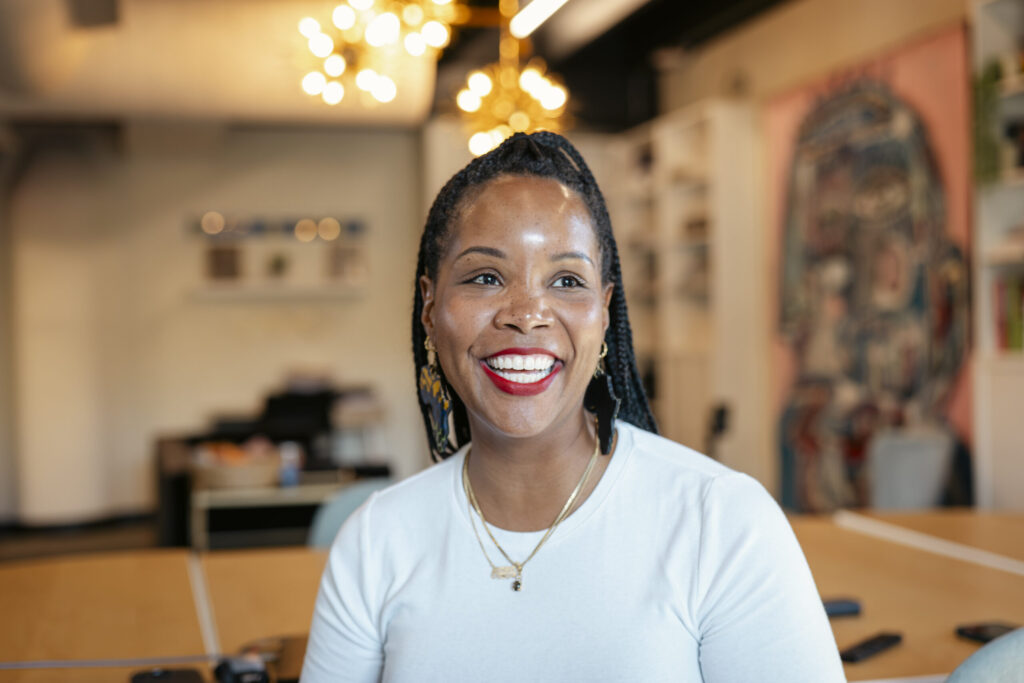
One last opportunity story. It’s about a baby, due in September 2026. But it starts 75 years ago.
Sherri Chisholm’s maternal grandparents, Ruby and Luther, joined the Great Migration, leaving Alabama for Detroit in the 1950s. Ruby was a teacher’s aide and Luther worked on the auto lines. Their daughter, Chisholm’s mom, was a first-generation college student who became an elementary teacher and retired a principal. And her daughter, Chisholm, went to the University of Michigan, then Harvard, then Deloitte, then to leadership with large education organizations, then to Charlotte to lead on opportunity.
And still. When Sherri and Joe Chisholm arrived in Charlotte and went looking for a house in 2021, they couldn’t easily afford one. She remembers her real-estate agent asking whether any family member could lend them $60,000 for a down payment. They laughed.
“My grandparents migrated. My mother did better. I did better. And still,” she said. “It speaks to how long the journey with economic mobility is.”
They settled in University City. Their 5-year-old, Jocelyn, is in Pre-K and reading at a second-grade level. And yet, five years in, Chisholm says she’s struggled to find community outside of work. That tends to happen with people who make work their community. She’s spent countless evenings at fundraisers and meetings working out who to sit beside, who to talk to next, until the funders and nonprofit leaders and colleagues and friends blur together.
So she plans to spend a few months “figuring out who Sherri is” before pursuing another job. After she said that, I asked her the most clichéd question she gets.
“So are you staying in Charlotte?”
She nearly rolled her eyes, but held off. Yes, she said. But the question itself, she noted, says something about the city. “Several years ago it was like, ‘Do you like us? Do you like it here?’” she said. “And now, when we transition, it’s like, ‘Are you staying?’”
Some things don’t change.
“I now get what people mean when they say Charlotte’s a teenager,” she said. “We know we don’t want to be what we used to be, like we want to be a big girl. We don’t know how to get there, and I think that we’re often toggling between the two.”
Speaking of, Sherri and Joe spent years trying to give Jocelyn a sibling, and even with modern medicine, they’d finally given up. Then, around her 41st birthday, she got pregnant.
She’s due in September. Another child in her family’s long climb to prosperity, a bridge-builder’s baby, born into the generation Charlotte’s Opportunity era was always really about.