
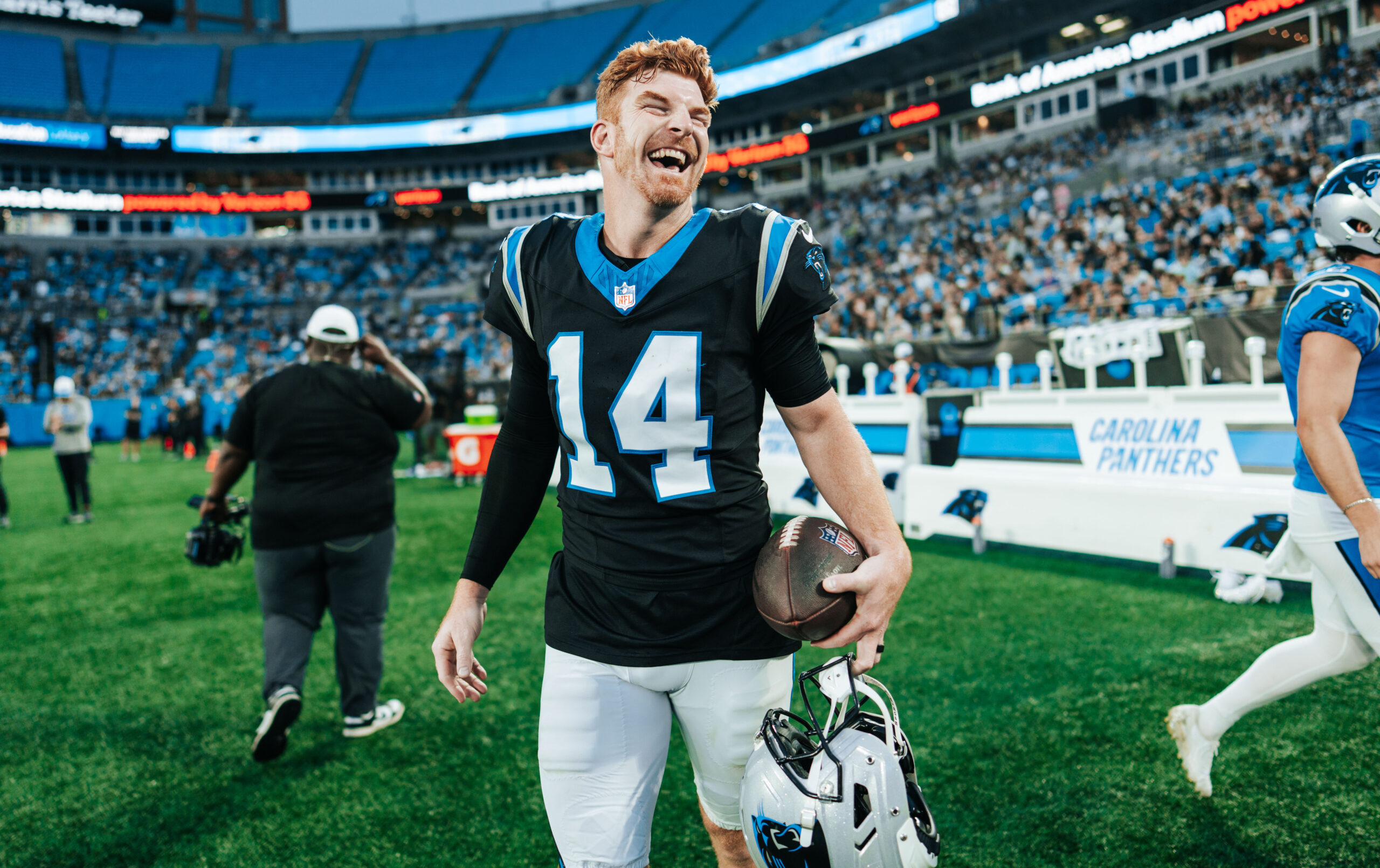
Before Andy Dalton signed a contract with the Panthers in 2023, he made a phone call to former tight end Greg Olsen.
Dalton had bounced to four cities in four years — from Cincinnati to Dallas to Chicago to New Orleans. He and his wife, J.J., had three kids. The youngest was 4, meaning his father hadn’t lived in the same city for more than a year of his life. It wore on the Daltons. And J.J. had been praying for stability.
So when he called Olsen, the player-turned-broadcaster with a voluminous Charlotte story, Dalton didn’t ask about the team.
“Alright, Greg, I don’t want your Panthers’ spiel,” Dalton said. “Give me your Charlotte spiel.”
Dalton smiled last week as he recalled Olsen’s response.
“You’re gonna come here,” Olsen said, “and then you’re not going to want to leave.”
The warning was music to Dalton, then 35, because it named something he’d been circling. After moving through new cities and systems and expectations, Charlotte offered the chance to stay put long enough for life to catch up.
Around the Panthers’ locker room, this comes up more often than their fans realize, especially among veterans with young families who realize that careers can be short — and kids’ childhoods shorter. Charlotte has long sold itself as a “great place to raise a family.” It also happens to have more millennial parents than most major U.S. cities. Put those together and it’s quietly become a place where this generation of professional athletes finds something steadier.
You can argue whether that has anything to do with on-field success. Either way, these Panthers brought late light to a dark fall for Charlotte, securing a playoff spot for the first time since 2017.
Bank of America Stadium filled up again in December with fans in black and blue, hollering the ageless “Keep Pounding” chant, sensing that something coherent was being built. Sure, the move back toward respectability was fueled by young talent, including 22-year-old rookie Tetairoa McMillan. But given the way the season unfolded — a roller coaster of bad losses followed by big wins — it’s also been shaped, more quietly, by the emotional maturity of players who believe that life is about more than the highs and lows of a pro career.

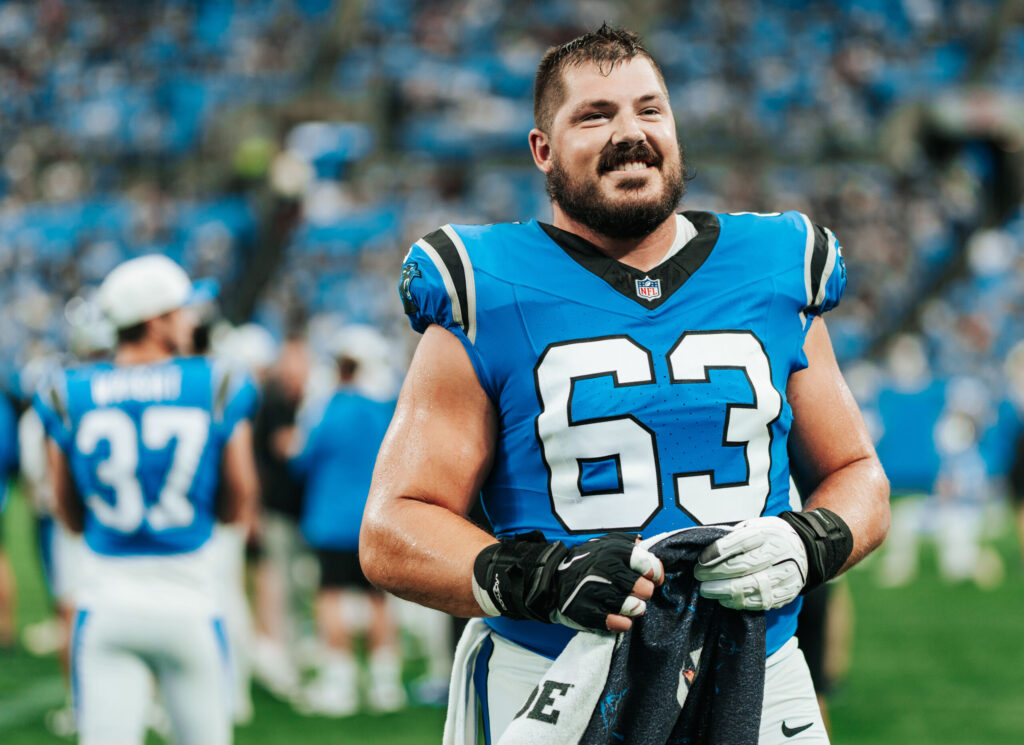
You can see the connection between city and player through offensive lineman Austin Corbett’s story.
Corbett arrived in Charlotte three years ago after winning a Super Bowl in Los Angeles. A father of three who lives just over the state line in Fort Mill, he’s become one of the Panthers’ most respected leaders. Last month the team named him its nominee for the NFL’s Man of the Year Award. I spoke with Corbett twice last week, in the lead-up to the regular-season finale against Tampa Bay. He ranged from poetic to pragmatic about Charlotte, and he says he has friends playing in other cities who want to move here.
Corbett, 30, grew up as a member of the Walker River Paiute native American tribe in Nevada. His father drives trucks; his mom works at a daycare. He attended the University of Nevada, married Madison just after his senior year, and was drafted by Cleveland in 2018 before being traded to Los Angeles in 2019. For whatever reason, neither Cleveland or L.A. ever felt like a place to stay. Charlotte, though?
“It’s hard to put into words sometimes,” Corbett said. “When it’s home, it’s just, home.”
On Wednesday afternoon, Corbett stood at a small podium expecting a routine media availability and instead received the Pro Football Writers Association’s “good guy” award. Corbett accepted the award in socks and a sweat-soaked hoodie, joking that he hates attention. But the award fit. Local beat reporters who’ve been with the team for years talked about his accountability, his availability, the way he showed up every week, even when injured, without making noise about it.
A few minutes later, I met Corbett at his locker and mentioned that I’d seen one of the last images of him with the Rams, kneeling down with his oldest son, then-15-month-old Ford, after the 2022 Super Bowl.
“I don’t know what photo you saw,” Corbett interrupted, laughing, “but was he pantsless?”
He was. Corbett then went on to tell a story most parents will identify with, of big moments punctuated by the unexpected. After that Super Bowl, you see, Corbett’s wife Madison rushed down to the field with Ford and forgot their diaper bag in the excitement. A teammate had a spare. Corbett put Ford down and changed him right there on the confetti-covered turf.
“I give them both big hugs and grab Ford and then all of a sudden it’s like, Ah, he’s peeing on me!” Corbett remembered. “His diaper was so full.”
Corbett signed with the Panthers a month later. In an introductory video, Madison said that Charlotte was a place she’d always dreamed of living. They’ve since had two more children here. And although Austin’s current contract expires after this season and he could be picked up by another team, he says they’ll either keep their home here or come back to settle.
I asked him if there’s one thing Charlotte doesn’t have that he wishes it did.
“Maybe a little snow,” he said.
On Saturday, after the discouraging loss to Tampa Bay, Corbett posted a simple picture on social media, of Madison and Ford, now 5, wearing rain ponchos on the sidelines, with the caption, “Ford’s first road game!”
“Just giving them the opportunity to see Dad do this,” Corbett told me of his goals now. “And to know that I’m providing everything. [Ford] doesn’t know it, but he’s the most spoiled kid in the world. Every time he says, ‘Oh, you’re going to work today?’ and we’re driving past the stadium [I remind him], that’s not normal life, buddy.”
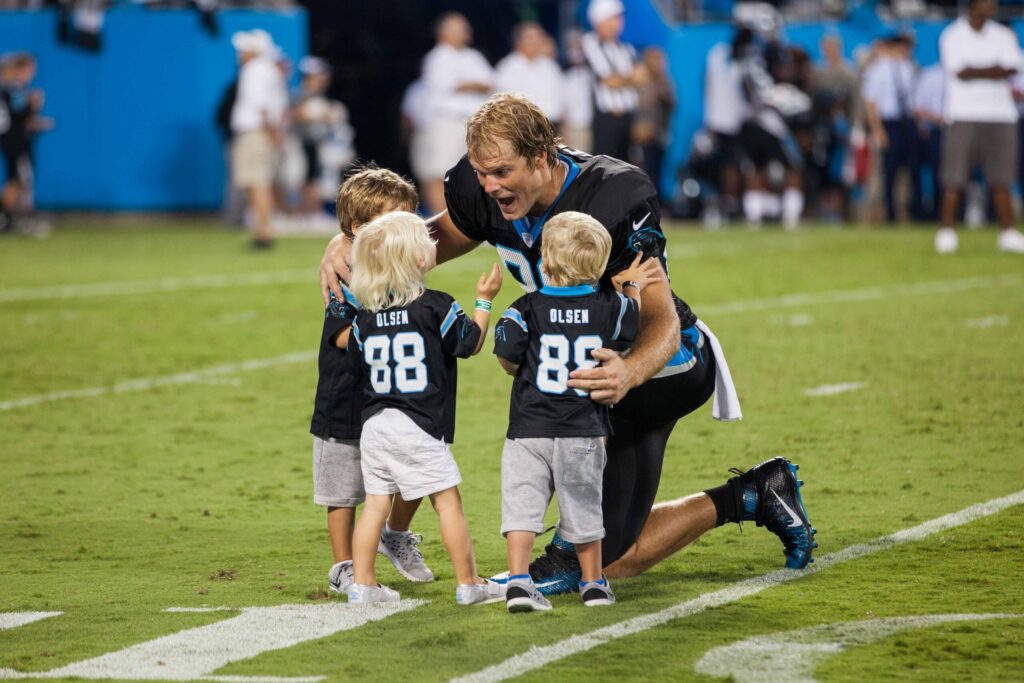
The trend of athletes settling in Charlotte dates back nearly 40 years, to the city’s first major professional franchise, and players named Dell and Muggsy.
When the city landed the NBA’s Hornets in the late 1980s, owner George Shinn pushed to draft a 5-foot-3 point guard named Muggsy Bogues in the expansion draft. Coaches were skeptical. Shinn called UNC legend Dean Smith, who vouched for Bogues, and Shinn told the staff, “We’re going to pick Muggsy.”
The team also took Dell Curry that year.
Curry and Bogues didn’t just play here for years. They became part of the city for decades. Curry, of course, raised his ultrafamous son, future NBA Hall of Famer Stephen Curry, in south Charlotte. Bogues, meanwhile, was beloved for visiting elementary schools and middle schools, preaching his message that heart matters more than height. In a way, it became part of the city’s self-image as it grew from the 26th largest city in the U.S. in 1990 into the 14th today.
Only once in the city’s 38 years as a major pro sports town has Charlotte shed its underdog status. That was 2015, when the Panthers went 15-1 and rode made-for-Hollywood quarterback Cam Newton and a cast of homegrown All-Pros to an NFC Championship. Their loss to the Broncos in the Super Bowl was altogether shocking, and I’ll never forget how hungover the city seemed the next day.
In some ways, it’s taken the Panthers a decade to recover from that brush with the sun. Now, under coach Dave Canales, the language has shifted toward developing players and continuity. Building rather than renting. It feels familiar, finally.
Charlotte has never been the loudest or most glamorous sports city, and maybe it never will. It’s rarely sold itself as a destination for superstardom. What it offers instead are quiet neighborhoods, moms’ Facebook groups (Corbett says his neighborhood’s group is wildly helpful when he’s out of town), and distinct seasons. And it offers a civic culture, passed down through the generations of business leaders who helped recruit pro sports here, that tends to see athletes less as a spectacle than as neighbors with unusual jobs.
And it’s not for everyone, of course. In 2005, Panthers’ player Brentson Buckner told former Observer reporter and current Panthers’ senior writer Darin Gantt, “I always say, this is a married man’s paradise.”
Whether that’s a compliment or a dig is up to the reader.
That relationship continues to prove durable. Many Panthers from those mid-2010s glory years remain. Olsen, of course. Thomas Davis, whose son graduates from Weddington High this year and has committed to Notre Dame. Jonathan Stewart, deeply rooted and growing the game of golf. And Luke Kuechly, who turns up everywhere from Brawley’s Beverage to the sidelines of Johnson C. Smith football games. As it happens, Olsen, Kuechly, and Stewart coach Charlotte Christian’s Middle School football team.
Other athletes, like London Fletcher, who never played for the Panthers, made a Charlotte home and are raising kids here. Former Duke basketball standout Shane Battier moved here with his family from Miami last year, the Observer’s Scott Fowler noted. And then there’s former NFL quarterback Mark Maye, whose youngest son, Drake, went to Myers Park High and may just win the NFL’s MVP award this year for the New England Patriots.
It’s natural to wonder whether today’s young stars, when their careers slow and their lives widen, will look to Charlotte not as a place to be from, but as a place to return to.
After last weekend’s home game against the Seahawks, Andy Dalton’s entire family joined him on the field. His kids are now 11, 8, and 6, and Andy jokes that he and J.J. feel “like Uber drivers at times.” Andy says Charlotte gave them the right mix of former professional athletes who can commiserate over their strange lives, and friends who aren’t involved in sports at all.
After that Seahawks game, J.J. later posted a photo of the family, sharing her gratitude for their current place in life, for the timing of their Charlotte move, for patience, and for prayers answered differently than she expected.
It felt like the long version of what Olsen had told him three years ago, and what many of us discover.
You come here. Then, sometimes without meaning to, you stay and build something that lasts longer than any one job.