


They were dominant newsmakers of their time who shaped the city as we know it today.
Collectively, this year’s Southminster 8 Over 80: Lifetime of Purpose winners built museums, changed laws, integrated schools, balanced national budgets, grew amusement parks, led media, shaped higher ed, sat as mayor, and pastored to all.
But they’re all more than their resumes. They’ve loved, lost, traveled, and continued to contribute to the city they love. Their collective wisdom is vast. Their hearts are, too. What follows are eight portraits of personality, snapshots of people still living the good life in Charlotte, well into their 80s and 90s. Hope you enjoy.
Bags packed: Martha Bedell Alexander
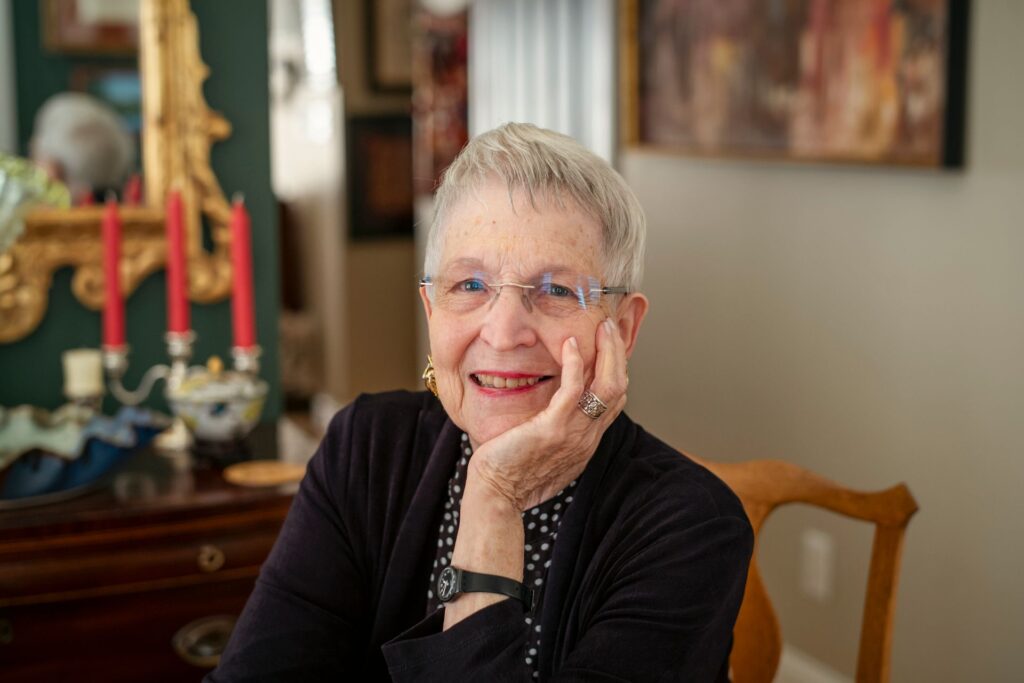
Somewhere in a lava field in Iceland, Martha Alexander fell behind her group. Her 18-year-old grandson turned around to wait for her, and said, “I cannot believe that’s my grandmother.”
She caught up, strapped on a helmet and a harness, and let a guide lower her into the volcano.
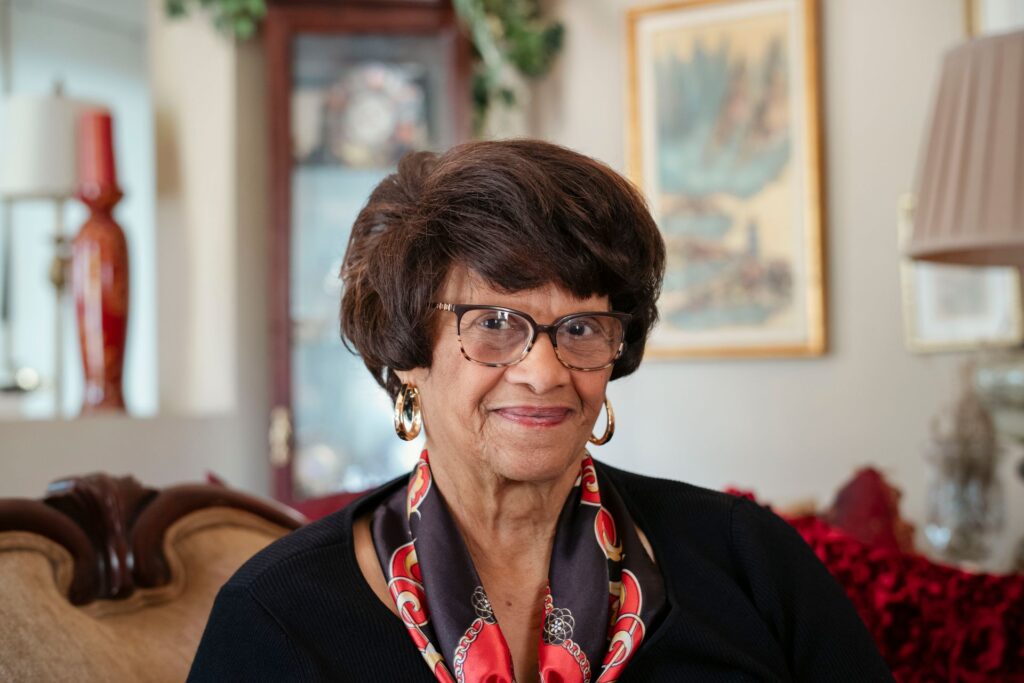
That was a few years ago. Martha is 87 now. You may remember her for her 20 years as a state legislator, or her 11 as executive director of the Charlotte Council on Alcoholism, or the time she spent as the president of the Junior League.
Her home tells a fuller story. Her refrigerator is full of magnets from places she’s been — Ibiza, Nice, Lyon, Joshua Tree, South Africa. She’s been to all seven continents and about 50 countries. “I was trying to reach my age,” she tells me.
One night in Zimbabwe, she climbed into the bed and felt something furry at her feet. She slowly peeled back the covers, only to find a hot water bottle in a furry cover, left there to keep her warm.
The next morning the guide said, “I guess you heard the lion last night?” She hadn’t, so he showed her the prints, right outside.
“You just have to be open to adventure,” Martha says.
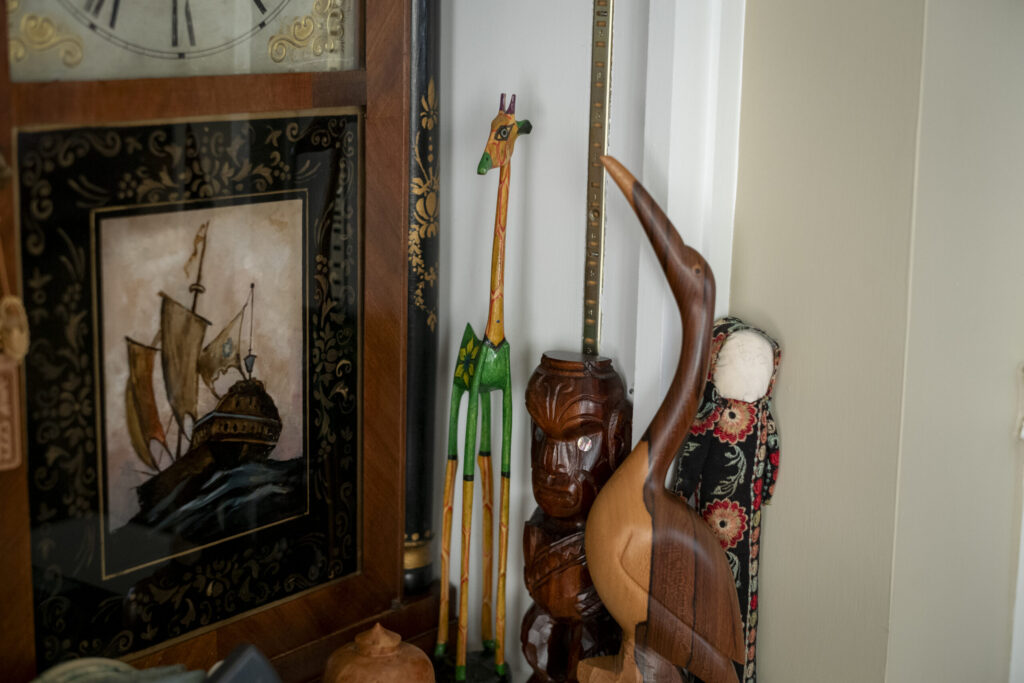
Hers started in Jacksonville, Florida, where she grew up, and at Florida State. The summer after her junior year, in 1960, a sorority sister talked her into a group trip that originated in Charlotte. Eight guys and 41 girls, she recalls. One of the guys was a Davidson student bound for medical school at McGill. She married him, moved to Montreal, and taught school.
She got fired for being pregnant. “I could have maybe been the first ERA person,” she says.
They settled in Charlotte, his hometown, in 1970. She became a chaplain’s assistant at Presbyterian Hospital, a job that required a counseling degree. With two teenagers at home, she earned a master’s at UNC Charlotte. That work led her to the board of the Council on Alcoholism, and then the board made her executive director.
On her first day, a man called the office at 7 a.m. She picked up. He tore into the board for hiring the wrong person, not knowing he was talking to that person. She listened.
“I’m Martha Alexander,” she said, “and I’m the new executive director.”
In 1992, voters sent her to Raleigh as a state representative, and then again nine more times. She spent 15 years on one bill, to make insurers cover mental health the way they cover physical health. It passed in 2007.
“Somebody had told me when I went into politics, ‘You’re gonna learn what you are willing to stand up for,’” she said. “And you do.”
In her final years in the legislature, she took classes for fun: agricultural economics at N.C. State, the voices of Latin America at UNC Greensboro. One March, UNC Greensboro called to say she’d taken so many that she had to stop and graduate. She put together a portfolio over a couple of weekends and had a second master’s that May.
After losing her seat in 2012, she enrolled in a doctorate program at Northeastern. She finished at 80, during COVID, and watched her graduation in a cap and gown from her front steps.
She was in the Dominican Republic later when Northeastern emailed to say she’d won a university-wide award. She called to say they had the wrong person. They laughed and said no, they didn’t. In Boston she stood in a line with twentysomethings. “They think I’m a professor,” she remembers thinking.
One morning a couple of years ago, she woke up and heard an instruction in her head: You need to go to Botswana. So she went, spending two months at a theological school in Gaborone, cataloging more than 1,000 books. She went back this May to watch 14 women be ordained as priests.
Along the way, she brought other Charlotte leaders along. Carol Hardison, who’s retiring as CEO of Crisis Assistance Ministry next year, traces her career to a dinner with Alexander in the 1990s. “Martha was the sole person who opened that door for me,” Hardison wrote in support of Martha’s 8 Over 80 nomination.
She still has traveling to do. She’s taken four of her five grandkids on overseas trips, one at a time. She has one to go, and they’re thinking Thailand.
“My bag is packed. I’m ready to go,” she tells us. “Y’all got anyplace you’re going?”
Better together: Erskine Bowles and Nelson Schwab
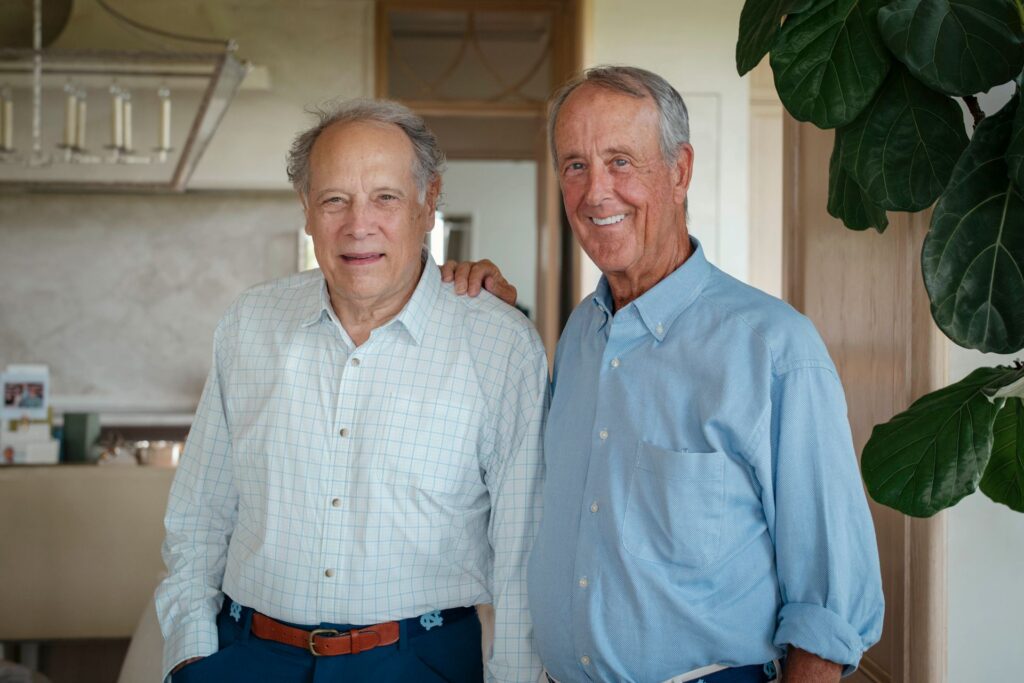
The young man from Cincinnati saw the young man from Greensboro driving a golf cart around Chapel Hill and thought, “I better meet this guy.”
This was in the fall of 1963, Nelson Schwab says. Lowly freshmen at UNC didn’t have golf carts. Hell, they could barely get dates, because back then the only women allowed admission were juniors and seniors.
Sixty-three years later, we’re in Nelson’s top-floor SouthPark condo with a view of Charlotte’s skyline. In the chair next to Nelson, Erskine Bowles fidgets.
“I’m terrified to hear this story,” Erskine says.
Nelson breezes over the details and says, “That started a friendship that’s, I don’t know what the math is, but it’s up there.”
Wait, I interrupt and turn to Erskine, “what were you doing in a golf cart?”
Erskine looks at Nelson, debating whether to answer. “I’d jumped off the top of a roof, trying to fly on low octane fuel,” he says. He broke his back, a leg, and crushed both heels. He told his father, a member of Governor Terry Sanford’s administration, that he’d been mugged.
“Son, I’ve heard a lot of things,” Skipper Bowles told his son, “but never got mugged by your heels.”
They’re 81 now, both wearing UNC belts. They finish each other’s sentences — and maybe embellish each other’s stories — without thinking.
Erskine’s bio will tell you he was a pioneer in financial services, chief of staff for President Clinton, and president of the UNC system. Nelson’s says he ran Carowinds and its sister theme parks, and chaired the board of trustees at their alma mater. They’ve been in business together for 30 years, back to when they founded Carousel Capital, a private equity firm. Then, in early 2020, they launched their audacious Housing Impact Fund, raising $225 million to purchase old units, fix them up, and lower the rent.
When Southminster asked each man to be honored as an 8 Over 80 winner on his own, each said no. Neither knew the other had.
“We would only come as one,” Erskine says.
It’s funny to think back now, Nelson says, and remember how he felt a sharp “sense of loss” when they graduated from UNC in 1967, thinking he and his friends were going separate ways.
They didn’t. One year, Erskine was president of the UNC system, Nelson was board chair, and they were honoring another classmate as alumnus of the year. Erskine recalls Nelson giving a speech and saying, “If you’d ask anybody in the ’60s, would the three of us be here today? The answer was no.”
“Not only no, but hell no,” Nelson corrects his friend.
They are portraits of success now, but there were losses. Erskine worked on his father’s 1972 campaign for governor, which ended in a loss, and then he lost two runs for U.S. Senate himself. The day after the second one, in 2004, Nelson stopped by the East Boulevard campaign headquarters with a ham sandwich. He found Erskine alone, and said, “There’s life beyond this.”
Not every idea born from their friendship was a good one. Once, they considered getting in the pillow business together. “That was alcohol influenced,” Nelson says.
But this latest one. It’s good. They were concerned about homelessness and economic mobility in Charlotte. They met Roof Above’s Liz Clasen-Kelly, who gave them a face that, in Erskine’s words, said, “You silly boys.” She put them through a crash course in affordable housing, and why it’s the root of both.
They teamed up with Mark Ethridge of Ascent Housing, who’d already worked on preserving affordable units but didn’t have capital. They could fix that. Together they’ve helped save about 2,000 units. The fund promises to keep the rent down for 20 years. “We’re not dating these apartments; we’re marrying them,” Erskine says. At a celebration of the fund in April, tenant Aisha Johnson said her rent went from $1,500 a month at a hotel to $305 at Lake Mist.
Nelson cries when he talks about it. “That’s how much it means to him,” Erskine says.
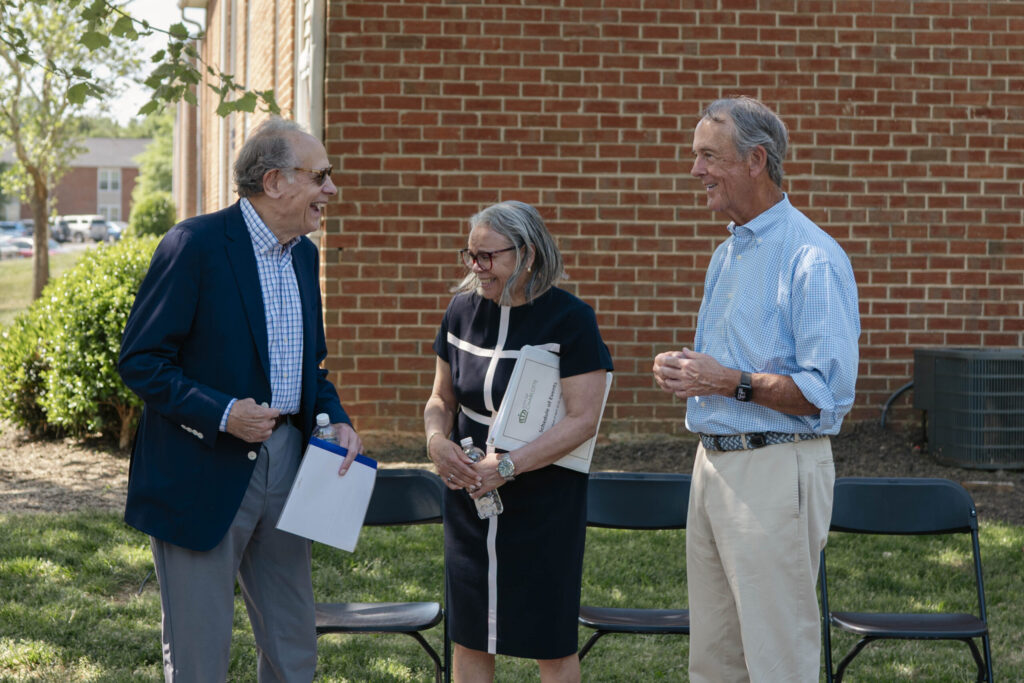
One key to the fund’s success, Nelson and Erskine say, is that they’ve worked with investors “from the far right to the far left.”
That’s been their philosophy in everything. Differences aside, better together. President Obama once asked Erskine how Clinton’s White House negotiated a balanced budget with Republican Newt Gingrich. Obama told him he’d tried having drinks with Republicans once, and tried playing golf with them once, and still no luck. Erskine replied, “You answered your question when you said once.”
Erskine had spent months in a conference room with Gingrich in the 1990s. “We built up trust, and with trust, you can develop a common set of facts, and with trust in a common set of facts, you can get almost any deal done.”
I ask them to compare what they’ve achieved alone with what they’ve achieved together, and they each disagree with the premise.
“You don’t really achieve much on your own,” Nelson says.
“I’ve had no successes by myself,” Erskine says, adding that Nelson is “the only person in my whole life I’ve known who puts you first in everything he does.”
When it’s time to take a photo, they stand in the light near the terrace, where Nelson keeps a BB gun for the vultures that land there, and Erskine recalls a line from the late Senator Al Simpson: “Always put your arm around them. That way, they can’t kick you out of the picture.”
And Erskine puts a hand on Nelson’s shoulder.
Long distance: Dot Counts-Scoggins
This is a story about Dot Counts-Scoggins, an 84-year-old civil rights legend, that’s not been told. She may disown me for telling it, but I’ll make it up to her.
To hear it, you have to take that famous picture of her walking into Harding High on that September 4, 1957, morning, and unfreeze it. Turn it into a reel, a motion picture, and rewind …
… Watch her walk backward toward her father’s car. Watch the white kids retreat. Watch her go home and sit at the dinner table the night before, to hear her father’s now-famous advice: Remember who you are. Remember that you’re inferior to no one. Remember that you can be anything you want to be. And don’t hold your head low for anybody.
Rewind faster now, through the part where Charlotte’s schools admitted her and three other Black kids to integrate. Wave at her grandmother, Emily, sitting at that black Singer sewing machine, pumping the pedal to create that historic plaid dress.
OK, when you get to June 26, 1957, at Grinnell College in Iowa, where Dot was one of 1,800 Presbyterians to attend a weeklong National Youth Assembly, stop. Let’s go there.
Dot’s unpacking her bags in a dorm room. She wants to be a nurse. Her roommate is a white girl from rural Illinois who’s never been this close to a Black person. Dot says, “I need to know why you’re watching me.” The girl has wild questions: Do you have a tail? Does your skin rub off?
Dot sits her down. “A lot of what you’ve heard are myths and are not true. Believe it or not, you and I are alike in a lot of ways.”
Outside of the dorm room, Dot sees other Black kids. They hang together most of the week. One is a boy from Cleveland, Ohio, named Lewis. He’s three years older than Dot, a rising senior, and he tells her he’s planning to attend college at Johnson C. Smith, the university across the street from her house. He’ll look her up when he gets there, he says.
He never shows up. Dot barely thinks about him again.
Then her life happens. Fast-forward now …
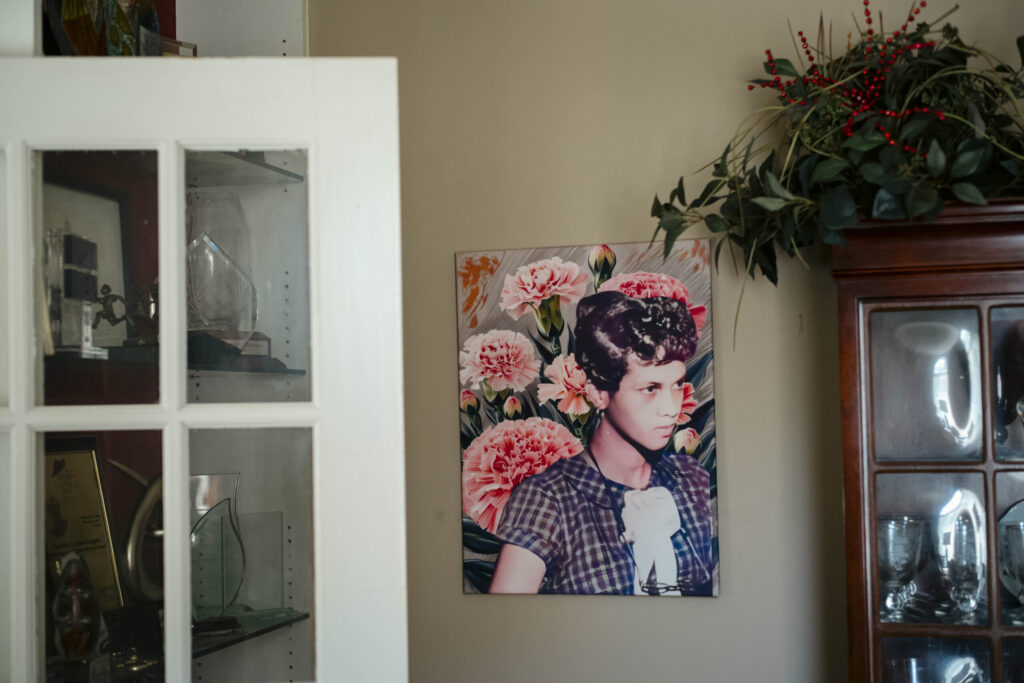
… the dress and the stones and the spit. The picture. Through her father pulling her out of Harding after four days, because police say they can’t guarantee her safety.
Sixty years in a blink: high school graduation in Asheville … college at Johnson C. Smith … to New York where she works at a center for abused children … marriage and a return to Charlotte in 1969 … the adoption of her two children … the years she raises them in Matthews while building a career in childcare and education … a divorce and a move back to West End, into a house just a few blocks over from where she grew up … and then into retirement. …
… OK. Hit play again. About a decade ago, Dot receives a note on Messenger, out of nowhere.
I don’t know whether you remember me. I’m Lewis Smith from Cleveland, Ohio. If you remember me, he said, give me your contact information.
Dot never gives out her contact information. In the nearly 10 years I’ve known her, I’ve received notes from reporters and artists around the world who want to get in touch with her. The deal is, I’m supposed to look into them to make sure they’re legit before I share. She’s seen her story twisted too many times to trust blindly.
But with Lewis, she gives him her number.
They talk and talk. He visits Charlotte a few times. She goes to Cleveland a time or two. He’s her date when she receives UNCF’s Maya Angelou Women Who Lead Award in 2018, holding open every door for her on the way to the ballroom.
Her friends and family ask her why she couldn’t find someone who lives in Charlotte instead of one who lives 500 miles up 77.
She’s quick to retort, “I have my space here. Then we come together and we don’t have to go through all the other stuff that people go through living in the same place.”
This goes on for years, up until Lewis’s death two years ago.
Every night at 8:30, her phone would ring. She knew it was him. They would share their life stories with each other in nightly chapters, two people in their 70s and then 80s, bonded by the summer before she became a legend.
“Somehow or other”: Larry Dagenhart
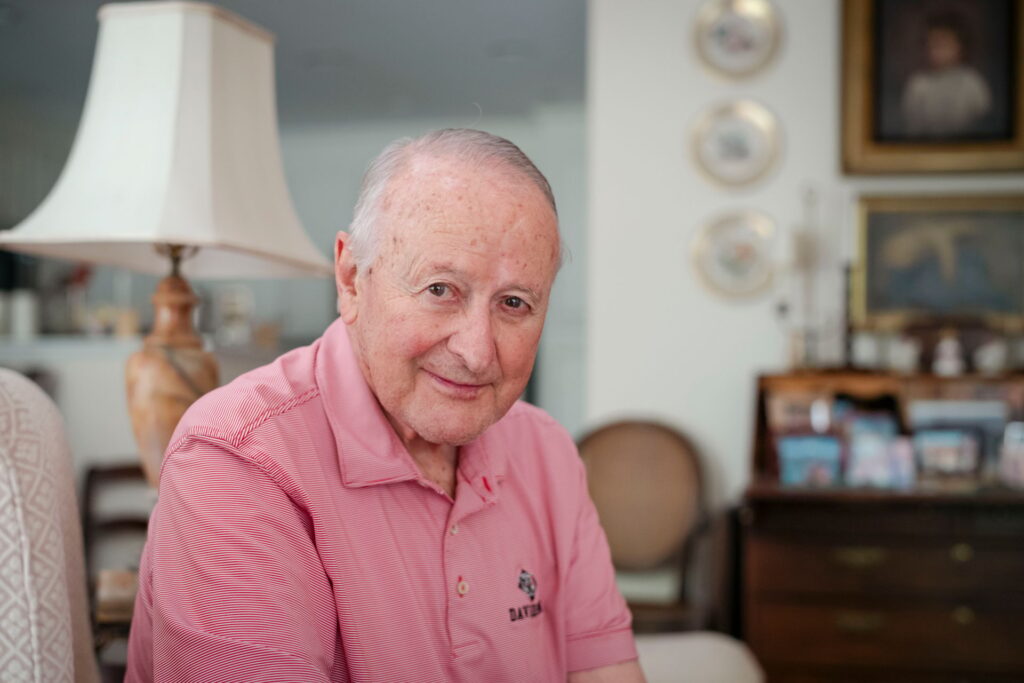
Larry Dagenhart picked okra this morning, some of the last of the season, and gave it away.
I tell him I’m an okra fan, and he shares his simple recipe: drop in a little salty water, then three minutes in the microwave. “I don’t have to have it fried.”
We’re in his first-floor apartment at Southminster, where he’s lived since 2012 and where he’s basically the mayor. On our walk through campus, everybody wanted Larry’s ear: the woman behind the scone cart, Carol on her way to the pool, even CEO Ben Gilchrist. “He’s the big dog here,” Gilchrist said.
“He’s one of the most sought-after people here,” says Gail Samuels, Larry’s companion of several years. “He’s very intelligent, but he never acts like a big shot.”
The big controversy this week is that someone swapped the coffee table in his floor’s lobby with the one upstairs. Both floors are in an uproar, and they came to him: “Larry, you got to see what we can do about that.”
People have been saying that to him for a long, long time. He’s 94. He ran his law firm, Helms Mulliss, for 17 years. He chaired the Chamber, United Way, Arts & Science Council, and Foundation For The Carolinas, and he spent 29 years as a trustee at Davidson College.
“Somehow or other,” he says, “I ended up doing it all.”
He spent his early years in Taylorsville, where his father always said, “farming and bootlegging’s about all you could do.” In 1944, the war opened jobs in Wilmington’s shipyard, so his dad moved the family there.
“I couldn’t swim. I thought a yacht was a ‘yatchet,’” Larry remembers. His new high school, New Hanover, had 2,000 students, and a boy from out of town could go unnoticed for four years. So freshman year, he sang “Summertime” in a school show. He wound up class president.
He also coached the Lutheran church basketball team, which had an eighth-grader named Sonny Jurgensen, the future Hall of Fame quarterback. Larry didn’t think it was right to start an eighth-grader, “but I put him in after about two minutes.”
Larry went to Davidson on a full ride, then to NYU for a year of law school. Then the Army. At Fort Benning, he was handed an infantry platoon. He told his sergeant he didn’t know anything about running one, and the sergeant grinned and said he’d been looking for a lieutenant like that.
“He ran it,” Larry says, “and I patted my foot and made everybody happy.”
You know those people who just make others feel better? That’s Larry.

He met his wife, Sarah, during his Army years. Back in New York, she modeled, and he went on a quiz show “Tic-Tac-Dough,” which billed him as “a shoe salesman from Fayetteville.” He won enough money to take her to Europe for six weeks.
He loved New York, but in 1958 they moved to Charlotte. He used to tell Sarah, “If we’d stayed, we’d have gotten divorced, and I’d be fat, rich, and dead.” Instead they were married 63 years, until Sarah died in 2020.
The firm he joined had five lawyers. One was James B. McMillan, who told him to try cases his own way “because the jury will spot insincerity in a heartbeat.” A decade later, McMillan was the federal judge who ordered busing to desegregate Charlotte’s schools. After the ruling, Larry says McMillan “had a little bit of a hard time getting a golf game.”
Larry became president of The Charlotte City Club, where business leaders made decisions over meals. He helped integrate the Club, first for Black men. In October 1982, the Club opened to women, and Larry invited his wife’s best friend, Harriet Cuthbertson, to be the first to eat lunch on the all-male second floor. Her picture landed on the front page the next day, with the lede, “Harriet Cuthbertson made history Friday.”
We don’t make any history during our visit, but we sure talk about it. He’s writing it all down for his eight grandchildren, how this boy from Alexander County became chairman of everything in Charlotte.
Before we leave, he takes us outside to his main creative project, his garden.
“This is a pluperfect mess,” he says. The Juliet tomatoes are coming in. Gail loves the red roses. He’s been waiting on cool weather to cut the rest back.
I mention that gardening here is a long way from the fields. He says someone asked him once why he became a lawyer instead of a farmer.
“I heard,” he says, “lawyers didn’t have to sucker tobacco.”
The good friend: Rev. Dr. Clifford A. Jones
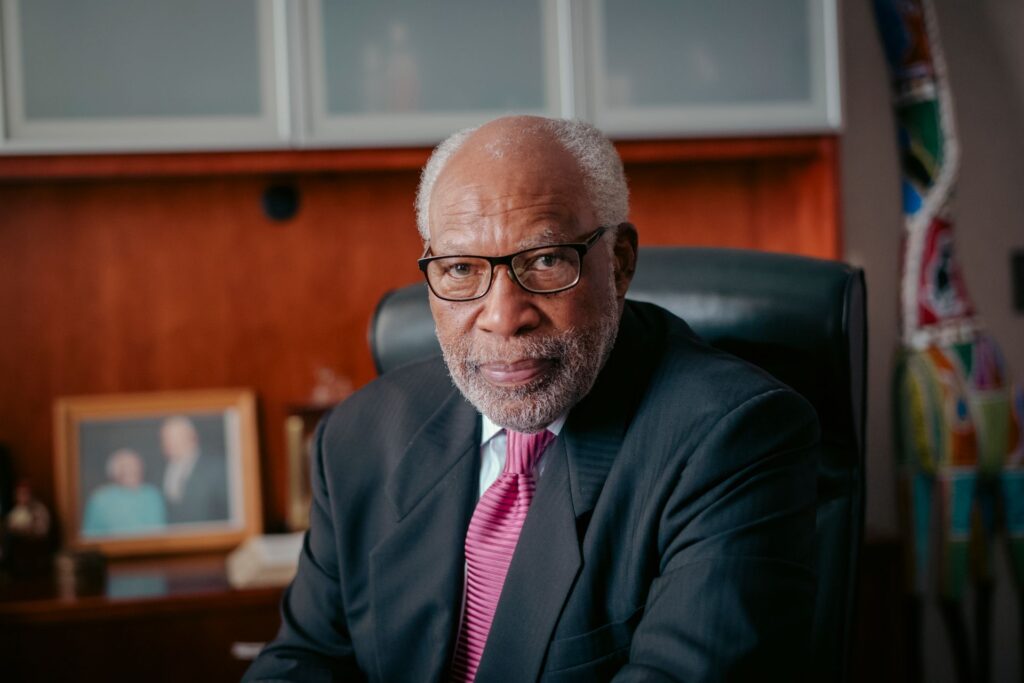
He reaches for the little figurine he calls “my friend.”
Thirty years ago, the Rev. Dr. Clifford A. Jones Sr. stopped at a clearance sale at a novelty shop in Calabash, the little fried shrimp capital of North Carolina, where he saw his friend alone on a shelf. The figurine has a worn boater hat, a light jacket, and loose-fitting pants pulled up over his belly. He’s plopped on a stump, the years and wisdom showing in the wrinkles of his face, and his head is tilted.
“He was the only one on the shelf, sitting by himself. Nobody wanted him,” Jones tells us. “I walked in and looked, and our eyes met. … I said, ‘I’ll take it.’”
The figurine holds a permanent place in the pastor’s office at Friendship Missionary Baptist Church on Beatties Ford Road, where Jones has served for 44 years, ever since 872 congregants voted to bring him here from Sampson County in October 1982. He’s grown the congregation to about 9,000 today. Among them are former Charlotte mayors, judges, business leaders, and athletes. They sit in the pews like anybody else. “You come here to worship,” Jones says. “You leave that stuff outside.”
Friendship is far more than a worship center, he says. It has a child development center, services and programs for homeless women, an intergenerational center that provides care for elderly people with Alzheimer’s and Parkinson’s, and the popular summer program Youth Opportunity University, which his wife, Brenda, helped him start in 1994.
Jones, 82, grew up among the tomato fields of southern New Jersey, then played football at Maryland State College, where he says his claim to fame is being teammates with future Hall of Famer Art Shell. He and Brenda then went to Rochester, New York, to become teachers. While there, something kept calling him. He’d come home from church and mimic the preacher, and tell Brenda, “I can do that. … I’m not going to do that.”
“It was a long, agonizing, uncomfortable mental state,” he says now, his voice deep and each word intentional and careful. After about 18 months in that state, Brenda’s father took him to meet a preacher in his community in Asheville. The preacher pointed at Jones and said, “I don’t know why you’re running. The Lord’s called you to preach.”
Jones gave his first sermon that May. That August, he moved to Wake Forest for seminary.
Now Jones has an office with a library where he blends today’s issues with history and scripture for each sermon. “We think everything is new: this never happened before. And just a casual glance of world history, or biblical history, or sociology … you find that there are similarities.”

Some things are new. Jones had lost his parents, brothers, and sisters. But in February 2025, he found a loss he hadn’t encountered before, when Brenda, his wife of more than a half-century, passed. Her obituary noted that she called everyone “hun,” “shug,” or “sweetheart.”
Jones brings her death up in our conversation, and a question comes to me, so I ask it. How does the pastor who helps people through loss help himself?
“I don’t know,” he says.
The office goes quiet.
“I can quote the scriptures,” he continues. “I hear all of that, and I’ve said all of that. But I’m still on the journey. Accepted? I have. I know she’s not going to be at the house when I get there. But there’s still grief.”
He’s reading a book, Three Roads Back, about how Emerson, Thoreau, and William James dealt with their greatest losses. One idea bothered him: We don’t choose our families, but we do choose our friends, so the loss of a friend can be the harder one.
But over time, he’s come to agree. Most of us have acquaintances, but rarely do we have true friends, he says.
“A little of you dies, a little of you is buried, a little of you never returns, because no one else can replace that friend,” he says, looking down at the figurine on the table. “What do you do when you won’t see that smile again, or hear that voice? I don’t know. I don’t have an answer.”
Then he looks at me and says, “Change it. Let’s move.”
So we do, and I get back to asking questions that have answers. Like whether he ever imagines what his figurine friend is thinking.
“Just depends on where you sit, and how you look at him,” he says. “Sometimes he’s that grandfather saying, What’s the matter? Then another time he’s saying, It’ll be okay.”
Either way, Jones says, “He never leaves me. That’s what I mean about a friend.”
Life of discovery: Freda Nicholson
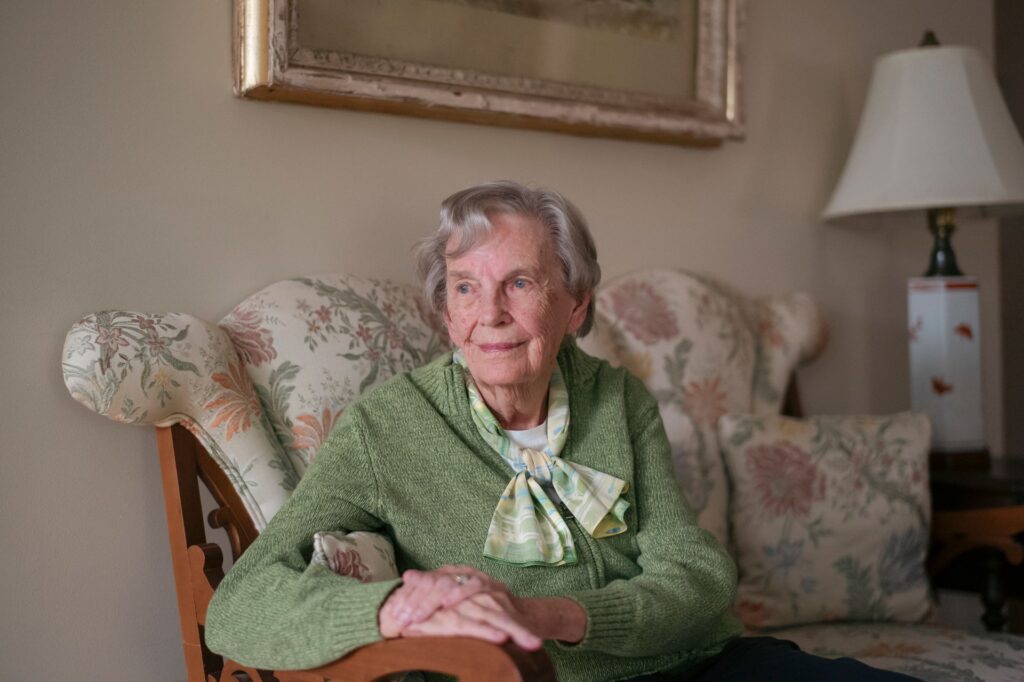
Down along the Swannanoa River where she learned to swim, in a home where her family always had a pig and grew their own vegetables, an 11-year-old girl was raising four children alone.
Her father, sick with tuberculosis after serving in the trenches in France, was in a hospital not far from home. Her mother was about 50 miles east, in the state psychiatric hospital in Morganton.
So the little girl cooked and took care of her two kid brothers and the two-year-old twins.
Then the sheriff showed up. She still doesn’t know who reported them. He told her they couldn’t stay there, a child cooking for children. He sent Freda and the two brothers to Crossnore School. The twins went to an orphanage in Oxford, halfway across the state.
“I thought I would never see them again,” Freda Nicholson is telling us now.
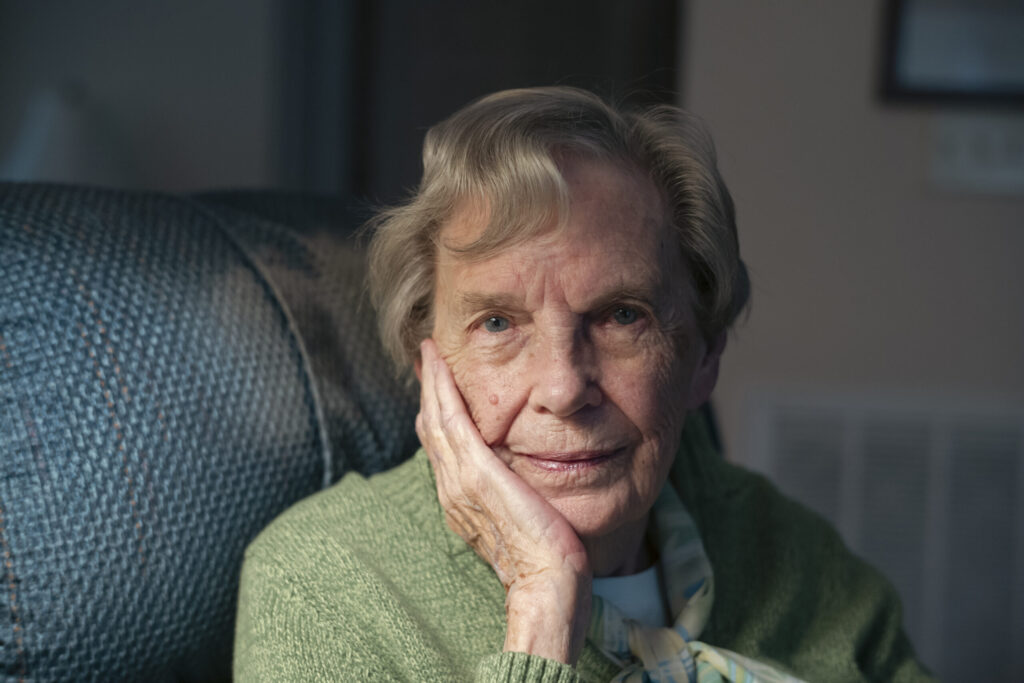
She’s sitting in a recliner that was her husband’s, in her cottage at Sharon Towers. Last month she turned 92 and Discovery Place, which she ran for 20 years, threw her a big party and named its Legacy Society after her.
She’s a long way from that day with the sheriff, and still she says, “It was horrible.” Two years later, when Freda was in ninth grade, her father came to get them, and then the twins.
Crossnore was good for her, though. Every child had a job, and for three months hers was in the local hospital. That’s how she decided to become a nurse.
She took a full scholarship to nursing school in Savannah, which opened her eyes. “We were poor, but we didn’t know it, because so was most everybody else,” she says of her childhood.
Her first hospital job was in New Orleans, where she met a surgeon from Statesville. They married, moved to Charlotte in 1956, and took jobs at Presbyterian. Six children came in 12 years. The first four were boys who liked to hang out at the little Nature Museum next to Freedom Park. Freda volunteered there, and within a few years she was on staff, teaching kids about the human body with a transparent mannequin. Schools sent her every fifth and ninth grader, primarily for sex education, she says, “because they didn’t want to teach it.”
About 300,000 kids came through each year, and the leadership team decided to build a science museum. Freda helped make sure it went on the poorer end of Tryon Street, to reach kids who didn’t have access to such things. She’d been poor, too; the difference, she says, is that city kids know it.
The building was mostly complete in early 1981 when the CEO resigned suddenly. Retired UNC Charlotte chancellor Dean Colvard asked Freda to take the job. Her children were all, “Do it, do it, do it.”
In her first weeks, Freda learned that cost overruns and delays left Discovery Place $1.1 million short. She’d seen tougher challenges. She asked two bankers, Hugh McColl and Ed Crutchfield, to her office, along with Observer publisher Rolfe Neill and city manager Wendell White. As she tells it, the four men looked at each other and agreed to find a solution. They raised money and closed the gap within weeks.
“It was the power of those people,” she says.
The grand opening was on Halloween 1981. Her 10-year-old son ran into Gov. Jim Hunt in the elevator, and Hunt asked where he was going.
“My mom owns this place,” the boy said.
Freda ran the operation for 20 years, with few other women in America in those roles. Once she went to Barcelona for an international museum conference and found herself registered as “Fred A.” When she retired at the end of 2000, 800,000 people a year were coming through.
Freda made a point of leaving her office for an hour a day to stand on the floor and listen to kids. Sometimes she’d ask them on their way out if they liked the museum.
“What museum?” they’d say.
A girl who didn’t know she was poor built a place where kids didn’t know they were learning.
As we’re leaving, she points to a painting on the wall. It’s the first portrait the fresco painter Ben Long ever made, and it’s of her. Her eyes follow you.
One of Freda’s 14 grandchildren is getting married this weekend, and the family is coming from Guatemala, London, Germany. She’ll meet her newest great-grandchild for the first time.
The family she thought she’d lost at 11 now stretches across three continents. She thinks some might show up before we leave.
Living to tell it all: Glenn Proctor
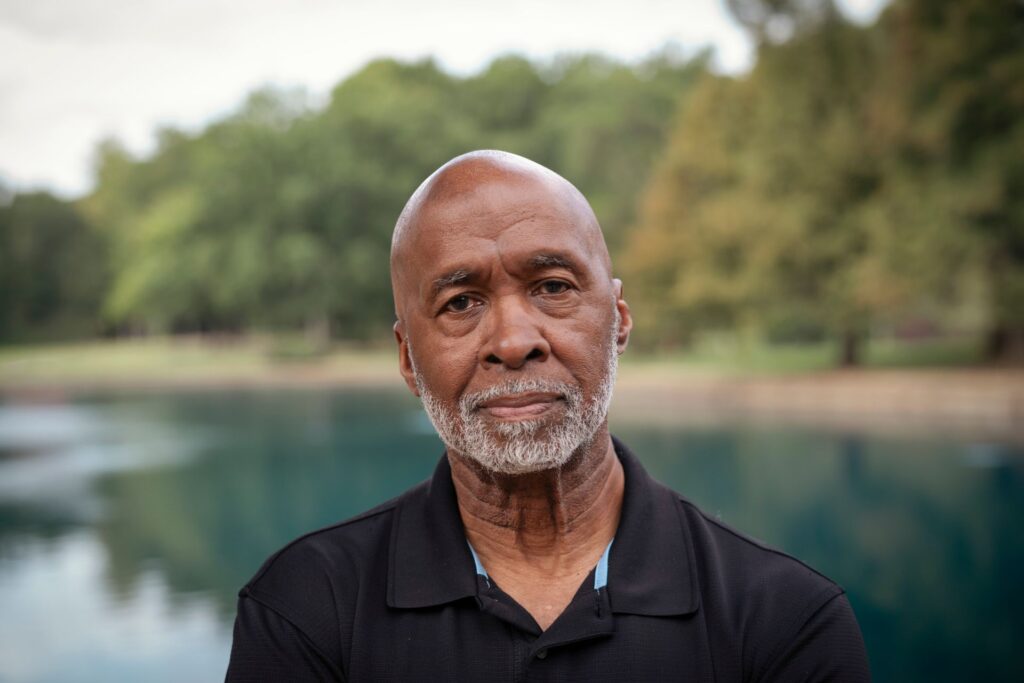
We find Glenn Proctor on a park bench. We’d arranged to meet at Freedom Park, but we didn’t specify a place, which wouldn’t be a problem except the park covers 98 acres.
“We journalists aren’t good with details,” he says, laughing, when we finally spot each other.
We sit at a nearby picnic table. He says his wife, Terry, always gives him instructions before award interviews: “Be nice.”
I’ve known Glenn since COVID times, when we were on a Zoom panel together with the Veterans Bridge Home. I tell him he’s never been not nice to me.
“Ehhh,” he says. “Ask the people that know me. … I’ve always been hardcore.”
He didn’t expect to live much past his teens, and now he’s 80. He’s a peer support specialist and a mentor to military vets, journalism vets, addiction vets. A few times a month, a family calls his home office because someone they love is in trouble. He goes to them.
And he listens. Why?
Because he was a foster kid in Philadelphia, passed among aunts and grandparents, three junior highs and two high schools.
Because he had to fistfight to survive. Because he started sneaking whiskey when he was 12 and kept on for more than two decades. “We were just badass kids. … In those environments, you don’t learn how to fight. It’s innate. It’s all part of what you do: you drink, and you fight.”
Because he chose the Marine Corps, and he did that because, “Who’s the baddest?”
Because he spent 13 months in combat in Vietnam, walking ahead of the troops with instruments that tested the air for chemicals.
Because in 1969, home from that war, he was staying with his grandfather, who took his own life when Glenn was one room over.
Because he was a writer before he was a Marine, and the next year a newspaper in West Chester, Pennsylvania, hired him with no training or clips except a three-ring binder of poems, and then gave him the inimitable Dave Barry as a deskmate.
Because he drank his way through all of that, and a paper in Iowa demoted him three times.
Because he got sober, and then was on a team that won a Pulitzer at the Akron Beacon Journal, and then became a Pulitzer judge.
Because he was an editor at the muscly Newark Star-Ledger on September 11, and led a team that worked around the clock to write a remembrance of every local victim.
Because then he ran the Richmond Times-Dispatch, “a Black man in the cradle of the Confederacy.”
Because none of those paragraphs that start with “Because” will bother him.
“I tell it all,” he says. “I’m a good coach because I’m telling it all.”
Glenn Proctor has been a Charlottean since he retired from Richmond in 2011. He subscribes to every publication in town, and offers the next generation of journalists encouragement and advice (thanks, Glenn). He’s taught courses in mental health first aid and suicide prevention. He helps with training at Veterans Bridge Home. He’s been on scene with police crisis teams. During the pandemic he was certified in grief support, and he sat with families whose loved ones died “behind the glass.” In September he had five mental health events and a signing for his seventh book. His soft, raspy, deliberate voice lowers the dread of any situation.
Because. What a concept, to face the reasons with clear eyes, to own all of it.
“I don’t play tennis. I don’t play golf. I don’t f***ing play pickleball,” he says. “If I just need to listen, that’s OK, too.”
Most of the boys he ran with are gone, to drugs or alcohol or war, but “the good brother saw something in this crazy ass to keep,” he says, and we laugh. In fact, through all the hard stuff, I realize at the end of our two-hour conversation that we’ve laughed a lot.
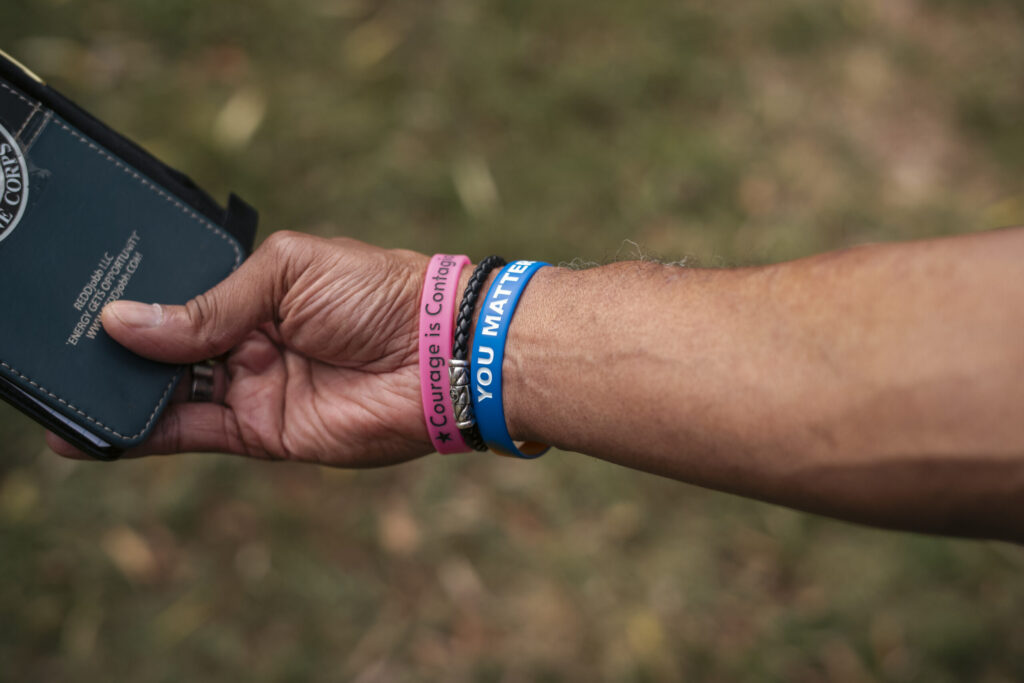
We look for a spot for a picture at the park. I ask if he wants his Marine Corps cap on or off. Off, he says, and when he slides his hands in his pockets we notice the two bracelets.
One says, “My story matters.”
The other says, “You matter.”
If you or someone you know is struggling, call or text 988. Veterans can press 1.
Forever and ever: Richard Vinroot

Ask Richard Vinroot how tall he is, and he’ll give two numbers.
“6-7,” he tells me. Then he answers the question I didn’t ask.
“She was 5-3.”
She is Judy. More than 60 years ago, she was serving punch at a girls’ dorm in Chapel Hill, and suddenly a line of college boys liked punch. Richard, a reserve on the Heels’ basketball team, isn’t sure she noticed him at all. She became a cheerleader. He stayed on the bench.
“At the end of the game, she showered, and I waited,” he says now. “She was the athlete.”
“I was the most uncool guy in the world,” he adds, which is a strange way to say “loved,” but let him try to convince us of it.
Let him tell us how this uncool boy grew up on Dellwood Avenue in the 1940s and loved a dog named Duke who was always escaping under the picket fence. About how he became an 8-year-old who begged for a pony until his parents gave in, moved out to Meadowood Lane, and Santa Claus brought him a Shetland named Sue.
His story has holes. An 8th-grader at McClintock, he beat up an 11th-grade bully on the bus, got kicked off the bus, walked three miles to school for a month, then became student body president.
He starred in basketball at East Meck in the late 1950s, and the paper covered nearly every shot. But one day he went downtown for a pickup game and saw a Black teen, Paul Grier, dunking and dazzling. Richard came home and told his dad, “Something’s wrong with our society. This kid is that good, and we’ve never heard of him.” Decades later, a man called to Richard from across Charlotte Country Club. It was Grier, who’d spent 30 years as a caddie. When he retired, he asked Richard to say a few words.
Yeah, Richard. What was Judy thinking?
Surely she wouldn’t ask that uncool Morehead Scholar to a sorority dance after that night with the punch. Surely she wouldn’t marry him while he was in law school.
No, no. Not this man who, studying for the bar exam in summer 1966, walked across campus at midnight and saw the light on in the office of Dean Smith, who’d coached UNC to five mediocre seasons to that point and hadn’t made an NCAA tournament.
“Coach, what are you doing?” Richard asked.
“Trying to save my job,” Smith told him.
Smith returned the question.
“I’m trying to pass the bar so I can get a job.”
Nerds!
Smith led UNC to a Final Four the next season, the first of 11. Richard passed the bar.
And surely Judy wouldn’t stand for what her husband did that winter, after two of his classmates were killed in Vietnam. Richard was too tall to be drafted into the Army, so one Monday he signed a waiver and volunteered. And Judy? “She understood.”

Then this uncool guy came home to Charlotte, took a job at Robinson Bradshaw, made partner, won a city council seat, became a two-term mayor, had three remarkable kids, and was the Republican nominee for governor.
Judy taught first grade, volunteered at church and with the Salvation Army, and spent 20 years teaching adults to read at CPCC.
I ask what she saw in him. “I’m honestly not sure. I guess there’s something about a guy who doesn’t know what cool is,” Richard says. “I’m delighted she saw something in me.”
He’s clearer about what he saw in her.
“I won the lottery when I married her,” he says, “and she helped me so much of my life to be better than I really am.”
We’re in his office on the 23rd floor of the Legacy Union building. He’s 85 and comes here every weekday, mostly to read the paper and be around people. He talks regularly with another Robinson Bradshaw attorney, Rob Harrington, who you may know as Charlotte’s current mayor. Richard’s a Republican; Harrington’s a Democrat. It doesn’t matter. Judy wasn’t a Republican; Richard’s still not sure if she ever voted for him.
What he can tell you is that since she died in March 2024 after a long illness, this tall man hasn’t been able to talk about her without choking up.
“I can promise you, she would be rolling her eyes that I would be tearful at all as I look back,” he says. “But I can’t help it.”
***
Thank you for reading. We hope to see a few of you at Thursday’s 8 Over 80 event at Quail Hollow.