

🎧 Listen to the audio version of this story, as read by Michael. 🎧
The son of a woman who flew across the Atlantic in the Hindenburg bursts into the building where he’s reinventing the textile industry in the Carolinas.
“Where are they?” Derick Close says, all gruff and gravelly, as if he’s looking for vandals.
He’s just looking for me and a photographer. We’d arranged to meet at Springs Creative, the 139-year-old family business he runs in Rock Hill, but Close is a few minutes late and needs to make up time. He’s flying out to Dallas tonight, then to Korea tomorrow for a few meetings, then to Shanghai to throw a retirement party for a longtime employee, then to Ho Chi Minh City in Vietnam to visit his team’s new offices there.
We can hear someone whisper, “They’re in there.”
Close pokes his head into the room where we’ve been waiting, spots us, and says, “Right where they’re supposed to be. Good,” then turns around and walks away.
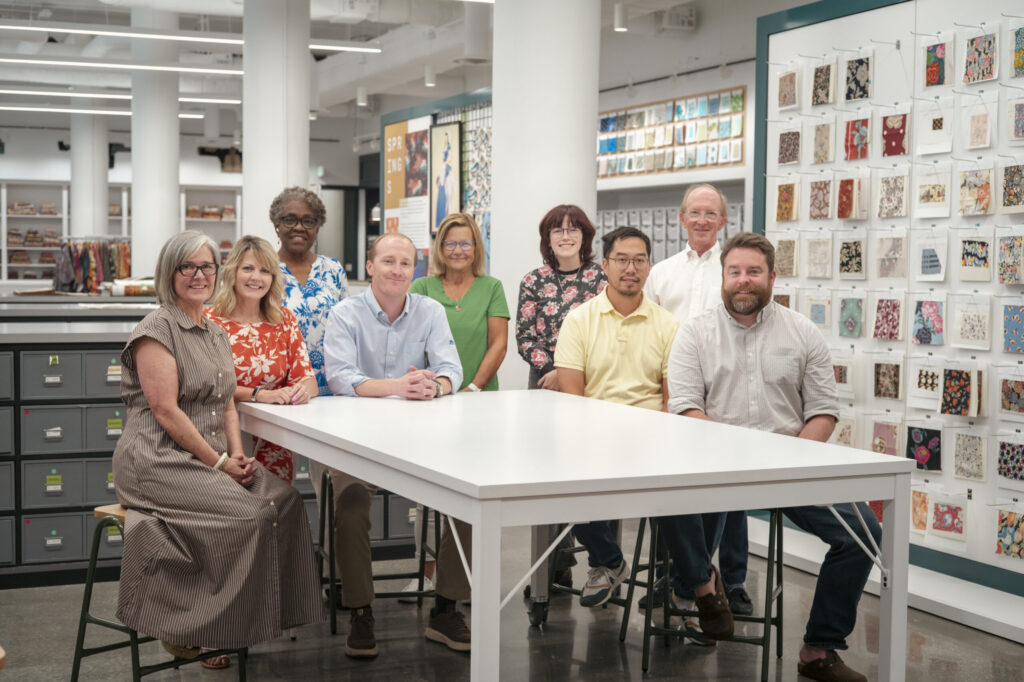
When he returns, he brings in his team. He zooms through introductions, firing off titles for staffers that may or may not be their actual titles. It’s a running gag; Kathryn Lawrie has been vice president of residential sales and merchandising for more than a year, but Close tells me she runs marketing.
“And this is Claude,” Close says, leaving me to figure out later that Claude’s his son. Claude is the company president, and eventually he’ll be CEO, making him a sixth-generation leader of this remarkable business that’s central to the remaking of this resilient South Carolina city.
We’re in the Baxter Mill Archive, which houses a private collection of 1.5 million sketches and swatches and other design pieces the Springs family has collected and preserved since 1887. It’s the largest design archive of its kind in the country, including a Renaissance-era cut velvet, 1930s Snow White prints, and 18th-century robes from Uzbekistan that were once given to soldiers as medals. “You’d look good in one of those,” Close hollers from across the room when he sees me looking at the robes. It was like this on both of my visits this summer: he’s always just kind of … around. Here and everywhere at the same time.
In the back are rolls of wallpaper that mix classic settings with characters from Disney, Marvel, and Lucasfilm. One roll is of an 1800s water terrace scene, but if you look closer you can see Spider-Man hanging upside down from a tree.
An old scene, with a timeless character, made for the future. It’s just the kind of thing a hack writer, certainly not me, would use as a metaphor for an entire city.
Rock Hill, y’all.
Charlotteans may remember it as the city where the Panthers planned to build their headquarters and practice facility along I-77, before the deal fell through, setting off months of disputes between the city and team owner David Tepper. But just four years later, Rock Hill is on the verge of turning its harshest civic humiliation into a triumph.
Last month, the city and its surrounding county, York, finally agreed on terms to land the global plasma-therapy maker Octapharma, which promises to build a $1.5 billion manufacturing campus on the former Panthers site, and to bring 1,500 jobs averaging over $100,000 annually. Economist Mark Vitner called it the “week’s biggest win” in the most recent issue of “This Week Across The South.” That news followed a June announcement that Novant Health will invest about $300 million in a new medical campus on the same site, adding about 250 jobs.
That’s upward of 1,750 jobs and $1.8 billion invested in Rock Hill, announced just this summer. People in Charlotte seem to be noticing. The Charlotte Business Journal on Friday published a story around the thesis that Octapharma could help make the I-77 corridor a major artery for the life sciences industry, connecting it with The Pearl in Charlotte. And one post on Threads last week, questioning Rock Hill’s status as a “suburb,” was met with swift corrections from Charlotte residents eager to claim the South Carolina city as part of us.
Rock Hill leaders say they’re a little of both. Yes, they’re connected to Charlotte by highways and history, and yes, they hope to help drive the region’s life-sciences economic development wave. But in conversations I’ve had with them since June, they’re eager to note that Rock Hill won’t lose its identity, not on their watch.
“We are a community that is born of grit,” Mayor John Gettys told me.
You can find that grit in places like the world-class textile archives, housed in a repurposed printing and finishing company building now called the Thread, and owned by a fast-talking, business-minded CEO whose mother was none other than the revered naturalist and conservationist Anne Springs Close. Anne basically wrote the blueprint for living a full and meaningful life in Charlotte, or anywhere else, hiking Kilimanjaro three times, carrying the Olympic torch, and preserving thousands of acres of greenspace for future generations.
***


A few blocks away from the archives, Gettys looks out the window of his second-story law offices over Main Street. It’s now lined with breweries and restaurants and shops, with a boutique hotel in the works.
When I ask him how the view’s changed, he brings up the roof.
In the mid-1970s, a new shopping mall along the interstate sucked the economic life out of Rock Hill’s downtown, just a few miles away. So leaders put a roof over Main Street, turning the heart of the city into a climate-controlled shopping arcade. It didn’t work. The roof came off in 1993. The city held a “Raze the Roof” party.
“It was the right decision when we put it on,” Gettys says of the roof, “and it was the right decision when we took it off.”
That’s how leaders talk in Rock Hill. Make a decision, live with it, and move on to the next one.
The city, which will celebrate its 175th anniversary next year, was founded when two landowning families agreed to let the railroad come through their properties along a rocky ridge.
“When you’re born on top of rock, you got to work real hard to get something in the ground,” says Gettys, who was raised here and whose great-uncle was a U.S. Congressman. “And that’s just really been our story forever.”
Few years tested that resolve more than 2022. When the Panthers’ headquarters deal collapsed, the ensuing legal drama became a bitter public debate over who was more at fault. The company Tepper created to run the project filed for bankruptcy, and eventually reached about $100 million in settlements with Rock Hill, York County, and contractors. Rock Hill bought the property, which sprawls along Palmetto Parkway and Mt. Gallant Road, out of bankruptcy for about $26 million, Gettys says.
“When we had individuals and others trying to lay blame at the city of Rock Hill, when you had talk radio and other publications in Charlotte picking the hometown person versus this little community that obviously was ‘in over their head’ — I’ll put that in quotation marks — the people of Rock Hill were very encouraging,” Gettys says now.
The structures on the site came down. Access roads were gated with no trespassing signs. Residents had all sorts of ideas for it. Some circulated a petition arguing that the site would be perfect for a — you guessed it — Buc-ee’s.
Instead, Gettys and other officials did the hardest thing a wounded city can do. They waited. They wanted good-paying jobs in a forward-thinking industry.
South Carolina commerce secretary Harry Lightsey mentioned to Gettys that he’d seen studies showing life sciences could become a major industry in the region. A 2023 study listed biopharmaceuticals as the top possible industry for the site, CBJ noted.
North Carolina was emerging as a national leader. Life-sciences is now the second-largest sector in the state, with about $82 billion in economic impact, officials said at the N.C. Biotech Summit in Charlotte last year. Eighteen companies announced expansions or relocations to North Carolina in 2025 alone, many in the Charlotte region.
Gettys and Derick Close, who lives in Charlotte, began tapping on the window at the state line, working with the Charlotte Regional Business Alliance to get the word out that future investments were welcome here.
Meanwhile, the city did less-sexy work of beefing up water and sewer lines. It also worked on that old cliche about economic development being a team sport. City leaders brought York Technical College and Winthrop University into the conversations as part of the sales package. York Tech recently purchased the old Business Technology Center, giving it a home for workforce training. And Winthrop is adding an engineering degree in advanced manufacturing. The city plans to put public money into each institution, to strengthen the partnerships. “Our job now is to make sure these jobs go to our people,” Gettys says.
Still, despite all that work and collaboration, the Octapharma deal almost fell through. In late June, when Gettys expected to be celebrating, York County’s council wanted to adjust the economic package to include more money for schools. The city and county spent much of July in testy and very-public negotiations, before agreeing to the terms near the end of the month. When I visited with Gettys last week, he was lighter than he’d been in our earlier correspondence in July. He said he didn’t want to dwell on that dispute, saying only that it was “challenging.”
Make a decision, live with it, and move on to the next one.
Except for one thing.
“Do you still watch Panthers games?” I ask Gettys.
“No,” he says. “Gave my PSLs away.”
It highlights the larger friction point I’d come to ask him about — how Rock Hill stays Rock Hill, while also being part of Charlotte.
To answer that, he quotes his predecessor, former mayor Doug Echols.
“We have to think of Charlotte as a campfire,” Gettys says. “You want to be close enough to stay warm, but you don’t want to get burned.”
***
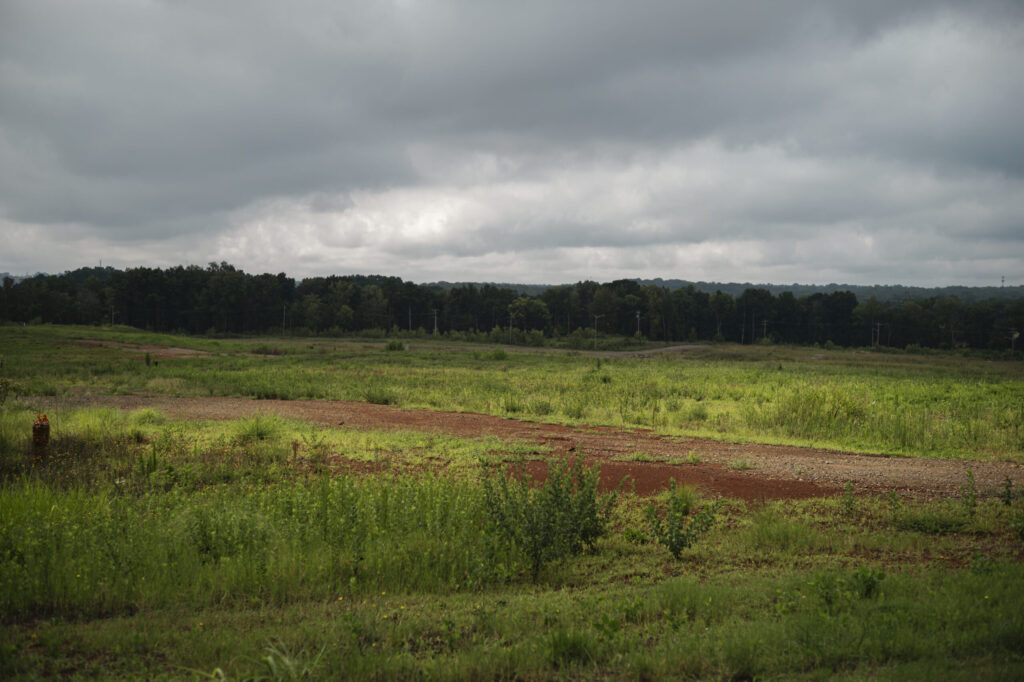
The former Panthers site is now just one large rolling field, green and hopeful as a breath waiting to be exhaled.
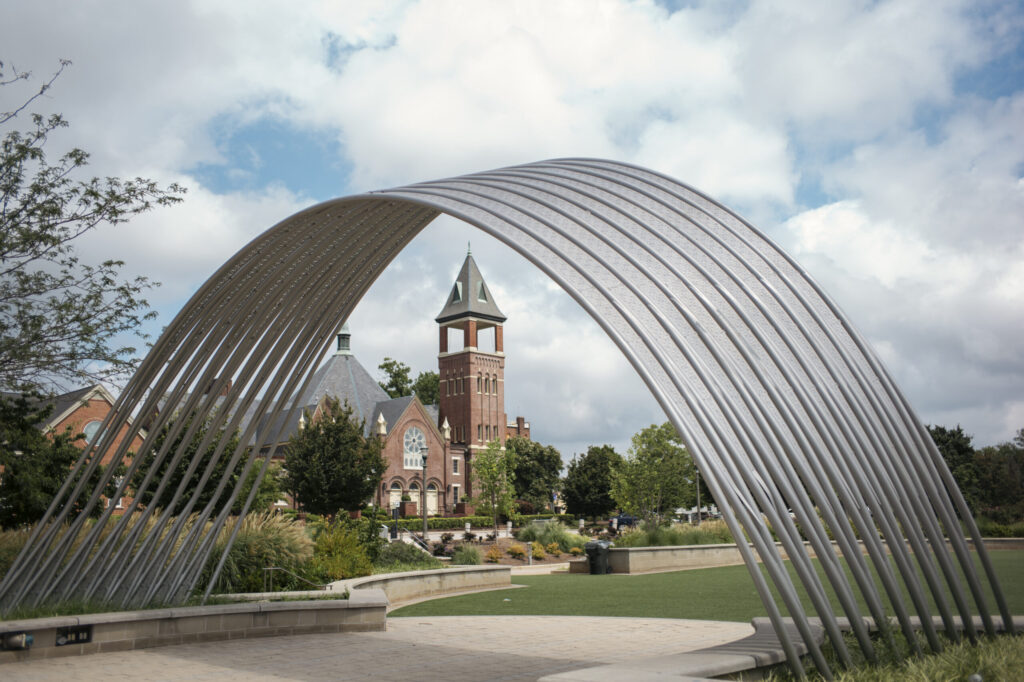
Elsewhere, elements of Rock Hill’s future have already been constructed. Downtown’s filled with places to eat and drink. Some have Charlotte roots — Amelie’s is there, and Old Town Kitchen and Cocktails is run by the restaurant group that owns Goodyear House in NoDa — while others could only have been born here. Kounter, for instance, honors the history of the Friendship Nine, a group of Black students who staged a 1961 sit-in at the former McCrory’s Five and Dime on the same site.
The Lantern Hotel is scheduled to open next spring inside the 75-year-old former Andrew Jackson Hotel. Jim Shore, the artist whose folk-carved Disney figurines sell worldwide, is building a storefront and museum a block from Gettys’ law office.
Rock Hill, with about 78,000 residents, is the fourth-largest city in the Charlotte region. It has challenges like any other. Gettys has devoted much of his eight years as mayor to reducing the poverty rate, dropping it from 18.5% when he took office to about 13% now. Of course that comes with the tension over displacement and affordable housing, but Gettys says he’s focusing on creating “jobs that make housing affordable.”
A similar tension is at the center of the I-77 toll lanes debate in Charlotte, which Rock Hill is watching closely from afar. A few Rock Hill city council members firmly oppose tolls, but others see the lanes as key to ensuring reliable travel times for goods and services from the airport and downtown Charlotte. Gettys says he can see both sides.
“It’s like everything in politics right now: You just sit back and wait until those that have the ability to make decisions can bring to the table more value than what they initially brought,” he says. “Money is not value; money is an element to get to value.”
One thing that’s been particularly valuable for Rock Hill is sports. The city’s long been known as a capital for high school football, but in the past decade it’s become home of cycling, cornhole, and disc golf. When ESPN comes to town for the cornhole world championships each year, the pros climb the parking decks between matches and take bets dropping bags from the top deck onto boards below. “There’s a whole economy going on,” Gettys laughs.
Gettys is buying into it. At 58 with three grown sons, he and his wife just put a contract on a condo on Main Street, just to be closer to what’s next.
And somehow, that “what’s next” includes textiles.
***
People have been writing obituaries for textiles in North and South Carolina for decades, to the point where it was hard to imagine them ever being reborn.
Global markets are a funny thing, though.
Springs grew to 24,000 employees across 42 plants in its heyday, before the industry went offshore in the 1990s. Springs sold to a Brazilian conglomerate in 2007. But after that company struggled to make a profit, Derick Close tells me he bought back the South Carolina plants “for 10 cents on the dollar,” and started over.
About five years ago, Close says, the industry’s math began to flip, as overseas production became more expensive. Technology’s only accelerated that shift since.
“This has nothing to do with Trump. The prices started to inch up, and then you had COVID, and then you had container prices go from $3,000 to $23,000,” Close says. “Everybody could see all of a sudden doing business overseas ain’t as easy as it once was. When prices were 50 cents an hour in China, and everything was wide open, an idiot could do it.”
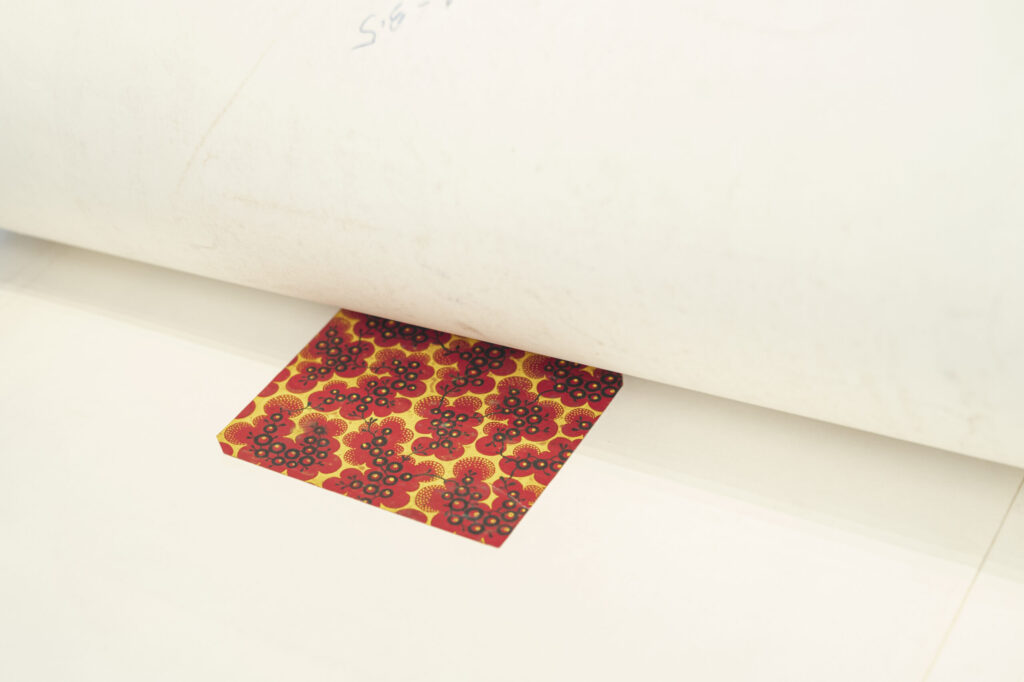
Springs’ supply chain has increasingly become local. Milliken spins polyester in Spartanburg, S.C., for less than countries overseas can spin it. That polyester then goes to a mill in Fort Lawn, which Springs bought back from the Brazilian company. It’s not a mill in the traditional sense anymore; it’s mostly a digital printing lab. The creative hub in downtown Rock Hill creates the product design, sends the files to the printer, and suddenly this old company has moved into an operation where it can get large quantities of product out the door within a day. Springs maintains contracts with Walmart and other big stores, and on the day we visited last week, its creative team was at L.L. Bean’s headquarters working on a project.
The higher-end stuff is where the archives come in. Springs has long had licenses to use Disney products for crafts and quilting fabric by the yard. But the license was strict, in that each design had to follow Disney’s style guides. Last year, Springs team members flew to Disney’s headquarters to pitch them on the idea of redrawing the characters by hand, and blending them in with some of Springs’ archived design patterns and scenes. Disney said yes.
Springs is the only company in the country, at least in the fabric and wallpaper industry, that has such leeway with Disney’s characters.
The result is an elevated line of wallpapers and fabrics, with Spider-Man in the water terrace, or Star Wars creatures hiding in a 19th-century animal print, that Springs is marketing to higher end chains like Pottery Barn. Lucasfilm liked the Star Wars print so much, it wanted it for the walls of its own entryway.
“They’ve basically taken the handcuffs off,” says Kathryn Lawrie, the sales executive Close still calls the marketing lead.
Lawrie, in some ways, symbolizes the economy Rock Hill is trying to build in other industries. She came to Winthrop as an undergraduate two decades ago from Columbia. She says it was “a suitcase college. I packed up and left every weekend because there wasn’t a restaurant, a bar. There was nothing to do.”
Now, she says, “I couldn’t think of a better place to have a young family.”
She spends her days working alongside the next generation of design students from Winthrop, which has classrooms and space next door to Springs. The students just walk down and use the archives for creative inspiration. Springs has hired several Winthrop grads right out of school.
Before I left last week — long after Derick Close tornadoed off to wherever he needed to be next — Kathryn told me something that stuck. She waved her arm around the archive, the only one like it in the country, and talked about how a single 100-year-old design can serve dozens of clients over time.
“What design is really new anymore?” she said. “It’s all inspired by something. There’s always a root to every story.”
It’s just the kind of thing a hack writer, certainly not me, would use as a metaphor for an entire city.
Go see Rock Hill for yourself
Baxter Mill Archive: The archive is trade-focused, but tours are available by appointment through baxtermillarchive.com, where you can also see the before-and-after sliders of original archive pieces reimagined with Disney, Star Wars, and Marvel characters — including that Spider-Man wallpaper. You can also email curator Kirsten Simpson at kristen.simpson@baxtermillarchive.com to inquire.
Eat downtown: Kounter, in the old McCrory’s where the Friendship Nine staged a sit-in; The Flipside Restaurant from renowned local restaurateurs Jon and Amy Fortes, Old Town Kitchen & Cocktails from the Goodyear House team; Amelie’s on Main Street. The mayor recommends Elk Avenue Tavern and Bear Walrus. And I was partial to the Knowledge Perk Coffee Shop on my visits.
Other things: The Main Street Children’s Museum is built around the whimsical art of Rock Hill’s own Vernon Grant, the illustrator who created the Rice Krispies characters. The Anne Springs Close Greenway, which is 15 minutes up the road in Fort Mill, offers hiking, kayaking, and a window into the Close family’s legacy.
Coming soon: The Lantern Hotel is scheduled to open next spring in the 75-year-old Andrew Jackson Hotel, and will include a restaurant from Charlotte restaurateur Jim Noble; Jim Shore’s museum and storefront is scheduled to open later this year or early next, a block off Main; and Christmasville returns December 3-6.