
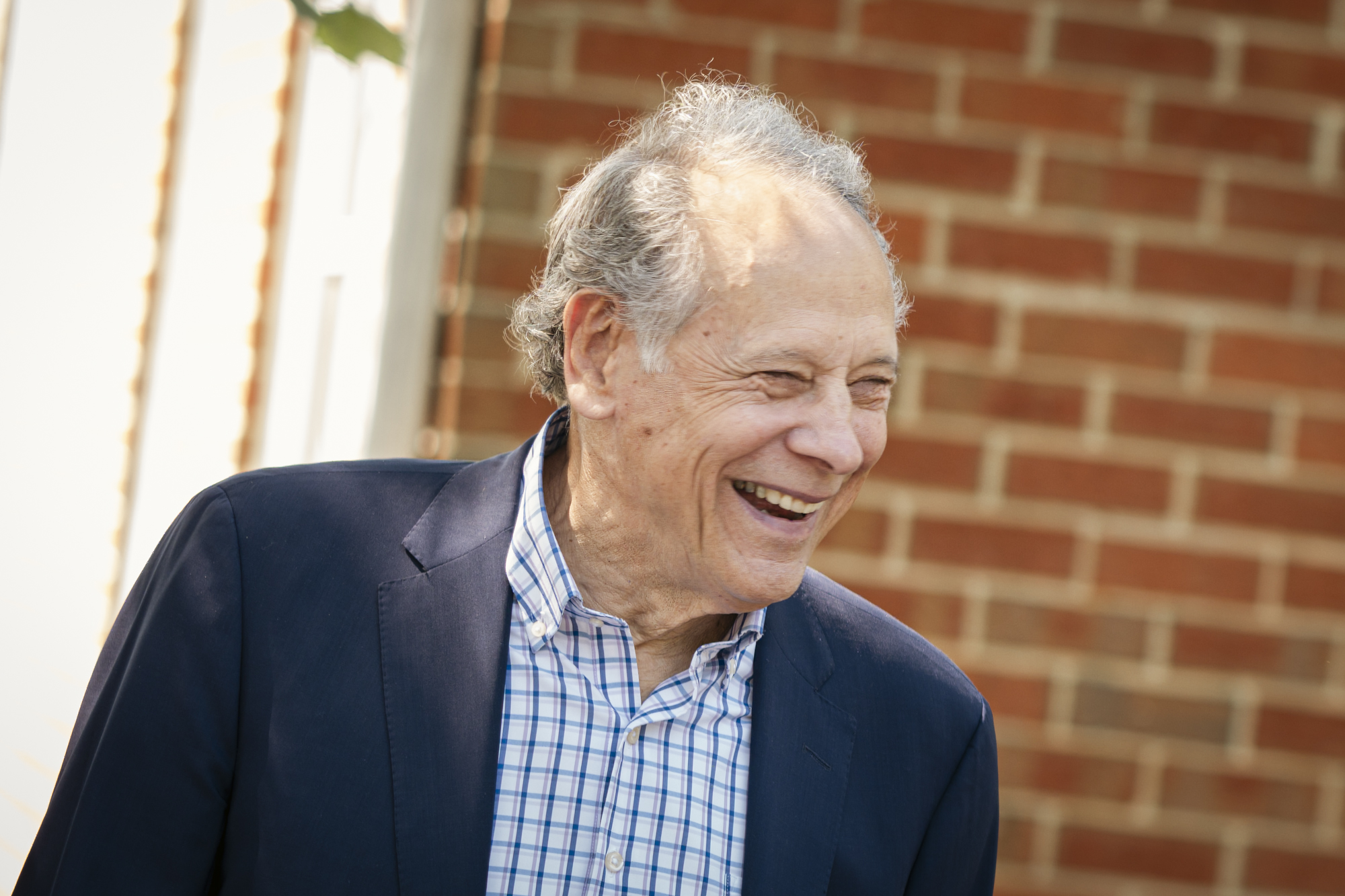
The day after the 2004 election, Nelson Schwab packed a ham sandwich.
His closest friend, Erskine Bowles, had lost a hard-fought race for U.S. Senate by nearly five percentage points, his second loss in a Senate race in two years. Schwab walked into the campaign offices on East Boulevard. He saw papers scattered everywhere and found Bowles alone, then handed over the sandwich.
“I just tried to be there and say, ‘There’s life beyond this,’” Schwab recalled to me on September 14, in an interview in his SouthPark condo with Bowles sitting next to him. “But it’s hard.”
I could almost hear those words — “There’s life beyond this. But it’s hard.” — echoing throughout Charlotte on Friday, as news began to spread that Schwab had died at 81 years old. He leaves behind a legacy as one of our city’s warmest and most sincere business and civic leaders.
Six years ago, Schwab and Bowles created the Housing Impact Fund to purchase old and deteriorating apartment complexes, fix them up, and keep the rent low for Charlotte’s most vulnerable people. They teamed up with Mark Ethridge of Ascent Housing, who had completed one naturally occurring affordable housing project, but wasn’t sure he could continue with it because he didn’t have the capital. Schwab and Bowles raised $225 million, and Ascent and the Housing Impact Fund have now saved and fixed about 2,000 units. And because the properties are deed-restricted, those units will remain affordable for 20 years.
Schwab and Bowles, it should be noted, did all the Housing Impact Fund work for no pay.
“When Nelson describes what we’ve done with Housing Impact Fund, he always cries. But that’s how much it means to him,” Bowles said in September. “It’d been wrong to pay us to do it because we’ve gotten so much out of it.”
Schwab grew up in Cincinnati, where his great-grandfather was the mayor. He went to Chapel Hill, not knowing a soul there, in 1963. He befriended Bowles, a fellow freshman, early that fall. Schwab earned the nickname “Friday” for his love of weekends.
“The social side of the school got my attention right away,” Schwab said two months ago. “I had to kind of work that equilibrium between schoolwork and partying. Took me a little while, but I got it in the end.”
Schwab remembered feeling a “sense of loss” on graduation day, worried about separating from the friends he’d made. But for the remainder of his life he kept close ties with about a dozen UNC classmates, including Bowles, the former Clinton White House chief of staff who’s essentially a member of the Schwab family.
Schwab graduated with an English degree and had been accepted to business school, but decided he wasn’t ready. “Drove my father crazy,” he told me. He moved home to Cincinnati and spent three years working at Fifth Third Bank, then went to the Wharton School at Penn for his MBA.
Cincinnati-based Taft Broadcasting recruited him home to run its real-estate holdings, including its amusement parks. He put together a group that bought out Taft’s amusement park division in the early 1980s, then built the roller-coaster company into a powerhouse in the theme park industry, with the name Kings Entertainment, which included Carowinds. He moved Kings Entertainment’s headquarters to Charlotte in 1985.
His old friend, Bowles, had gotten involved in juvenile diabetes, after his oldest son was diagnosed. Schwab helped design a walk to raise money for the cause. “We sweetened the pot,” Schwab said. “Anybody who finished two miles or whatever got a pass to Carowinds.”
In 1992, Schwab was CEO when Kings Entertainment sold to movie giant Paramount for $400 million. He’d leave the company two years later, and the employees from Kings gave him a life-sized carousel horse as a retirement gift.
In 1996, he and Bowles formed an investment firm designed to buy midsized companies in the Southeast, and they named it Carousel Capital.
“Guys like me were a dime a dozen,” Bowles said. “Nelson was one of the best leaders I’d ever met.”
Longtime Charlotteans will remember that in 2001 and 2002, Schwab fought like hell to keep the original Hornets in the city. He led an effort to round up potential owners to buy the team from owners George Shinn and Ray Wooldridge, who’d become widely unpopular with fans. But they declined and moved the team to New Orleans. Schwab continued his effort, though, and helped ensure the NBA soon gave Charlotte an expansion team, the Bobcats, under new ownership.
He served as chairman of the board for the Charlotte Chamber, Blumenthal Performing Arts, and his alma mater. He was chair of UNC’s trustees when a separate board hired Bowles to be the UNC system president.
Schwab and Bowles wore matching UNC belts to our meeting on September 14. They finished each other’s sentences at times, and acted like Abbott and Costello at others. Bowles said that at one point, they thought about going into the pillow business together, and Schwab grumbled that the idea was “alcohol influenced.”
When we talked that day, Schwab had just returned from a trip to New York, where he was receiving regular medical treatments. The day after our interview, he flew to Wyoming to spend time with his daughter. He was back in New York for more treatments in early October, when he fainted and suffered a fall that kept him from attending Southminster’s 8 Over 80 awards ceremony. Bowles told the crowd that Schwab had been receiving treatments for T-cell lymphoma, but then joked, “I promise you, I think Nelson did this to me on purpose.”
“You will never hear this guy complain about anything. He’s going to make the best of it,” Bowles told me, sitting next to Schwab in September. “He is the only person in my whole life I’ve known who puts you first in everything he does. … I know when I first started working with him, I had come [with the mindset that] you got to win. Nelson taught me it was really important for both sides to win, and he was right.”
Schwab was a family man first, his friends say. He leaves behind his wife, Jane, and four children and four grandchildren. He was such a good gift-giver, according to his obituary, that one of his daughters had to ask him to “consider pulling back at Christmas, just a little bit, as he had come to eclipse Santa Claus in the eyes of his grandchildren.”
In Schwab’s final weeks, Mark Ethridge, the Ascent Housing co-founder who worked hand in glove with Schwab for six years, put together a 12-page document called “Letters to Nelson.” Many of the notes are from people who live in complexes that have been saved by the Housing Impact Fund. Roof Above’s Liz Clasen-Kelly also wrote a letter, as did Ethridge.
Schwab’s children — who live in Wyoming, Montana, Connecticut, and Atlanta — flew to Charlotte a couple of weeks ago, when it became clear Schwab was near the end. Along with Bowles, they held a “pre-Thanksgiving” on November 6, a week before he died.
“After a lifetime of thinking of others first and always being the friend who was first to call or the one to really show up in times of need,” Ethridge wrote in a text message earlier today, “it was fitting that his final chapter was an opportunity for everyone in his orbit to have a chance to try and give those same gifts of friendship back to him in return.”
At that pre-Thanksgiving gathering, Ethridge says, Schwab listened as his family read “Letters to Nelson” aloud.
Read Nelson Schwab’s obituary, and UNC-Chapel Hill’s remembrance.