
🎧 Listen to the audio version of this story, as read by Michael.🎧
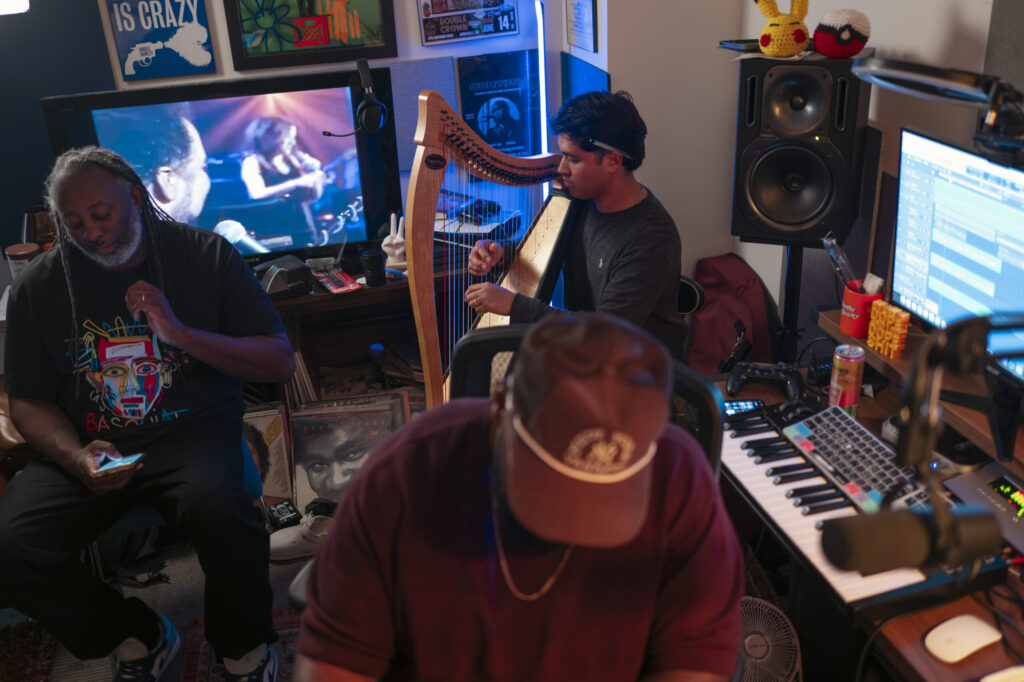
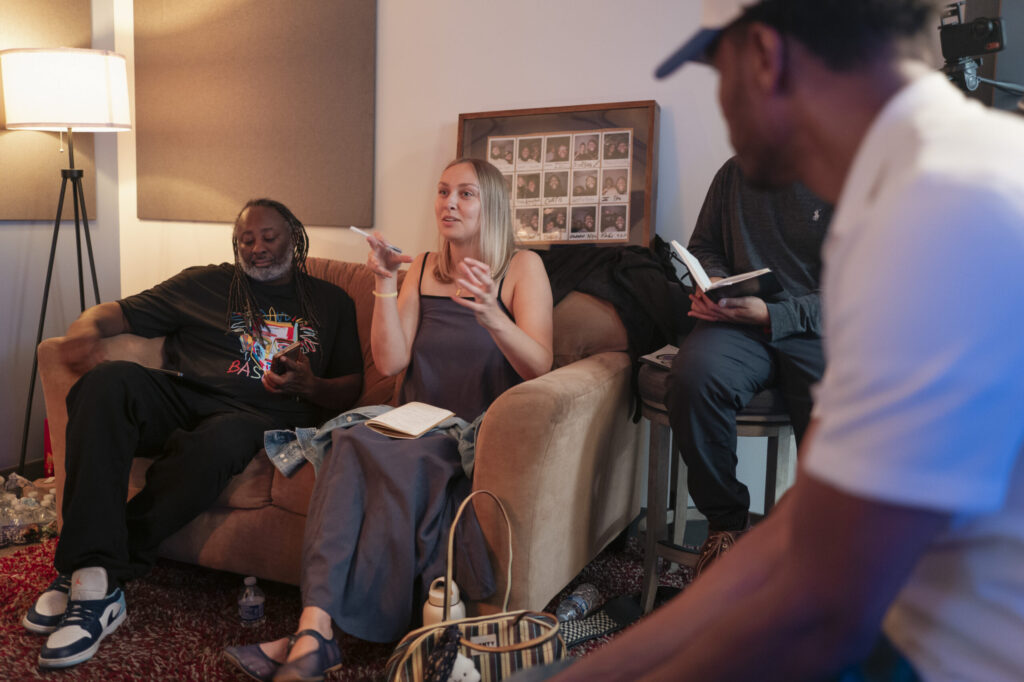
The poet’s dreaming up metaphors. The songwriter’s scribbling in a notebook. The harpist is making rain sounds on his strings. The producer is tapping the keyboard and capturing it all. They’re creating a song for Charlotte, tentatively called “Together We Build.”
The sax player’s here, too, but he forgot his sax today, so he’s bringing the laughs.
“It gives me Free Willy feelings,” Harvey Cummings says after hearing the initial hook. Then he starts clapping and humming Michael Jackson’s “Will You Be There,” the famous track from the 1993 film. The artists crack up, but Harvey insists it’s not a joke. He means it as a compliment.
“When I say that, it’s like hopeful,” he says. “It’s a core memory song. You can see that whale jumping.”
We’re in a windowless basement studio in uptown, beneath the busy city streets on a blistering mid-July afternoon, all because one man asked us to be here.
You want to take a risk with me? Dae-Lee Arrington had said to everyone. The people in the studio, some of our city’s most accomplished local artists, said yes before knowing what he wanted from them. No questions asked.
They just knew that when Dae-Lee has a vision, he tends to turn it into something.
This might be his dreamiest idea yet. He’s mounting a public campaign to build relationships and trust between people who run Charlotte, from politicians to C-suiters to developers to activists to nonprofit leaders — and by extension foster trust between the institutions they run and the general public. It’s a worthy, if wishful, mission. Gallup released its annual “trust in institutions” report this month, which shows confidence at record or near-record lows in nearly every category.
Dae-Lee, though, has a distinct background and set of skills. He’s a Grammy-nominated former music producer who’s spent the past five years teaching leadership across differences with his Bridge Builder business. The day we met in the studio, he posted a vision essay for this new project. In it, he argues that the city’s recent quarrels stem from leaders who don’t know and trust each other, and says that’s a natural byproduct of the city’s rapid growth. At the end, he included 30 testimonials from notable leaders across multiple industries, and invited others to add their voice.
“We’re leaving value on the table that our city desperately needs,” Dae-Lee told me over breakfast one morning. “If we want our growth to be different, to be healthier, the same ways of going about it are not going to work. … I don’t believe I’m alone in thinking these things. I’m just creating opportunities for others to say yes.”
Dae-Lee knows that sounds vague. And he knows Charlotte’s launched plenty of well-intentioned efforts that ended as conversations, and he’ll tell you his could join them. So he wanted to create an example, a microcosm, through music. He leaned back to his recording days — his daughters joke that he’s a “retired rapper” — and tapped into his old connections to curate a cast of eight artists with different specialties.
In one chair on the first day of recording is Bluz Rogers, an Emmy-winning spoken word poet who’s coached national slam champions. In another is Emily Sage, a multidisciplinary artist whose songs have millions of Spotify plays and who’s now building art from whispers. There’s harpist Joseph Quisol, who earned a master’s degree from Harvard and has roots in the Philippines and Puerto Rico. Producer and keyboardist Curt Keyz, who built the studio we’re in, describes his style as Marvin Gaye meets Frank Ocean with Southern charm. And of course there’s Harvey Cummings, the celebrated jazz artist who once was asked to go on tour with none other than Prince.
Joining later in the week will be percussionist Claudio Ortiz and keyboard player Liza Ortiz, a well-known brother-and-sister combination who’ve been pushing Latin sounds in Charlotte for years. Also part of the collaboration will be soul singer-songwriter Ahji, who was a background vocalist for Fantasia.
At the beginning of the first session, Dae-Lee tossed out a word he’s been thinking about: “Ecotones.”
They’re places where multiple ecosystems meet, like estuaries, to create life that’s only possible with the combination. Dae-Lee grew up in Norfolk, Virginia, which happens to be near the mouth of one of the country’s largest ecotones, the Chesapeake Bay, where a mix of saltwater and freshwater produces an abundance of wildlife. Point being, Dae-Lee likes the idea that certain things can only exist in places where multiple worlds come together.
“The fact that I can reach out to y’all and say, ‘Hey, take a risk with me,’ and y’all are like, ‘OK,’ without fully knowing what the risk is, I think it’s a testament to the relationships and trust that exists,” Dae-Lee tells the group.
“Imagine if that could happen in the government center. In our corporations. Our nonprofits. Our schools.”
***
It seems pretty cloud-bound, until you consider what’s at stake.
We’ve been writing for several months about how Charlotte’s stumbling through an era of leadership turnover. The mayor just retired early, and several prominent institutions — Foundation For the Carolinas, CMPD, Charlotte Ballet, Crisis Assistance Ministry, Habitat for Humanity, The Charlotte Observer, Discovery Place, OurBRIDGE for Kids — have had or are facing leadership transitions.
Meanwhile, we’re encountering critical issues that will shape the future for generations. When city council returns from its July recess next month, they’ll be pressing on whether to revisit the I-77 toll lanes proposal, how to address data centers, and what to do about a new state law that could end their 30-year initiative of requiring minority- and women-owned businesses be included in government contracts. Decisions that all have wide-reaching implications on who benefits from Charlotte’s growth, and who doesn’t.
Trust is hard to hold because reasons to be cynical are so readily available, and easily understood and shareable. When Axios revealed last week that one of the potential I-77 developers had been pitching the project to investors as lucrative in May, certainly toll lanes opponents saw reason to doubt that the bidding process would be competitive. When the YMCA announced it would sell the Morrison branch to a church, it was only natural for people to protest and question why.
Complicating matters on council, several current members are considering runs for mayor in 2027, and will want to raise their individual profiles. Hard to make music if a bunch of people want to sing solo.
National political conversations, meanwhile, are emphasizing wealth gaps. Locally, that’s translated into a simplistic but alluring storyline about “the business community” vs. “the people.” I’ve had countless conversations about this over the past few months. I know people on both “sides.” And few people could articulate why the framing bothers me better than Dae-Lee did.
“Because you have all these relationships,” he told me one morning last month. He’s trying to foster more of those with his initiative. “When you move beyond your silo to another, yes, there’s friction. There’s a lack of understanding. There’s difficulty in that transition, but there’s also opportunity to understand this new silo and the people who exist in it, rather than I assume or I heard and I know.”
Some do this already. County Commission chair Mark Jerrell is an example. He said in a recent R&D in the NC podcast that he’s fortunate to go into rooms with “the grasstops and the grassroots” as he puts it. He tries to carry one side’s perspectives into the other side’s rooms. At the grasstops, he says he’s seen a disconnect, “not because they’re bad people, not because they don’t care about community. Their lives are just different.” And at the grassroots, he says he tells folks, “there’s opportunities to stop judging people. Because I know people want to help when they can. Being that bridge is something I love.”
That’s the space Dae-Lee operates in, too. He’s worked with everyone from executives to entry-levelers, and he has three kids — two teenagers and a 4-year-old. The more we’ve talked, the more I’ve come to believe he’s not necessarily trying to bridge gaps between different wealth classes, or across races, or political parties.
He’s trying to build a path for people to move beyond seeing someone’s identity, to seeing their character.
***
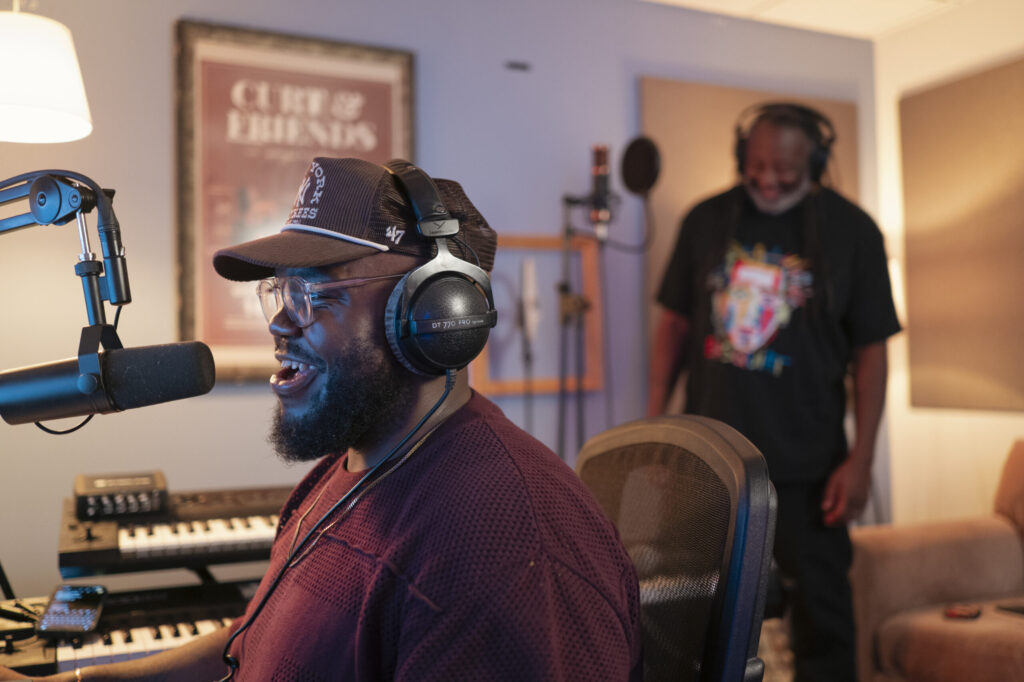
The first studio session opens with Curt Keyz (his real name is Curtis Hayes) playing a draft of the song’s hook, which he’d created the previous night, after digesting Dae-Lee’s vision. Then Curt turns to the room — all these artists with their own special talents — and says he wants to see where they take it.
“I’m just gonna get the drums going, and we can just vibe,” Keyz says. “My manifesto is nothing’s whack. Things are just misplaced.”
Bluz Rogers, the poet, is first to speak up. He’d entered the room “a blank canvas,” he says, and within 15 minutes he’d drafted a 166-word poem that set the tone for the rest of the project. It included the lines:
When the trusses of trust are broken,
when the commute to heal community is taking too long,
let’s build a bridge.
A brave one.
An audacious construction,
designed with love,
engineered with hope,
that carries us over the currents of troubled waters.
It was refreshing and surprising to see artists throw imperfect and unedited works out into the air, and to see them be received without judgment.
Emily Sage shares what she has in her notebook, then leaves the room to write. When she returns, she and Curt lock into a conversation about how the song progresses. Curt says the song’s hook, about a completed bridge, is the “solution” to the challenge Dae-Lee has posed to them. Emily agrees that the lyrics should build toward that, to “leave us a path for having the chorus be like the resolution.”
Later, Emily tells us about her new “whisper project.” She’s working with new mothers, asking them to whisper their wishes for their babies into a mic. She’s putting the recordings together, individual whispers talking all over each other. Curt loves the idea. They decide that before we leave, each of us in the room must whisper our hopes for our city into the mic. One by one, we all do so (photographer Logan Cyrus and I even contributed), each of us barely louder than breath. When you hear the finished song, listen closely to what sounds like ambient noise under the music. You might mistake it for static. But that’s us.
“It’s like the sweetest version of yourself,” Curt says.
The session ends with Emily singing the hook by herself with Curt recording. I’ve tried to find a way to describe Emily’s voice to you in soundless text, and the best I can come up with is this: You know how it feels to sway in a hammock on a nice day? She sounds like whatever that feeling is.
Let’s build a bridge, she sings to close the recording session. Let’s build it strong.
***
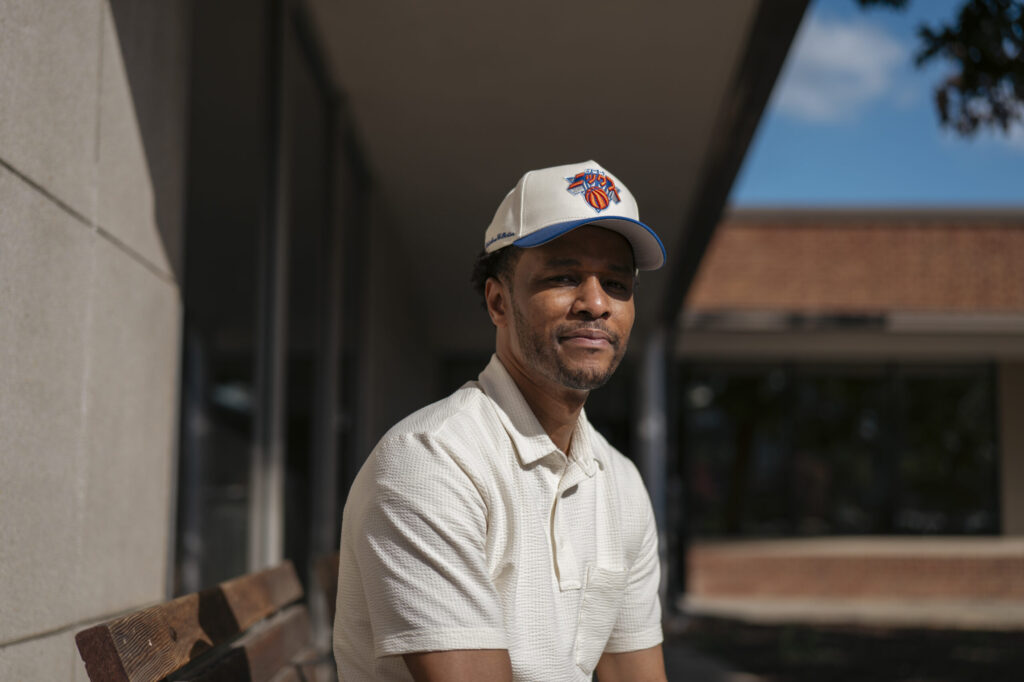
David “Dae-Lee” Arrington calls his life story a journey from “the corner to the cul-de-sac.”
He was a Black kid from a Black neighborhood in Norfolk. He remembers piling into a station wagon with his family for church on Sundays. He had a decent but strained relationship with his father.
During his senior year at Granby High in 2000, he led the basketball team to a state championship. His father came up to him after the game and said he was proud of him.
“That’s one of the only times I remember him telling me that,” Arrington told me several years ago. “The fact that he would choose that moment to say he was proud of me … because of basketball?”
Dae-Lee stopped playing the game competitively after that. His uncle lived in Ballantyne and had a car-detailing business. Dae-Lee enrolled in the Art Institute of Charlotte and moved from Norfolk (the corner) to south Charlotte (the cul-de-sac).
Soon he got his own place with two roommates, both white. They became his closest friends. On weekends, one of them asked Dae-Lee if he wanted to take Jet Skis out on a lake with his family. Dae-Lee told the guy that wasn’t normal to him. His roommates, in turn, saw in Dae-Lee traits that weren’t normal to them. He wolfed down food, and when they asked him why, he said because his siblings always ate new boxes of cereal before he could get to them.
He turned to church and art. Many Sundays he was the only Black person on the church stage, and the organizations celebrated the fact that he brought diversity. That’s how, he says, he learned the difference between being welcomed and being valued. He became deeply engaged with Charlotte’s arts community, meeting funders and wealthy philanthropists along the way. He kept building those relationships, kept being curious. A few years ago, he and I were planning to have coffee, and he insisted on coming to my house instead of a coffee shop. He tells the musicians that’s the goal: “Not a water cooler relationship. A ‘I can come over to your crib, kick my feet up on your couch’ relationship.”
The 2016 police killing of Keith Lamont Scott, and the 2020 George Floyd protests, forced organizations around town to consider diversity in the workplace. Dae-Lee worried that it would lead to companies “checking boxes.” So he cooked up a Bridge Builder consulting practice, and top companies asked him to come in and talk about the difference between “welcomed” and “valued.”
In 2022, he launched a YouTube show called Bridge Builder Conversations, in which he interviewed leaders like former Bank of America CEO Hugh McColl, former Mayor Harvey Gantt, and others, exploring who they were beyond the Wikipedia highlights. He parlayed that into a leadership-development program. Each cohort has a dozen or so participants, and Dae-Lee curates the groups based on what he knows about the individuals, so that he can have a range of backgrounds and opinions.
His larger hope is that the participants take what they’ve learned about themselves, and about others, back to their leadership roles at work.
Dae-Lee’s favorite proof of what’s possible is the relationship built between nonprofit veteran Colin Pinckney and Carolina Ko, a Bank of America executive who was new to the city when she joined the first cohort. They got to know each other outside of meetings, and Colin eventually invited Carolina onto his board at the Harvest Center. Months later, Carolina introduced Colin to Bank of America Charlotte President Kieth Cockrell. Cockrell wound up participating in Charlotte Ballet’s “Dancing with the Stars of Charlotte,” raising nearly $100,000 for the Harvest Center.
“Ain’t no way that Colin’s going to walk up to Carolina and say, ‘Hey, you work at Bank of America, right? Can you get … Kieth Cockrell to support our work?’” Dae-Lee told me. “That ain’t gonna happen. … It’s an illustration of people taking the time and intentionally knowing one another.”
I attended a “graduation” ceremony for a Bridge Builder cohort last year, and the participants ranged from media leaders to public employees to nonprofits. They closed the session with a song, Jack Garratt’s “Surprise Yourself.”
***
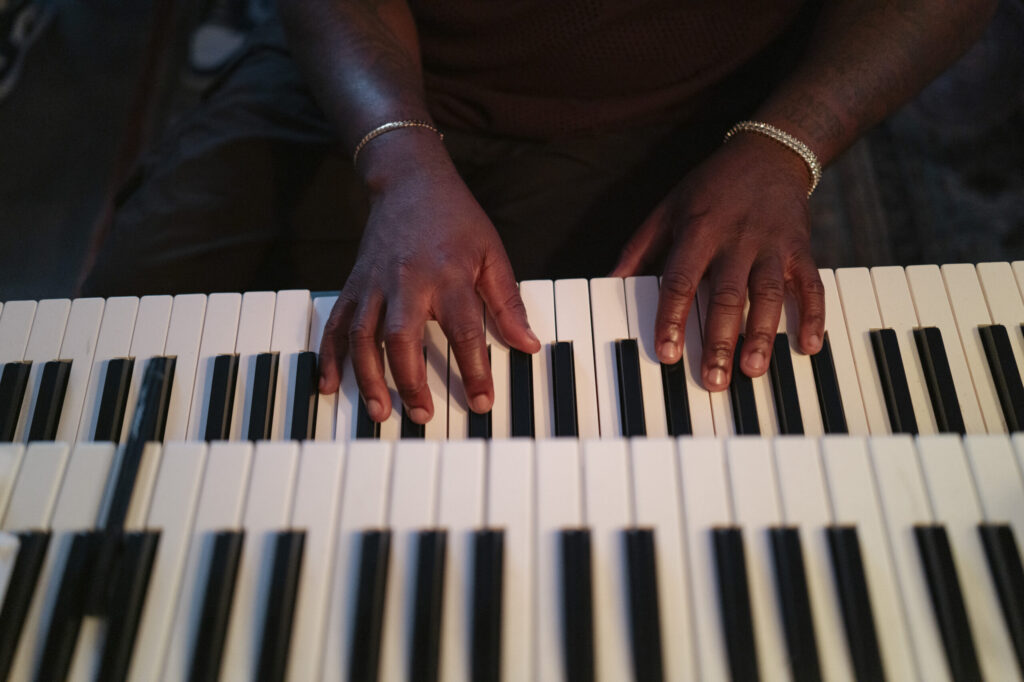
Two days after the first studio session, we’re back again, this time with Liza Ortiz and Claudio Ortiz, the Puerto Rico-born siblings who were raised by a Puerto Rican mother and a Venezuelan father.
Curt plays some of what he recorded in the first session, then Dae-Lee looks at Claudio and asks if he can add something that would connect with Charlotte’s Latin community. Claudio gently corrects him that there’s no such thing as a singular Latin sound, especially not in Charlotte.
“A Dominican will have a different rhythm to, like, mine,” Claudio says.
“Of course,” Dae-Lee says. “You tell me what it should sound like.”
Claudio tosses an egg shaker to Bluz, the poet, and starts tapping on the drum. That’s, in a way, what Dae-Lee hopes to do with this next phase of Bridge Builder: Take an idea he has on how to build trust among leaders, use the tools he’s learned through his leadership development work, and then see where they take it.
By the end of the six hours we spent together over two days, everyone’s contributed what they do best, even if it’s just a whisper. Whether the song gets 10 views or 10 million, it’s theirs.
Joseph Quisol puts on headphones and tickles his harp toward a mic. Curt hits a button on the computer, sending sounds into the headphones, and Quisol says, “Oh, it’s looping!” with boyish excitement. On the couch, Harvey Cummings picks up his 1954 sax, and belts out notes that will be layered in. Curt’s floating a suite of files by sunset. “All of this is a journey,” he says.
One of the last pieces of the day is from Liza. She’s creating loops on the keyboard. She’s self-taught and plays by ear, not by reading music. So she locks in with Curt, and the rest of us are left to watch in awe as he guides her into the beat with him.
At one point she gets worried. “Do we lose a little bit of the hopefulness with the minor?” Curt says that’s traditionally the case, but that with the right pairing, B-flat minor doesn’t have to be dark at all. “Over C-sharp, it still can be happy. It still can be some type of release.”
They keep going, and she winces whenever she stumbles on a note, but Curt keeps encouraging, until everything comes together.
“Nothing’s whack!” he’s saying louder now as Liza nails it. “Things are just misplaced!”
***
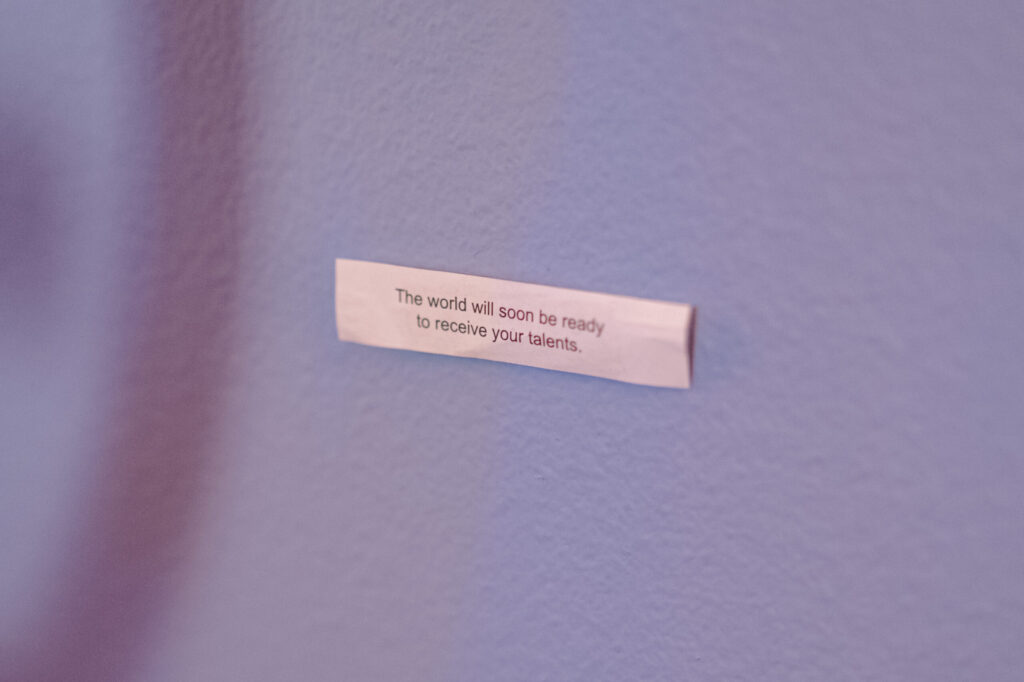
P.S.: Dae-Lee sent me a rough draft of the song’s final version on Friday evening. It’s not ready to be released; he says it should be in the next week or two. It’s about 75 percent there now, in his mind. I’ll share in the Optimist when it’s done.
At the end of August, Dae-Lee will host a public discussion with the founding stewards, “to move the conversation away from me,” he puts it. Anybody will be able to stream it.
Meantime, you can add your voice to his page of stewards, book a workshop with Dae-Lee, or find information about his cohorts here.
This all could go big, or it could go nowhere. Regardless, they made something, and that’s not nothing.