
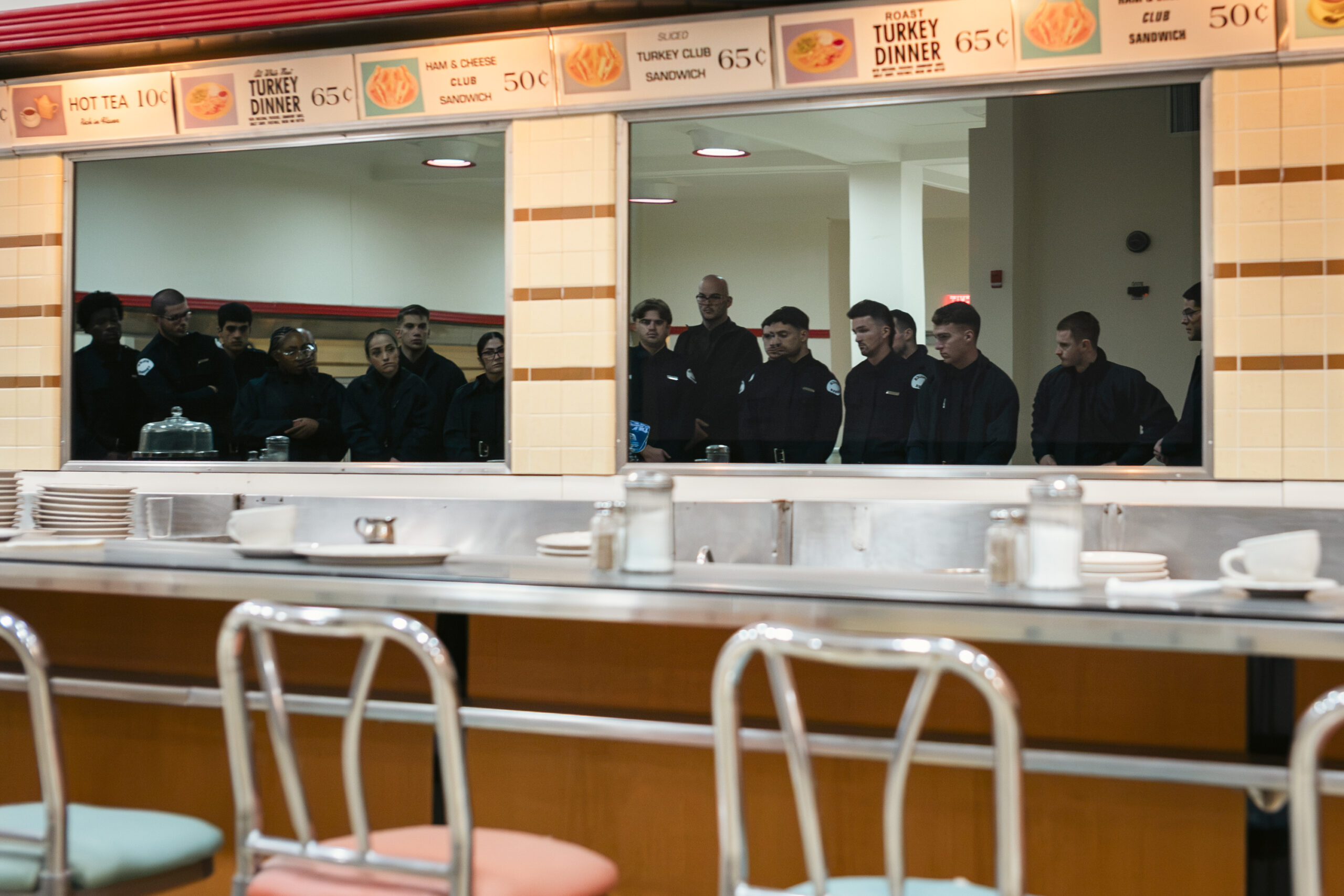
The police recruits of Class 205 bunch together in a dark room called the Hall of Shame.
Bright black-and-white images fill the walls around them, each broken to give the effect of shattered glass. On one wall is a photo of a Black woman in Birmingham, driven back by a high-powered fire hose.
“This taxpayer, she pays taxes to sustain the public good,” museum director John Swaine tells the recruits during their tour. “But Eugene Bull Connor, who ordered this activity, she also paid for his comfortable life. She paid for the comfortable life of the firefighters. She paid for the comfortable life of our police officers over here …”
Swaine turns to an image of a Black teenager, Walter Gadsden, held by a white officer while a German shepherd tries to take a bite of the boy’s midsection.
“This, I say to you,” Swaine says, “is not public protection.”
The members of Class 205 have completed more than 1,000 hours of training, more than the state requires, during a grueling eight-month police academy. They’re three days shy of graduating and receiving their badges. And now they’re here, on November 3, Election Day, in the International Civil Rights Center & Museum in Greensboro, staring stone-faced at the worst of their chosen profession.
For the past four years, CMPD has sent its recruits to visit the museum, at the end of their training. The building itself, an old Woolworth’s, is a reminder of the racist laws of the not-so-distant past. This is where four Black college students sat at a lunch counter on February 1, 1960, to ignite the sit-in movement across the South.
Class 205 is the first group of recruits to come through the museum since CMPD was forced to confront racism in its own ranks. In October, CMPD confirmed that seven officers were engaged in a text thread where they shared racist, sexist, and discriminatory religious remarks. Six have resigned, and the seventh is suspended without pay while awaiting a review from the city’s Civil Service Board.
All had been on the job for less than five years, and some of the officers in the texting scandal were in recruit classes that stood in this exact exhibit and stared at the exact same images. They’d put in the hours, taken the training, and known the expectations. One of the seven was even a class president.
And still …
“You can look at an image,” the Rev. Corine Mack, president of the Charlotte-Mecklenburg NAACP, tells me, “and not even see it.”
***
In 2010, a half-century after the Woolworth’s sit-in, I had the honor of sitting with two of the Greensboro Four, Franklin McCain and Joe McNeil. They still remembered the sounds and smells from that day.
“We were very ordinary people,” McNeil told me, “with very ordinary lives to live.”
As part of the story I wrote from my conversations with McCain and McNeil, I toured this civil rights museum twice. The lunch counter still sits in nearly the same spot it did in 1960, with the bygone prices still on the walls.
Many members of CMPD’s Class 205 would’ve been in middle school or younger when that story published.
CMPD draws its new officers from all over the country, some from places where they saw other cultures daily, others from areas where they hardly ever did.
“They show you how law enforcement started, and it wasn’t always pretty back then,” CMPD recruit trainer Gregory Dunston tells me. He’s taken the trip several times. “I imagine that some people have no clue about that.”
Really? I ask him.
“Yeah, I’m sure of that.”
On this visit, standing at the lunch counter with 20 young people who are days away from being sworn in as police officers, I remember a small detail from my conversation with McCain and McNeil 16 years ago.
The day they staged the sit-in, they told me, an officer stood directly behind them and slapped his nightstick against the palm of his hand, trying to intimidate them into leaving.
***
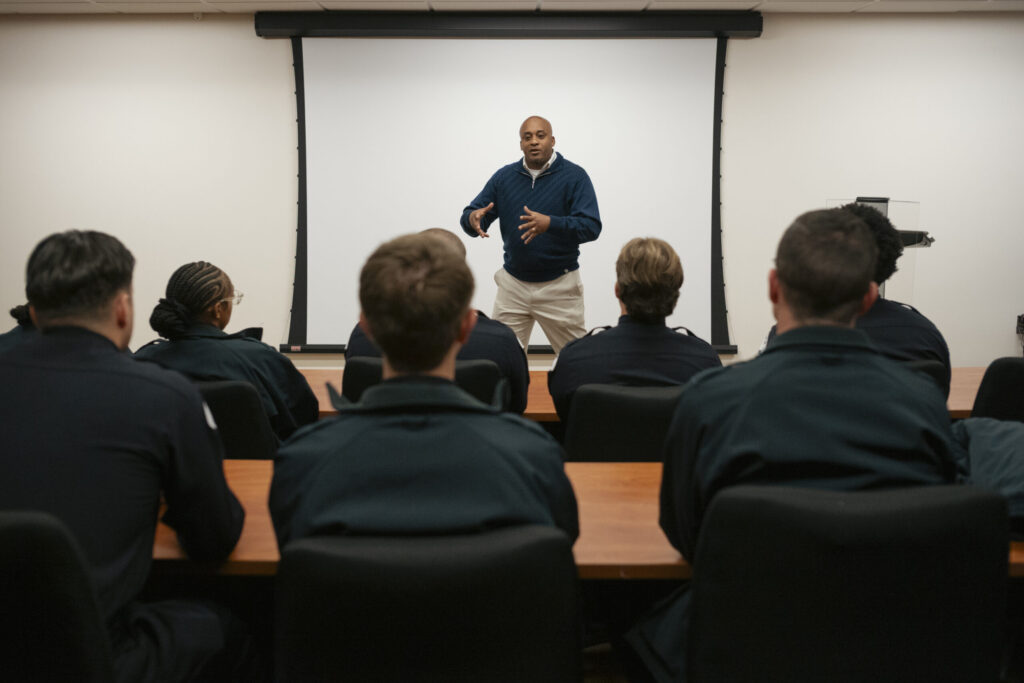
About an hour after the Hall of Shame, and two floors higher, Greg Jackson is animated. Jackson is the founder of the nonprofit Heal Charlotte. His rise in Charlotte’s civic world began when he was protesting the police killing of Keith Lamont Scott. He’s led these Greensboro excursions since their inception.
I’ve known Jackson for a decade, and he’s asked me to join him on the trip several times, but our schedules couldn’t align. When CMPD called about the November 3 trip, I made time, this time.
The question that’s nagged since the texting scandal broke out is … how? How does CMPD, a department that has had four consecutive Black chiefs, a department that went through the Scott protests … and the George Floyd protests … and countless reforms in training and policy … that even sends recruits to a civil rights museum before graduation … how does that department end up in a firestorm over discriminatory activity, in 2026?
After each tour, the recruits sit in a conference room with Jackson, and he doesn’t hold back.
“What you walk through downstairs still exists,” Jackson tells Class 205 on their November 3 trip. “It just looks different.”
About a third of the population CMPD covers is Black. More than half of the drivers CMPD’s officers stopped in 2025 were Black. And about 80 percent of those searched in those traffic stops were Black, according to records cited by The Charlotte Post earlier this month.
Jackson wants the officers to know that, for all the fitness training and driving simulations and target shooting and test-taking they endured during training, they’re about to police skeptical communities.
Jackson was once a leading skeptic. During those 2016 protests, a CMPD captain named Mike Campagna kept talking to Jackson and listening to his concerns. They formed a friendship. And Campagna, now retired, still serves on Jackson’s board.
“You can’t hate people up close,” Jackson tells the recruits, reciting a well-known line from former CMPD Chief Kerr Putney.
He gives them a hypothetical situation. Say he’s out in the streets protesting the school system, “and we’re mad at the superintendent, and we’re mad at the principals, and we’re mad at how they’re running schools. Do they come out when we’re protesting?”
The recruits shake their heads no.
“Who do they call?” Jackson says. “Police officers.”
“No matter who I’m mad at, I have to be mad at you,” Jackson goes on. “And there’s enough history downstairs to show you that if I’m mad at another system and they throw you there, and I throw that history on top of me being mad, what am I gonna do when I see you? I’m going to riot. It’s important for you to understand: I’m not even mad at you.”
***
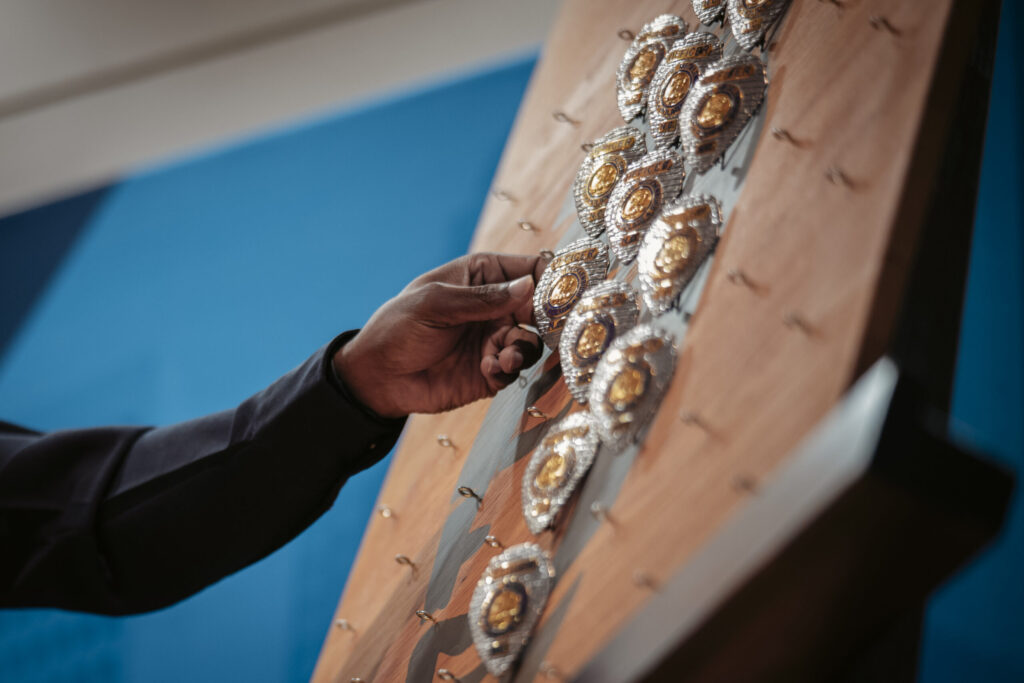
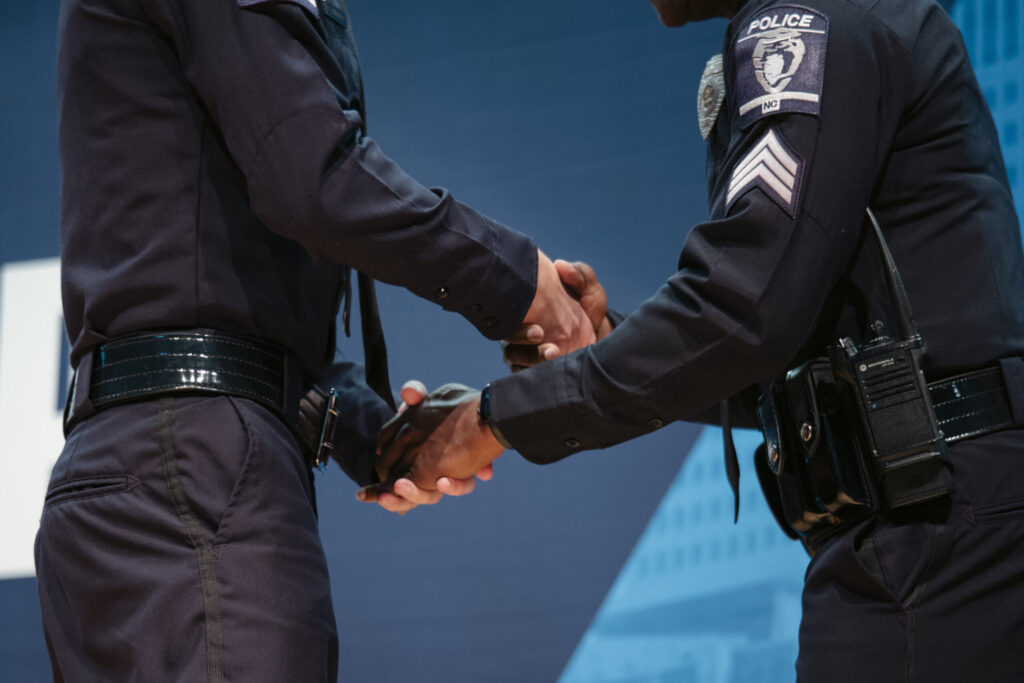
Jackson was “pissed” in mid-October, he tells me, after WBTV broke news of the racist text thread. He was hardly the only one. Among the most angry people was Chief Estella Patterson, CMPD’s first woman police chief.
Step back first. The texts came to light because of another investigation. In late July, the State Bureau of Investigation arrested CMPD officer Seth Elliott and charged him with misusing Flock cameras. Elliott resigned in August. But while the SBI investigated that case, they downloaded text messages from his phone.
They found a multi-year text thread that included six other CMPD officers, in which they made racist slurs and showed sexual and religious bias. WBTV reported that the officers had a competition to see who could pull over the most Black drivers, but CMPD says it found no evidence of it.
Patterson called U.S. Attorney Russ Ferguson and District Attorney Spencer Merriweather to see if they’d stand with her at a press conference. She tells me they cleared their schedules. At the mic on October 15, Patterson was stern. She said that six officers were identified in the text thread with Elliott, then said, “three of whom have resigned from the police department and the other three that I hope to soon refer to as former employees.”
Four days later, CMPD released the names of the officers — Mateo Juarez, Joseph Kelly, Alexander Larsen, Tredan Maronic, Matthew Osborn, and Jeremiah Todman. All except Todman have resigned. He remains suspended without pay pending the Civil Service Board’s review.
“I understand the frustration of the community. … As a Black woman, I understand 100 percent,” Patterson tells me. “But what I want to keep telling people is … we will not tolerate it. Any wind of something like that, we’re going to investigate it, and if there’s anything to it, those individuals will be removed from the organization. And I will take it a step further to try to get their certifications revoked, so they can’t be an officer anywhere in North Carolina, nor across the nation.”
Nine community organizations signed an open letter in October asking CMPD to find an independent agency to track and publish data on traffic stops, arrests, and citations — and to make individual officers’ data available in those areas.
“Racism, specifically anti-Black racism, is a feature, not a bug, of modern policing,” they wrote. “The entire system enables it, compounds it, and depends on it.”
Mack, the NAACP president, says conversations with Patterson have been productive. Mack was the one who initially called for the release of the officers’ names.
“I’m so grateful she is in that position,” Mack tells me. “We need someone like her, for such a time as this. … She was as agitated and hurt as I was when she saw the text messages.”
Mack adds, “The question now is, how many more officers are doing the same thing? How many more officers feel the same way? And how many Black and brown people’s lives are endangered because of that level of hate and discrimination?”
***
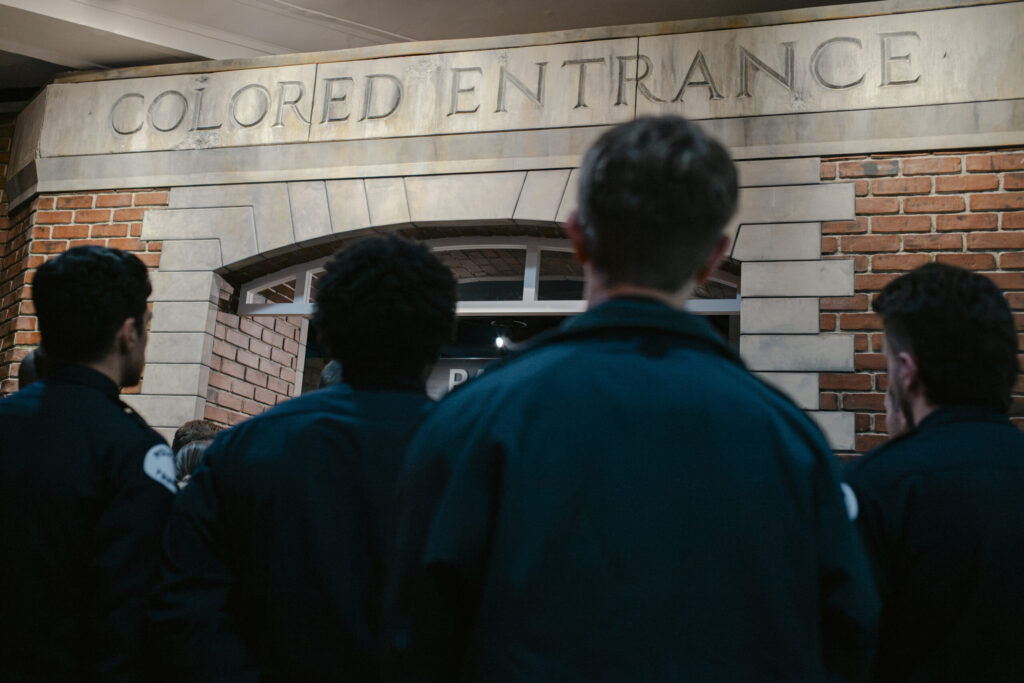
Back at the Civil Rights Museum on November 3, one of Jackson’s closing messages to the recruits is, “Don’t be the text thread.”
We walk out into a hallway and cram into an elevator to head down to the lobby. Stuffed into that tight space, Jackson, more at ease now, asks the recruits what they thought of the text messages.
“Embarrassing.”
“Awful.”
“Terrible.”
Downstairs, I ask Jackson how he’s processed the past month, given how close he’s been to the recruit classes. He says his own mother called him in a fury one day.
“Honestly, I couldn’t believe that they caught it so fast,” he says. “I couldn’t believe that she [Patterson] actually suspended them without pay. I couldn’t believe that she actually called for their [certifications] to be taken away.”
He gives the recruits two surveys — one before they go to the museum, and one after — to see how it changed their perspectives. He also walks with them through the museum, looking for recruits who may not be paying attention.
But it’s hardly foolproof.
“I think the Civil Rights Museum of Greensboro is a good place to start, but that doesn’t change the heart of mankind,” Mack says. “It may give you an epiphany. It may give you some opportunity to reflect, but that doesn’t change the heart.”
Just before we leave Greensboro, Jackson concedes that he’d taken several of the officers involved in the text thread to the museum. He says that in larger classes with 50 or so recruits, “five people gonna get past you.” The difference now, Jackson says, is that when he was protesting a decade ago he had to beg police departments to suspend officers without pay, and to be more transparent. This time, he says, CMPD did it without needing marches to force its hand.
“I’m mad, but then I’m impressed a little bit that they caught it,” he says. “I couldn’t really be mad at her. … I’m just mad at racism, because it exists.”
Because it exists.
***
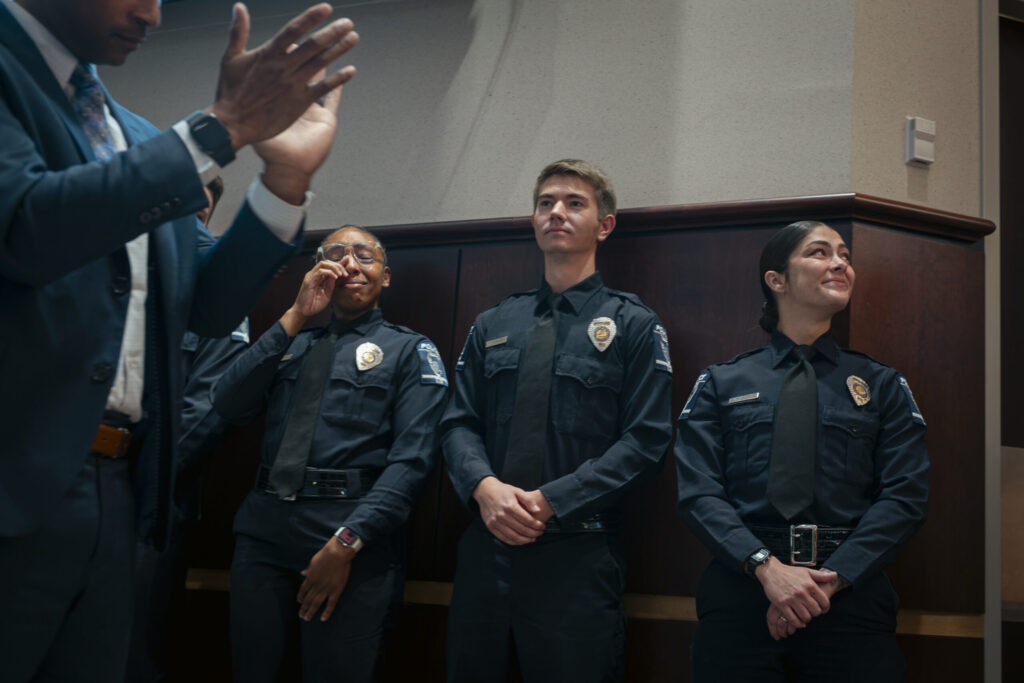
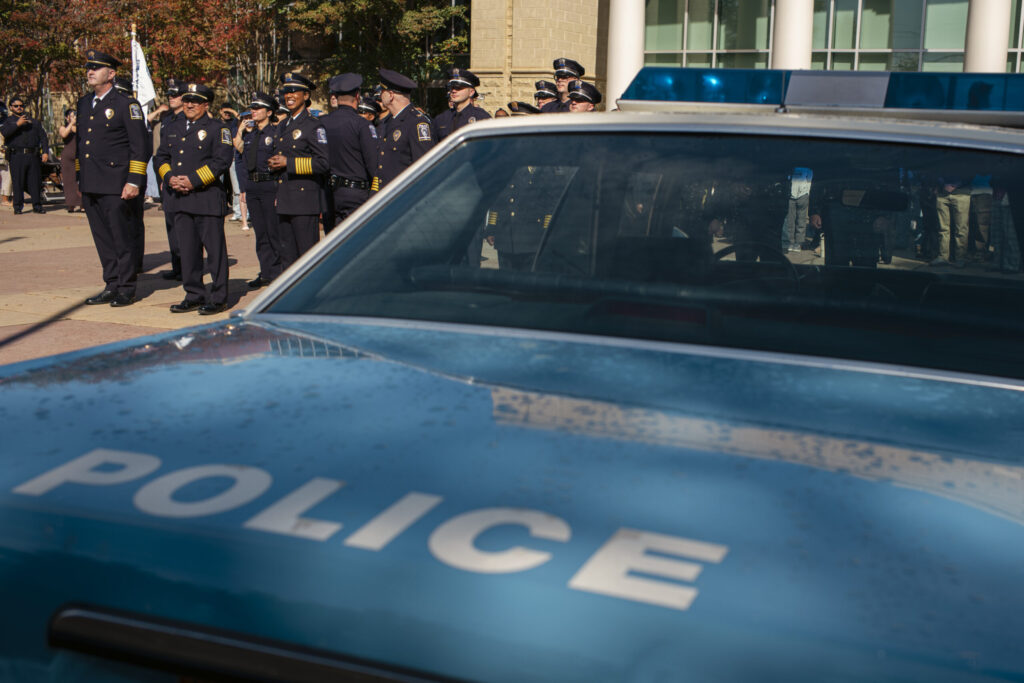
On November 6, three days after the museum trip, graduation day starts with rain. Families fill the auditorium at the police academy and training center on Shopton Road. Babies cry and babble. Fathers of the recruits hold cameras zoomed in too far. Others stay on FaceTime with family members who aren’t able to attend.
Chief Patterson participated in a physical training session with the recruits a week before their graduation. Before the workout, she talked to them about the text thread. Now she’s on stage, speaking to them one last time as recruits. Within the hour they’ll be officers, some for the next 30 years.
“Despite the noise and the nonsense of recent weeks, today is a super exciting day,” Patterson tells the audience. And later, “In this profession, all eyes are on us, and if we have a misstep, we typically don’t get the benefit of the doubt.”
Patterson had asked Class 205 to write “Why” statements, in which they shared why they want to be officers. She reads a few of them. One, she says, wrote that when he was six years old, “tragedy struck” and his mother died. He still remembers how responding officers from CMPD and Charlotte Fire stayed with him until his father arrived. He vowed to “lead by serving and protecting the Charlotte community with the same care and the same compassion that was shown to him and his family.”
The two class presidents, Savannah Bourgeois and Tyler Russell, give graduation speeches. “In the next few days, all of us will begin to feel the weight of the badge,” Bourgeois says, and then Russell says, “We have held each other accountable, even when it pained us to do so.”
Then all the members of Class 205 take the oath, which includes the line, “I will not be influenced in any matter on account of personal bias or prejudice.”
Afterward, I sit down with Patterson in an office.
She tells me that after she learned of the text messages, she met with CMPD’s recruiting team to ask what was in place to detect bias. She says they’re changing questions on the polygraph exams, which each recruit must take before even entering the academy. The polygraph is already effective at pressuring applicants into disclosing tendencies or past behaviors that don’t align with CMPD’s values, she says.
“You can try hard not to have a subliminal message or show facial expressions when something is asked,” Patterson says. “But a trained polygrapher can note those things and know, ‘OK, we need to delve a little bit more into this question. We need to ask more about this experience and see what they disclose and what they divulge.’”
I ask her for an example, and she says, “If someone is a sexual predator, that comes out in the polygraph.”
“What about implicit bias?” I ask.
“I don’t know how you detect it necessarily,” she says, before adding that it’s something the department wants to research.
That nagging question only grew larger for me as I followed Class 205’s final week: How on earth do people come through the training, go to the museum, see the diversity in CMPD’s ranks, hear those teachings, and then go out in the world and do the complete opposite?
When I ask Patterson, she sighs: “For eight months in the academy, they’re hearing the same messaging.” The part about the texts that still bothers her, she says, is that “nobody had the courage enough to speak up.”
Dunston, the recruit trainer, tells me graduation days are always special because, “I raised them.” Dunston is a Black man who’s been on the force for 17 years. He knew some of the officers in the text thread personally, and says he was “very close with a few of them.”
Dunston is the lead trainer for Class 206, which is in the middle of its eight-month training program and is scheduled to graduate in a few months. He says he’s been harping even more on how they need to carry themselves when they become officers. He created a PT drill where they had to police themselves.
“Just because everybody can’t see it now,” Dunston tells them, “you never know how it could come into the light.”
It’s just after noon when Dunston and I wrap up. The officers of Class 205 are with their families. On Monday, they’ll be with their divisions and policing Charlotte’s streets.
I ask Dunston what the new graduates will do with their last free weekend. He says they’ll probably celebrate. As for him, he’s not going anywhere.
“We still have two classes upstairs,” he says. “I’m gonna get into something more comfortable, and go back and do the work.”