

On her first day in charge of Crisis Assistance Ministry, Carol Hardison waited in the line.
This line, it forms each morning with people needing emergency financial help, dozens deep in hard times. Behind Hardison on that day in 2000 was a barber who’d been in the hospital but still had to pay the rent on his barber’s chair. In front of her was a grandmother who’d been injured on the job and missed a few weeks of work.
Hardison had spent 18 years in the corporate world before that, and she’d just had hip replacement surgery herself. Her coworkers brought her meals, her laptop, her mail. Standing in the line with people who didn’t have that kind of network helped frame the next 26 years as Crisis Assistance’s leader.
“I had just come from being on the couch six weeks, not only not losing a dime, but being given support and help and gifts,” she said. “And this man …”
She trailed off, before finishing a thought about the barber behind her.
“This whole concept of ‘If people like worked hard …’ I can’t get that.”
She stayed in line all the way into the lobby, where she saw a person give a stranger a quarter. Nearly every workday for more than a quarter-century, Hardison has walked through that same lobby of Charlotteans who need help.
She’s retiring on January 31, as only the second CEO in the organization’s 51-year history. She’s become one of the city’s go-to gauges for the state of poverty in Charlotte. If the measure of a city is how well it takes care of the least, Hardison has a better read on how we’re doing than just about anyone.
Since the end of pandemic relief programs that provided billions in utility and rent assistance, food assistance, and unemployment assistance, the job’s become exponentially more difficult.
“The worst of our 50-year history, I’m certain,” she told me recently of the past three years. “People would come in with 8, 10, $12,000 rent needs. … People had years worth of rent they owed because they used that money to pay medical bills and past debt.”
Evictions have jumped 50 percent in the past two years, she said. For about a decade, the yearly total in Mecklenburg County was just shy of 30,000. In 2025, more than 50,000 eviction notices were filed.
Most days, about 100 to 110 households come to the building on Spratt Street seeking emergency financial aid. Crisis Assistance can usually see about 75 of them. The busiest times are fall and spring, when summer power bills and winter heat bills come due. About 50 or 60 households won’t be served on those days.
She calls Crisis Assistance “an emergency room.”
***

One Thanksgiving when she was a kid, her father invited a man who’d been in prison to dinner.
Growing up in Florida — the family moved between Jacksonville and Tallahassee, twice in each — she was raised in a family where poverty was “integrated” into their social network.
Her father was a minister, then took a government job as a housing specialist, working on affordable housing and homelessness. Her mother was a spokesperson for a mental health organization.
Carol remembers nights when her dad would come home from a city council meeting celebrating receiving funding for a food pantry. She remembers the whole family protesting outside the governor’s mansion. Some days her mother would warn Carol and her siblings that she would be on the news that night, defending a halfway house project or some other initiative. “And I’d see her saying, ‘You know, these are people just like you and me,’” Carol remembers.
Hardison went to college at Furman in South Carolina, then moved to Charlotte in 1982 to take a job in corporate technology at Duke Power. She knew within a few months that it didn’t suit her, but she stayed for 18 years. She remembers looking out the window of her skyscraper one day and seeing homelessness on the street. “What am I doing up here?” she asked herself. “I’m supposed to be down there.”
She remembers her coworkers carrying copies of Computerworld to meetings, and a boss suggesting she should be reading it on weekends. Instead, she spent her free time volunteering at the Men’s Shelter.
In the late 1990s, during her 16th year at Duke, she remembers a big meeting where leaders stood on stage and spoke with great spirit about how Duke would one day be the top producer of energy in the world. After the presentation, her manager jumped out of his chair and turned to face the 300 or so employees behind him.
“If that doesn’t excite you,” her manager said with zeal, “you don’t belong here.”
Hardison heard that, then looked down at her notebook. During that same meeting, her only notes were a list of what she wanted to pack for an upcoming beach trip. She thought to herself, My manager just told me I don’t belong here.
She was approaching 40 then, and wondering what to do with her working life. She signed up for a class she’d seen offered on the back of the Junior League magazine. One of the people in the class was on Crisis Assistance Ministry’s board. Hardison had long considered the ministry’s founding director, Caroline Myers, a saint of Charlotte. (“I stalked her,” Hardison said.) Around the same time, Hardison saw in the Observer that Myers would be retiring. The board member encouraged her to apply. She did, and eventually received the job.
Duke gave her crucial skills, like how to manage people and measure results. The difference, she said, was that at Crisis Assistance, she didn’t have to look for ways to motivate her staff. Duke would take employees on trips and retreats to reinvigorate them. At Crisis Assistance, the staff just needs to see the line, and they’re ready for work.
“Everybody that’s ever walked through these doors has it,” she said.
***

Hardison moved to Charlotte when it had about 300,000 residents. She bought her first winter coat here. She reckoned she’d one day move to a “real city” like Boston. Somehow Charlotte became one of those, or something close to it, depending on who you talk to.
“We have museums. We have sports. We have activities, and I partake of it all,” she told me. “And yet that is the very reason there’s twice as many people at Crisis Assistance Ministry every day. So I just live in this split, bifurcated brain.”
I’ve been interviewing people in Charlotte for a long time, and don’t know if I’ve ever felt a quote in my bones more than that one.
In the same city where “the line” might mean a hundred people waiting for a pastry and coffee when a new shop opens, it can also mean the hundred people waiting for help paying their light bill. And the reason one person is in one line and another is in the other is not, on the whole, that they don’t “work hard.” Some have two jobs. Some have three. Hardison’s met several people with four jobs recently: They drive rideshare or delivery jobs in the morning, a day job at 8, a retail shift in the evening, and a weekend job at a nursing home or security.
“I can name real people that have four,” she said. “Why in the world wouldn’t you think something’s wrong with that picture?”
She excelled in math in school, and she sees the distance between rich and poor as a numbers problem. She says that when she sees big jobs announcements or construction projects, she notices that it’s easy to talk about the positives — the high-paying jobs, the economic impact. But she says we should also be talking about how “for every additional opportunity for wealth, there’s a number of low-income jobs that make that job possible.”
She’s considering digging deeper into those numbers in her retirement, and wants to bring them to those announcements. And as with everything with Hardison, she sees the 360-degree view. She loves going to Charlotte FC games, for instance, but she tries to spend her time talking to the stadium workers.
“I have tickets as well!” she says. “I’m not coming in here saying don’t upgrade the stadium with tax dollars. I get that completely. [But] know how many more low-income jobs that’s going to be. You can’t just be all excited about that upgrade without knowing this. That’s what I’m going to spend my time advocating on.”
When I visited with her again for a follow-up last week, I told her I wanted to drill down on this, because it’s something I feel, too. I’d just purchased concert tickets the day before, and walking past those people in need, it felt like an extravagance.
“Charlotte is a part of North Carolina, is a part of the United States of America, and this is the construct of the nation that we live in,” she said. And later: “The only pain is the constant realization that there’s more and more and more wealth in Charlotte-Mecklenburg … and it hasn’t hit the whole community. … These people making all the money aren’t bad people. They’re not wrong for taking the money.”
***
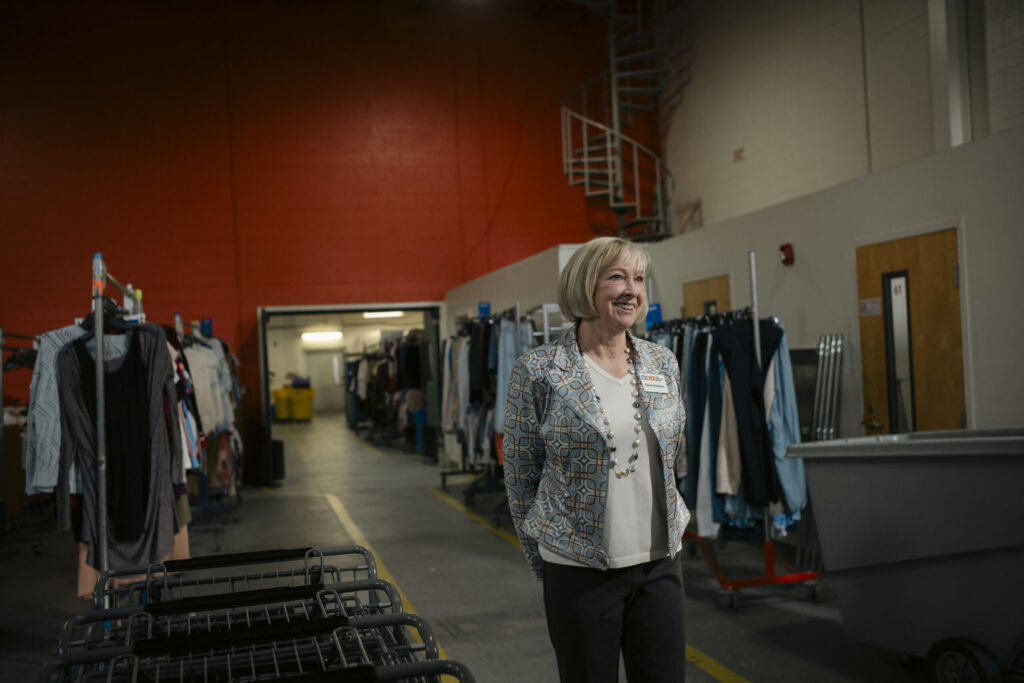
On Thursday morning last week, Hardison walked past the line and into the lobby, where dozens of people waited for their name to be called.
A man in the lobby noticed her and stopped her.
“Carol!” he said. “Do you know what part of a bird doesn’t fly?”
She leaned in closer and said she didn’t know.
“It’s the shadow!” the man said, cracking up. She started laughing, too. And he told her, “Now you can tell that joke the rest of the day.”
“He just wanted to be a human for a moment,” Hardison told me.
When I asked her how 26 years in this job has changed her, personally, she said that before she came to Crisis Assistance she knew, academically, that economic instability was an issue. But now she knows their names. “They’re real people. Moms and dads and kids.”
And she says ordinary Charlotte folks might not even notice that their Lyft driver with a nice and clean car might be the same person who stood in line at Crisis Assistance that morning.
The job’s also changed how she sees eating out, and just about any work that puts her in contact with service industry employees. She’s heard people complain about waiters and only leave a 10 percent tip. She always leaves 25 or 30 percent, because, as she puts it, “You don’t know that person didn’t start the day at Crisis Assistance.”
I asked Hardison how she feels about the eternal challenge for most nonprofit leaders: “How do you parse the ever-present nonprofit leader dilemma of knowing that if everything went great, you’d be out of a job?”
“Wild that you say that,” she said with a chuckle. Early in her time at Crisis Assistance, she told her employees that the goal was to work themselves out of a job. She told the board not to congratulate her when the agency served more people than the year before. She’s always wanted to serve fewer.
Emergency rooms, though, don’t have the power to stop the world’s illnesses. And so the line keeps forming.
“We want a sign on the door,” she told me, “that says, ‘Out of Business.’”