
Watch the video above on our new YouTube Channel.
On a bright Thursday morning in early October, I stepped out onto the 23rd-story patio of a downtown office tower with former Charlotte mayor Richard Vinroot. He scanned the city he once led, the city where 75 years ago he could ride down Providence Road on his boyhood pony.
Now we were looking in that southern direction, out over a construction site where two towers are rising on land that recently was home to a diner and a strip club.
“It’s unbelievable what’s happening in this city,” he said. “Stunned. I’m just stunned.”
Vinroot’s mom grew up on 36th Street back in the 1920s and 1930s. He was born here in 1941. He and his late wife, Judy, raised three children here. Now one of those kids, Laura Vinroot Poole, is one of the city’s top ambassadors through her worldwide fame in the fashion industry, as we wrote in October. Richard was the mayor in the early 1990s who brought the Panthers’ NFL franchise here. And he guided the city through one of its most difficult periods, when crimes surged and two police officers were shot off West Boulevard.
In other words, few people have given more to Charlotte and benefited more from Charlotte than Richard Vinroot.
I thought about the theme of reciprocity in Charlotte again last week, when I watched the first draft of the video my creative partner, Logan Cyrus, made using the visuals from The Charlotte Optimist in 2025. It’s filled with faces of givers and receivers, people of all stripes who use their talents in service of our city, and who benefit from the talents of others.
Some faces are determined. Some are crying. Others light up the video with smiles.
Since our May 4 launch, the Optimist has published 44 feature-length stories, and together they add up to a serial narrative of a place in time. They’re stories about icons. About present-day leaders. About people living in the shadows. About some of our most difficult moments. And some of our best. About neighbors and strangers and all the ways their fates are connected.
We’ve published more than 110,000 words in our emails, and seeing them blink by, in chronological order in a three-minute video, choked me up.
Each Optimist story so far has been the result of real conversations, and nearly all of them have been face-to-face. That was the promise when I formed the idea for this new outlet a little more than a year ago, to see people for who they are. And it was the promise I made to the initial funders who agreed to help me support my family financially while we launched this new nonprofit. I will forever be grateful for their trust.
One thing I couldn’t have predicted is your response. We’re already at 4,900 subscribers, with a 78.1 percent open rate — and each week I hear from someone who tells me the Optimist puts them in a better mood to start the week. Notes like that are a gift I’ll treasure, and they inspire me to put more back into the city where I’m raising my kids.
We haven’t gotten everything exactly right, but even when you’re upset with me or how I’ve framed a story, you’ve been considerate and kind — and you help me see a perspective I hadn’t considered.
We’re deeply motivated for 2026, and we can’t wait to keep doing more to bring people together around this slice of busy, ever-changing earth we share.
To do that, we’ll need your support.
If you’ve been moved by the Optimist this year, learned from it, argued with it, or simply liked the idea of it, I hope you’ll consider making a year-end, tax-exempt gift.
Like Charlotte itself, we don’t ask for something unless we believe we can give much more in return.

As we stood on that patio in October, high above the same parcel of land that used to house The Charlotte Observer building, Richard Vinroot pointed left and right. We’d spent an hour or so talking about his family — most anecdotes seemed to boomerang back to his love for Judy, who died in 2024 — and the Charlotte he’s known for 84 years.
And here’s the funny thing: Richard Vinroot almost didn’t come home to Charlotte. When he graduated from UNC’s law school 60 years ago, he got a job offer at a top law firm in Greensboro.
At the time, the Charlotte metro region population was about 270,000 people. The Triad — Greensboro, High Point, and Winston-Salem — was at about 460,000.
When he turned the job down and said he planned to move back to Charlotte, the law partner at that Greensboro firm scoffed: “Son, why are you considering Charlotte? That’s a salesman’s town. … [Greensboro] is where a young man or woman ought to come practice law in North Carolina.”
As we looked out at the city in 2025, in the heart of a county that now has 1.2 million people and continues to grow, Vinroot laughed at the scolding.
“He was so wrong,” Vinroot said. “This place is just, it’s just powerful.”
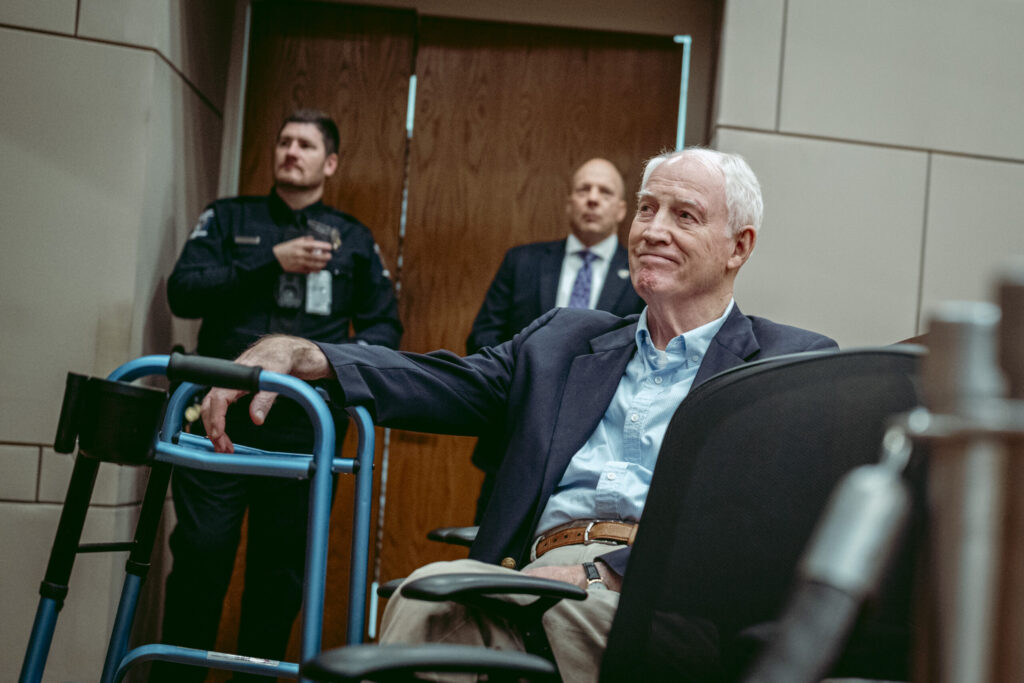
I saw Vinroot again a couple of weeks ago, at the swearing-in ceremony for Charlotte City Council. Current mayor Vi Lyles that night would present the Richard Vinroot International Achievement Award to a community member who’s made a difference.
This year’s winner was Tonya Jameson, a friend and former Observer reporter who now is Leading On Opportunity’s director of civic advancement. Jameson grew up in Maryland, like I did, but she’s been here for more than 30 years. She’s a Gen Xer who’s gone from a “Paid to Party” columnist at the paper to a director at a vital nonprofit — and someone who, also like I do, now has to wear reading glasses.
“I want to make sure that we create a city where every child can write their own story, regardless of their neighborhood,” Jameson said during her acceptance speech, looking up from her prepared remarks.
Off to the side in the front row, Richard Vinroot nodded and smiled.
Give: Visit The Charlotte Optimist’s membership page to support our work in 2026.
Watch: “44 Stories, 1 City.”
Charlotte by the numbers
157
New residents moving into the Charlotte region each day, according to updated figures from the Charlotte Regional Business Alliance.
115
Miles between Queens University’s Myers Park campus and Elon University’s Burlington campus. The two universities announced in September that they would merge.
$1,200
Monthly income, on a good month, for the day workers who line up on Wendover each morning near the Home Depot, waiting for work.
140,000
Number of people in Mecklenburg County who qualify for some form of food assistance, and who were left in limbo this fall after the government shutdown led to a pause in SNAP.
56
Years since Johnson C. Smith’s football team won a CIAA championship — a streak the Golden Bulls snapped this year under the leadership of coach Maurice Flowers.
1,200
Jobs expected to be created by Scout Motors’ decision to move its headquarters to Plaza Midwood.
52-48
Percentage of Mecklenburg voters who voted for and against the 1-cent transportation tax increase, to help fund about $25 billion in infrastructure investments over the next 30 years.
57
Years that Charlotte magazine operated as our city magazine, before its parent company announced its closure following this December’s issue.
5
Strokes separating Scottie Scheffler and the rest of the field as he rolled to the PGA Championship victory at Quail Hollow Club in May.
33
Years in the law enforcement career of CMPD chief Johnny Jennings, who shared the news of his retirement after this year in an exclusive with the Optimist in May.
49
Enrollment in the first class of Wake Forest School of Medicine-Charlotte, which opened this summer at The Pearl.
90
Age of modern Charlotte’s most influential figure, former Bank of America CEO Hugh McColl. The city celebrated with the opening of McColl Park on his birthday, June 18.
46.5
Roughly the number of years the old Carolina Theatre on Tryon Street sat closed, before its grand reopening as a centerpiece of Charlotte culture this past March.
250th
Anniversary of the Mecklenburg Declaration of Independence, signed on May 20, 1775, 13 months before the U.S. Declaration in 1776. Folks here marked the occasion with a celebration at Trade & Tryon at noon this past May 20.
31×13
Size, in feet, of Eric Halili’s new LED wall at Maya VP Studios, which opened in August.
3
Mecklenburg’s ranking among large urban counties in terms of the increase in population of children ages 0-4 since 2020. Most other major cities saw a decrease.
1
Number of weeks a little beer shop, Frank’s, had been open in Commonwealth Park, before it flooded. The neighborhood came to its rescue.
110,000+
Number of words published in the Charlotte Optimist this year, according to the beehiiv roundup.
Quotes from Optimist stories in 2025
I could start this section with another number: 34. That’s the number of consecutive, uninterrupted minutes Sheriff Garry McFadden spoke in an interview with me in August, after I asked him how he would interview himself. It was one of the most bizarre and fascinating stretches of time in my career.
Others were more concise! Here are a few other quotes I won’t forget from interviews with people in Charlotte this year.
“It’s like your best memory.”
— Soul Gastrolounge owner Lesa Kastanas, describing the city’s affection for the restaurant, which reopened this summer just north of NoDa.
“I mean, does music make the universe or does the universe make music? I think music makes the universe.”
— Andy Kastanas, talking earlier this year about his dream of opening Stylus Soundlounge at the new Soul location.
“I told him to major in veterinary science and minor in taxidermy — and either way you get your dog back.”
— Barbee Farms’ Tommy Barbee, on his advice to his son, Brent, when he went off to college. Brent wound up doing neither, and now he runs the family farm.
“Some days I feel like it makes what we went through during COVID look like small potatoes.” — Foundation for the Carolinas President Laura Yates Clark, on the changes to the nonprofit landscape in 2025.
“That’s how you feel about Charlotte? Cool. I don’t give a f**k. Don’t come. You ain’t gotta come here. That’s how I treat everything. … I allow people to have their opinions, bro. However you feel about me, however you feel about my city, however you feel about how I play golf, I don’t care.”
— Local golf celebrity Erick Lottary, on his reaction to national golf podcasters calling Charlotte “the most vanilla, bland place,” and “Diet Atlanta” in the lead-up to the PGA Championship.
“It was Christmas. Packages were wrapped.”
— Charlotte mayor Vi Lyles, remembering her first husband’s death in 1989. Lyles opened up to the Optimist this summer, months before winning her fifth consecutive term.
“Booty-shakin’! Booty-shakin’! Booty-shakin’! Booty-shakin’!”
— a fifth-grader from Afghanistan, enjoying the hell out of his morning at OurBRIDGE, a nonprofit that serves immigrant and refugee children, despite the many challenges facing organizations that help those populations these days.
In remembrance …
The year delivered two more doses of sad and awful news last Thursday.
A plane carrying NASCAR driver and noted humanitarian Greg Biffle and his family — including his wife, Cristina, and two children, 5-year-old Ryder and teenage daughter Emma — crashed in Statesville, killing all seven people aboard. Others lost were Dennis Dutton and his son, Jack, and Craig Wadsworth.
My friend and former Rocky Mount Telegram colleague Jeff Gluck, who’s covered NASCAR for more than two decades, wrote this in The Athletic, of Biffle’s work to help people in the wake of Hurricane Helene last year:
- “Biffle delivered essential supplies and communication to those who would otherwise have been missed; he told of one man who used a mirror to reflect the sun’s light at his helicopter when it was flying overhead. And he continued doing so long after the national media had turned its spotlight elsewhere. … Biffle didn’t fly his aid missions for any reason but to help those in dire situations, and did so at great personal risk. … Achievements in racing? Those are great, but are ultimately dwarfed by how a life is lived off the racetrack.”
Hours after that tragic news, we learned that former Gov. Jim Hunt died at 88. Hunt served four terms, was an absolute champion of public education, and will forever be one of the most important figures in North Carolina history.
As Andrew Dunn wrote in the Observer: “We still live in Jim Hunt’s North Carolina — not because we’re stuck in the past, but because we’re still living with the standard he set.”
Biffle and Hunt are two of several people who died this year after leaving a substantial mark on Charlotte and the surrounding region. Others include:
- James Ferguson, the courageous civil rights attorney who helped desegregate schools, secured pardons for the Wilmington Ten, and freed a Winston-Salem man who was wrongfully imprisoned for two decades, died in July at 82.
- Former Robinson Bradshaw partner Russell Robinson, one of the most generous souls in the city’s history, died in September at 93.
- Ukrainian immigrant Iryna Zarutska, whose life was tragically cut short at 23, when she was murdered on a light rail train. She leaves behind a lasting legacy, as her murder shifted the conversation about public safety and led to new state law.
- LendingTree CEO Doug Lebda, who led Charlotte into the tech era in the 1990s, died in an ATV accident in October at 55.
- Pettis Norman, the trailblazing Johnson C. Smith grad, who grew up in Charlotte and played a decade with the Dallas Cowboys. The Observer’s Alex Zietlow wrote a fantastic story on Norman.
- Humpy Wheeler, a giant of a personality who led Charlotte Motor Speedway for 33 years and turned NASCAR into a mainstream sport, died in August at 86.
- Also: Paul Antonio Irving, better known as Moses the Street Preacher, who for years stood at an east Charlotte intersection and made people smile. … David Cannon, better known as Ace from the famous Ace and TJ radio show … retired CMPD assistant chief Vicki Foster, who was beloved by both officers and community members.