
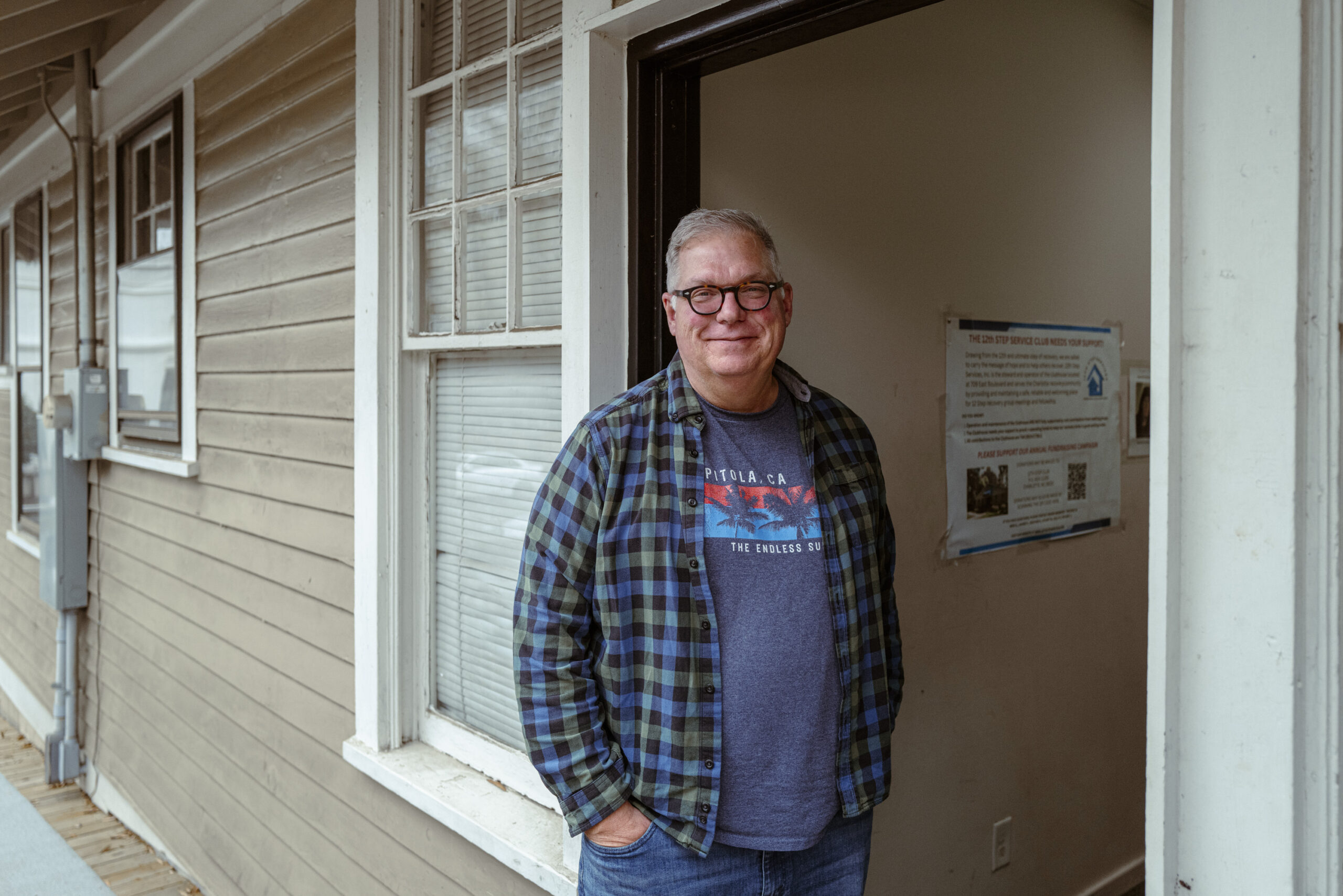
Stuart Watson had been sober for more than 21 years when he got fired from his job as one of Charlotte’s boldest and most theatrical television reporters in January 2015. He’d spent more than a decade here exposing fraud and corruption with banger stories that led to change.
Now he was 55 years old, walking toward WCNC’s exit in a daze, and being asked to turn over his ID and key card.
“They literally took away my identity,” Watson told me last month, 10 years after his January 9, 2015, dismissal. “I had invested my entire identity in my title.”
He slumped into his car, where he keeps a copy of his biological father’s death certificate, which lists “acute alcoholism” as the cause of death. He now was at his own turning point, a husband and father, and knew that he couldn’t leave them the same way. So as he drove away from the station for the last time and turned toward home, Watson called his sponsor before calling anyone else, even his wife.
“I’m sorry that happened,” the sponsor said. “That really sucks.”
That was it? I asked Watson as we sat in a coffee shop in south Charlotte last month. Not even a, How could they do that to you? Just, That really sucks?
Yep, he said. That was about it. Any other question might’ve only fueled a spiral. What he needed most, in that moment, was the routine he’d come to live by.
“When my kids are born, I go to a meeting,” Watson says now. “When I get fired, I go to a meeting. If I hit the Powerball — which I pray to sweet Jesus I will — I’ll go to a meeting. You know, that’s the whole thing. You have to keep on keeping on, no matter what your circumstances.”
I sat next to Watson at one of those 12-step meetings on a chilly Wednesday in mid-December. About 50 recovering souls filed into an easy-to-miss building on East Boulevard for the 7:15 a.m. start, and most are here every day. Men and women. Some in their 20s; some in their 70s. Outfits ranged from workout clothes to unwashed jeans to button-downs. They were lawyers and construction workers. Some pulled up in luxury cars; others walked from the bus station. Some faces I recognized as people who’ve had significant influence in Charlotte; others were worn and weary from the elements of winter.
All introduced themselves the same way: I’m an alcoholic.
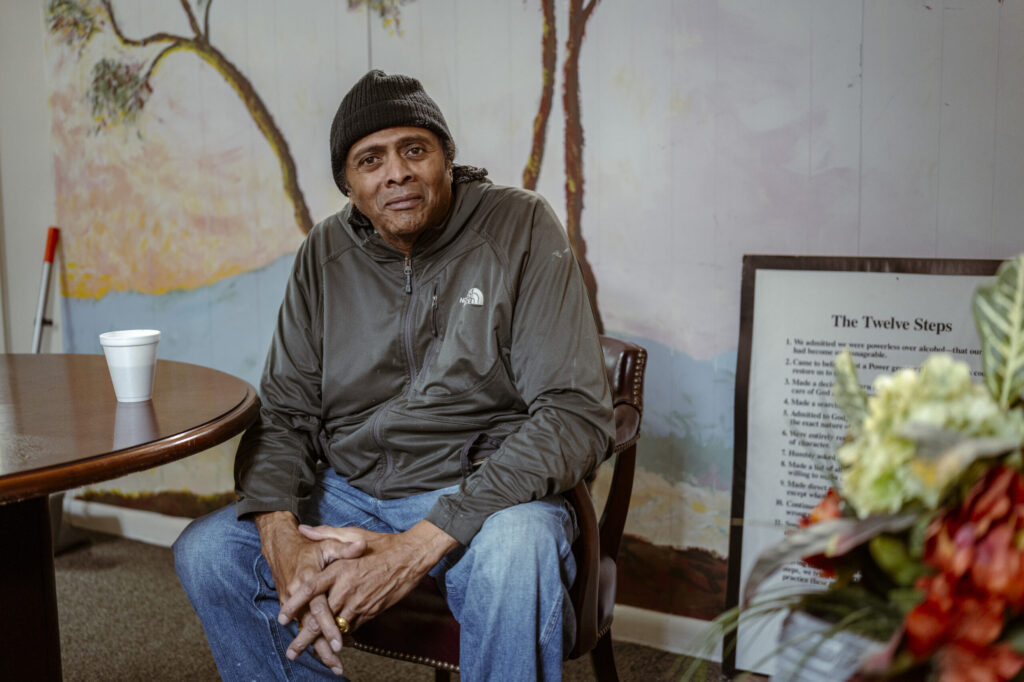
This group, 12th Step Services, is a more than 70-year-old local nonprofit that hosts about 20 meetings a week, focused on a range of addictions from alcohol to drugs. They’ve been meeting at 709 East Boulevard, a plain century-old building shaded by a stand of oaks, since 1975.
With a faded blue awning, it looks like an old VFW or American Legion Hall. But inside, each morning, the words spoken are as essential to the attendees as air itself. It’s a special place that has served tens of thousands of people, and now they’re trying to raise a little money to fix it up. Home Depot recently donated materials and labor to tear up the coffee-stained, 30-year-old carpet and replace it with flooring. But still they need to raise about $75,000 to replace windows, doors, plumbing, and on and on.
Watson reached out in December to share the group’s story as they raise money for repairs — and in a season of reflection for many, the timing felt unintentionally appropriate.
While much of Charlotte embraces Dry January as a reset, a temporary turn to mocktails and N/A beers, these early risers on East Boulevard dig for a discovery much deeper and more personal. Their common enemy is alcohol, but their common mission is to understand themselves and find peace with that understanding, whatever result it shows.
***

Hard drip coffee flows into Styrofoam cups and Yetis as everybody takes their seats. The group’s leaders agreed to let me join the meeting as long as I didn’t name anyone who didn’t volunteer to be named.
“Our common welfare should come first,” a man says, reading from the traditions of Alcoholics Anonymous. It’s a sentence that feels like it could stand to travel well beyond this room.
Another member reads the serenity prayer: “God, grant me the serenity to accept the things I cannot change, courage to change the things I can, and wisdom to know the difference.”
Watson is in charge of the discussion portion of the meeting on this morning. He pulls up page 62 of the Alcoholics Anonymous book, zeroing in on a passage about selfishness.
As a boy, Watson would ask his adoptive mother where he came from, and she’d tell him, “Heaven.” It wasn’t until he was an adult, using his investigative reporting skills, that he learned of his biological parents, and learned that alcoholism ran in his genes. His biological mother was a nursing student and his biological father was a U.S. Marine who served in World War II in the south Pacific, where he was hit in the back by shrapnel and contracted malaria. He processed the war with vodka, and never knew his son.
Stuart left a loving house with his adoptive parents to become a reporter, eager and obsessed. He aimed to break big stories and win big awards. Working at WKRN in Nashville in the 1990s, he had a bright future on camera, but one that dimmed each night in a dark bar.
That’s where he begins his story of selfishness with the group.
“I thought my problem was alcohol. No alcohol, no problem,” he tells the room, recalling his first impression of recovery. “Teach me how not to turn in at Weiss liquor store on East Main Street in Nashville, Tennessee, not to go to the La Fiesta Mexican food where the beer hit the bar before my butt hit the barstool.”
The room laughs at how familiar the story is.
“I did not want help,” he says. “I just wanted instruction.”
Then he asks the room to share their journey to realizing their own selfishness.
A woman raises her hand and introduces herself as an alcoholic.
“I wanted you to be my friend,” she says. “I wanted the ladies at the PTA to be my friend, so I joined the PTA. And then I took on the book sale for the kids, the worst job ever, thinking they would be my friend and invite me to their cocktail parties.”
They didn’t.
“I see it now everywhere,” she continues, “and I’ll be like, ‘Wow, I’m not thinking of other people. I’m thinking of me.’”
Later, another person raises their hand — someone I’ve known and admired for years, a brilliant person who served in various leadership roles in the area before retiring. But I never knew their struggles.
“My problem was I thought I had to be right,” the person says. “I was trying to remain in charge. I was trying to intellectualize this. It took probably two years for me to realize, Yes, I am the problem.”
When the sharing ends, a bell rings. The group closes with the Lord’s prayer — or a prayer of their own choosing — and just like that, the spell breaks.
Chairs scrape against the new floor. People shake hands and say they’ll see each other tomorrow. Then they spill back onto the sidewalk lining East Boulevard, some climbing into luxury cars, others heading toward the bus stop.
***
The lessons from the room could resonate with anyone searching for an off-ramp from self-destruction, and as a reminder that shared healing can unite people across status and circumstance.
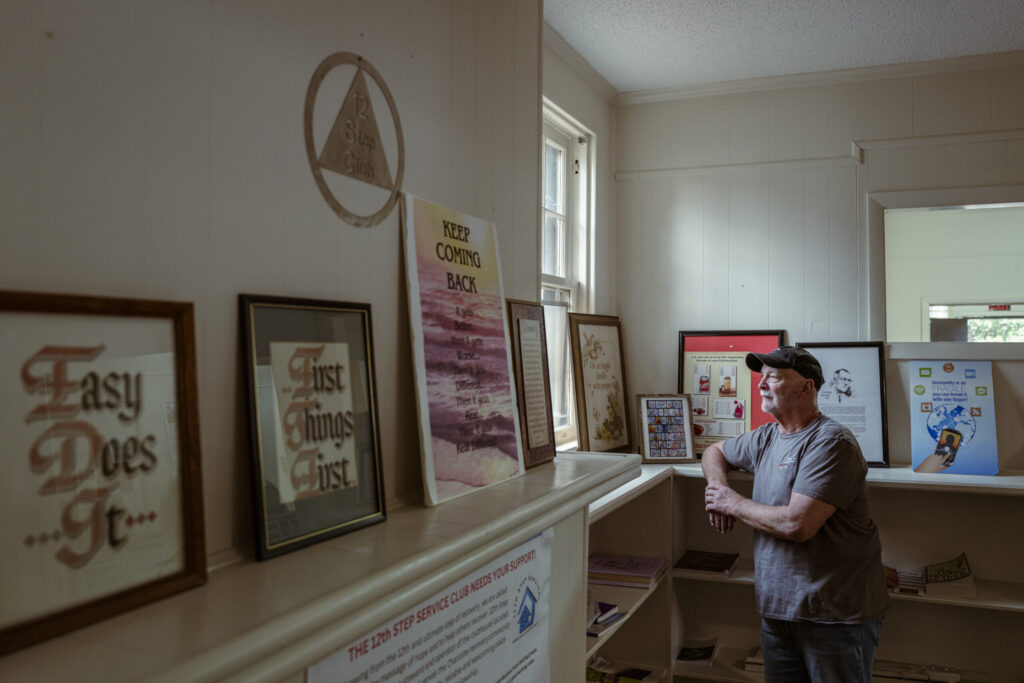
“People look at you and say, ‘I don’t know why you can’t quit,’” Jimmy Niell, a member of the group who volunteered his name, told me. Niell is a Charlotte native in his late 60s who was drinking and living in his parents’ house until eight years ago. Now he’s here every morning at 7:15 to get the coffee started. “People think it’s cured by willpower. It’s not.”
The meetings provide the club he’s been missing since his days playing high school sports, he says.
“There are judges, lawyers, priests, CEOs, every walk of life that’s come through here,” Niell says. “I tried to be unique. I said that I’m gonna be the one who can quit on my own. I couldn’t. I needed this place.”
Watson, meanwhile, still thinks like a reporter and storyteller, trained to look for patterns beneath the news and noise. Back when he was at the station, he worked through the lens of a recovering alcoholic, which is not necessarily a liability: He wanted community leaders to be as honest with themselves as people in the 12th Step meetings.
In 2004, Watson’s reporting revealed that a chain of dental centers was putting poor children through unnecessary procedures, only to receive larger Medicaid payouts. That dental chain shuttered, as the Observer noted. Later, he was direct in his reporting on former Mayor Patrick Cannon’s story, after Cannon’s arrest on corruption charges in 2013.
“I kept trying to point out in my coverage [that] I don’t know if this guy is a criminal, but I know he’s self-serving — which is fine! Just don’t pretend you’re serving the public,” Watson said.
He applies the same lens to the country’s troubles and tensions today, which he attributes to “unprocessed trauma.”
“We have been through 9/11, two wars, Wall Street collapsing, which is trauma, trauma, trauma, trauma, trauma,” he says. “And then finally, you had, you know, hundreds of thousands of people dying of COVID and complete isolation. And then, and then, you know, an attack on the Capitol.
“Nobody has said, ‘Folks, we’ve been through a lot.’”
Recovery begins with naming what’s broken, he says, and telling the truth about it.
***

Watson didn’t take another sip after being fired in 2015. He went on to form a few other projects, including a podcast series called “Man Listening,” which featured women telling their stories while he listened.
Even these days, it still stings when someone introduces him as a person who “used to be” a reporter.
“I thought my obit would be ‘Stuart Watson, three-time Peabody winner,’” he told me. “But people are like, no, idiot. It’s ‘Stuart Watson, married for 42 years, father of four.’”
In a city full of strivers, and in an era of social media trends where people brag about what they accomplish from “5 to 9” (as in before work and after work), Watson and the friends he leans on in the 12th Step program have found a superpower through their brushes with the bottom: Titles and awards and LinkedIn bios are no way to measure how far a person’s come.
“The three principal facets of the ego, in my view, are wealth, status, and power. Well, the whole notion of [recovery] is you’re powerless,” Watson says. “We’re going to talk about what’s going on with you. How can you be at peace, no matter what?
“If you’re suddenly named United States Senator or CEO of Bank of America, good for you. How are you going to stay sober?”
Editor’s note: We updated this story with the correct time of the meeting.