

I’ve found one way being the mayor of Charlotte has changed Rob Harrington. You ready?
He’s started ironing his handkerchiefs!
Look, if you read this newsletter, you know I usually ease into scandals. But I thought you should know this up front.
Here in the 14th-largest city in the country, this once-trifling hornets’ nest that became a gold rush town that became a Banktown, a city that made the dab go viral and did whatever this is, has a mayor who wipes his brow with a cloth that’s been pressed.
His wife barely recognizes him.
“What are you doing?” Sharon Harrington, who’s been married to this absolute wild man for 37 years, asked him the first time she saw it happening.
On the last Thursday in October, we’re in Harrington’s office at the government center, 17 days after he used a rare veto to prevent city council from delaying a vote on the all-important airport lease, and 11 days before the November 9 vote on that lease. If the lease gets done, Harrington will have navigated three generational issues he inherited over the summer — I-77, data centers, and the airport — and he will have steered a sometimes chaotic council toward something like order.
He’s decorated the office walls with old images from Charlotte’s mill-town days from the Levine Museum, and artwork courtesy of ArtPop and others. Before we sit, he tilts his head toward one piece behind the couch and says, “That seems slightly crooked. I’ll fix that.”
I ask him where that streak comes from. He warns me the answer will be “truly, truly mundane,” then tells me about the handkerchiefs, which leads to him talking about his father.
James Harrington was born in 1915 and served in the Navy. He ran the Harrington house in Florence, South Carolina, like a captain runs a ship. He had a ledger sheet for finances, which he filled out meticulously. He ironed everything.
“He had that streak in him,” the mayor tells me.
***
On a Thursday in early May, Rob and Sharon saw the news like everybody else: Mayor Vi Lyles announced she planned to retire on June 30, just seven months into her fifth term.
Lyles’ final year was difficult. She received death threats after the murder of Iryna Zarutska on the light rail, and by spring she seemed to have decided that the new fights, from data centers to the toll road, were for the next generation to figure out.
The Harringtons consider Lyles a family friend; Sharon worked for the city when she arrived in Charlotte in 1999, when Lyles was the deputy city manager, and calls her a mentor.
People started calling Rob, who’d chaired the Levine Museum and the library boards, and been president of both the county and state bar associations.
“He started to look in the mirror and said, well, maybe I can do that,” Sharon told me.
A crowd filled the chamber on June 22 to watch the city council do two important things: Honor Lyles’ lifetime of service to the city, and select a new mayor from a field of five finalists. About 30 speakers voiced support for their preferred candidates. Council members cast ballots in envelopes, and in a runoff with Carrie Cook, Harrington won the job with six votes.
I met him in the hallway afterward. He told me his phone was lighting up, and that he was going home to his grandkids. They’re 4 and 8 and were visiting for the week. Sharon considered bringing them to the meeting but decided against it because, as she told her husband, “If you lose, they’ll be upset.”
When she saw he’d won, she got a cake ready for him.
***
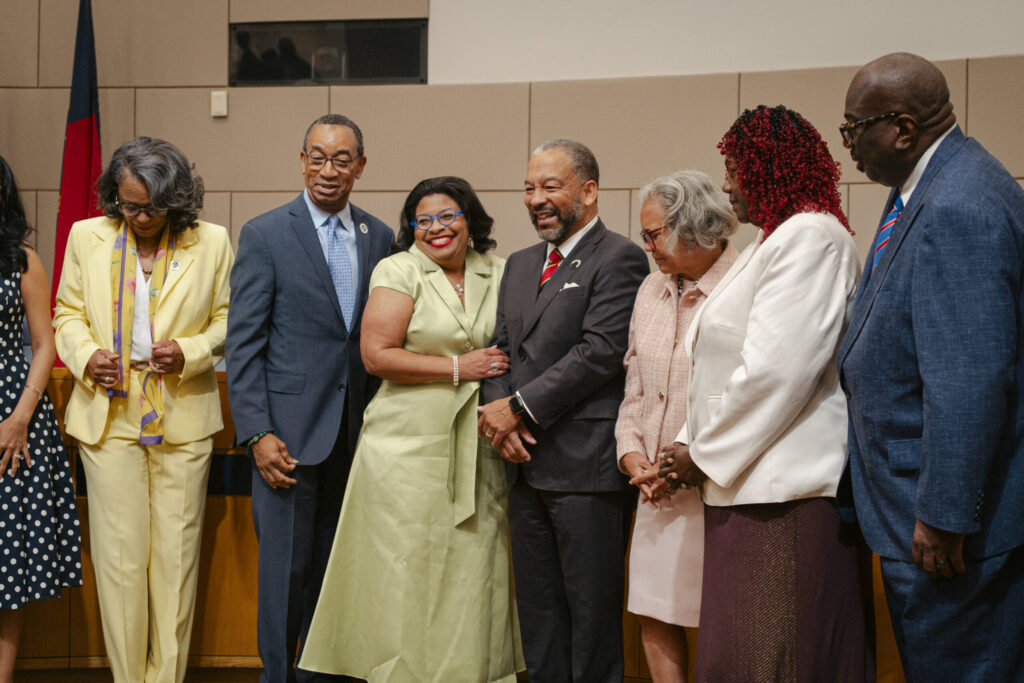
Rob and Sharon are well-known figures in Charlotte’s civic circles. He’s better known in some areas; she’s the star of others. But often, at least until he became mayor, they were known as a pair.
“I think people seeing you through your spouse does a lot to humanize you,” Rob told me. “And gosh, it provides a lot of company.”
They met in law school at Duke. He finished in 1987 and clerked for a federal judge in New Orleans, a conservative whose politics ran opposite his. His sisters lived there, so he felt at home. The judge gave him a tie from Ben Silver, and Harrington still buys his ties there today.
After Sharon finished law school two years later, she got a job in Washington, D.C., and Rob moved there. They married in 1989, had their son in 1990, and moved back to New Orleans for the next decade. They came to Charlotte in 1999, and Rob’s been at Robinson Bradshaw ever since.
New Orleans was once the biggest city in the South. Atlanta, Houston, Dallas, and Miami had passed it by the time the Harringtons arrived. The oil companies had moved offices to Houston. Harrington still calls New Orleans his second-favorite city, and it shapes how he views Charlotte.
“For all the challenges that come with growth, being in a place where the infrastructure in the city is receding is so much tougher,” he said. “We can always open parks. We can open pools in the summertime. We can pave streets. We can build highways. In some cities, that’s much more of a challenge.”
“I’m definitely marked by having been places where you couldn’t take it for granted,” he added. “You’ve got to hold this thing together and enjoy the benefits of it. Make sure the benefits get shared equitably, but also just realize that we have a whole lot of advantages, and cities don’t run on their own.”
He doesn’t think Charlotte is in danger of falling, but, “if you’re not careful, you don’t catch it in time.” That’s why leaders “need to lead with some form of optimism. Not telling a story that’s not true. Not avoiding the difficult parts. But I think we are a part of making people feel confident.”
***

Harrington was the youngest of five in that house in Florence. Born in 1962, he went to multiple elementary and middle schools while the community struggled to integrate. His oldest two sisters spent their entire schooling in segregated schools. All the Harrington siblings went to college. Four became professors; Rob became a lawyer.
Their father was a mail clerk on the railroad. In the smaller towns, the train would slow to a roll, and Rob’s dad would drop one bag of mail at one end of the platform, then pick up the outgoing mail at the other end.
Around 1970, airplanes took over long-haul mail. The postal service offered to keep James on, but he’d have to move to Columbia. He stayed put for his family. For several years, Rob’s dad had three jobs: selling vacuum cleaners, driving the activity bus for schools, and teaching night school. “Kind of holding it together,” Harrington remembers.
James got a job with the state’s vocational rehabilitation office, training people for jobs. Rob spent a couple of summers riding with him. “You just learn little things about people,” he said.
The Harringtons’ neighborhood included principals, teachers, ministers. Rob’s parents were both college graduates; his dad went to Claflin and his mom went to Bennett. Their next door neighbors, Charlie and Janie Rainey, didn’t have much education and couldn’t read well. Every so often, Charlie would come over with a stack of bills, and Rob’s dad would sit and work through them. On Saturday mornings, Charlie would pay him back with a plastic bowl of fruit and a glass bottle of Coke.
“It’s one of the things that happened in the neighborhood,” Rob recalls. “We didn’t have any money. They certainly didn’t have any money. But how could you help?”
***
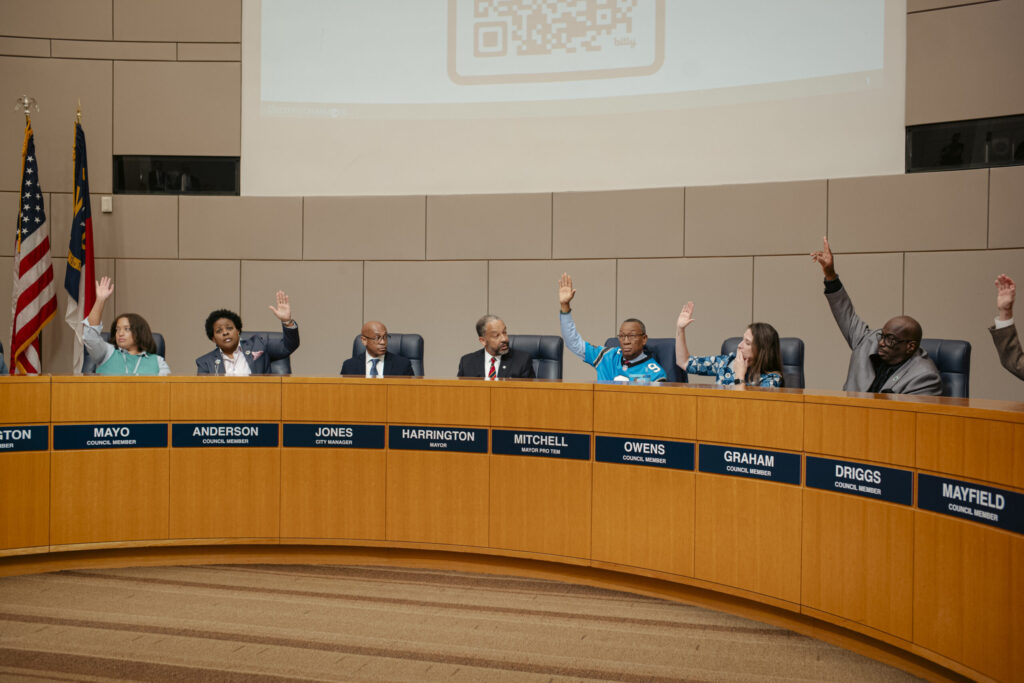
Sometimes during Monday council meetings, members will breeze through motions and seconds without explanation. Harrington believes his job is to slow them down, to read the motion and get a second, and have the discussion. Council members laugh at him, in the way that you’d laugh at the rule-following captain of a basketball team. During the public forum before the I-77 vote on September 21, Harrington kept each speaker to two minutes. He’d remind them that he’d given the same two minutes to everyone. People who shouted from the crowd were removed from the chamber.
He knows it sounds boring, to be known for running a decent meeting. But it’s what the council told him they wanted.
“If you’ve got a city of a million people, and you’ve got a four-and-a-half-billion-dollar budget, and you just tune in to watch it, I don’t want you watching something that you don’t understand,” he said. “I’ve got a decent amount of leeway to be pedantic.”
The part people don’t see, Sharon told me, is what happens in the days before a meeting. Sharon calls his city phone his “bat phone,” and he keeps it on 24 hours a day. Before any big vote, he’s usually working it, listening to concerns from council or community or staff. She said he wants them to have the data and all of their questions answered before they get to the dais.
“There are no surprises,” Sharon said. “He has done his level best to make sure that his fellow colleagues are ready to make a decision.”
Which brings us to October 12, and to the airport lease discussion. After airport leaders presented the highlights of the lease to city council, a few council members wanted to delay a vote. They went back and forth over whether the delay would be six weeks, or 45 days, or end on November 23. By the time they voted on when to have a vote, the rest of us in the room were confused. Still, the delay passed, 6-5.
That’s when Harrington did something no mayor’s done in more than a decade. “With some trepidation,” he said, “I’m going to veto that motion.”
After the veto, Harrington “connected in one way or another with everybody on council” and talked it through.
I asked him how the veto made him feel. He started by replaying the reasons — the motion was hasty, that they hadn’t discussed it enough — but I stopped him and said, “Yes, but how did it make you feel?”
“At the time, I felt like it was the right thing,” he said. “Afterwards, I felt like it was the right thing.”
He’s since used the word “trepidation” in other meetings with colleagues, and they’ve said, “I see that’s your word.”
***
Lots of folks are going into Monday night’s airport lease vote with trepidation.
This past week, outgoing U.S. Senator Thom Tillis said on the R&D in the NC podcast that he would “move heaven and Earth” to create an airport authority if anyone from Charlotte’s government “steps out of line.” Action NC sent an email blast over the weekend urging the city to pause the lease and look for ways to lower fares.
Harrington is, as ever, more diplomatic, telling me that “a healthy airport is vital to what we do here,” and that American Airlines has been a good partner. But he understands why airport workers want more than what the city can do for them under state laws, which keep local governments from setting wages or working conditions for private employers. He wants to help ensure that airport workers see a career path to move up and into different roles.
He compared it to the 77 debate, when people kept asking him: “What’s a year in the life of a city?”
“Well, that’s a great statement,” Harrington told me. “It is not tied to the facts or the situation. We weren’t able to bump it for a year. … That’s what we need to ask for: Just make a sound decision that’s not based on some things that aren’t really there.”
If the lease passes Monday, Harrington can turn to the rest of his list. He wants to work on housing and affordability, and find ways to help make construction easier. He spent the fall campaigning on behalf of the $125 million affordable housing bond, which passed with 62 percent of the vote.
He has assured people, time and again, that he will not run for mayor in the 2027 election.
I suggested to Sharon that, the way things are going, some community members are already whispering that he should stay on. She laughed. “I do think he’s been very successful, and the beauty of his decision-making is because he is present,” she said. “He’s not thinking about the campaign down the road or positioning himself for a campaign.”
I asked her how he’s different now than he was in June.
“I don’t think he is,” she said. “Just different hours.”
***
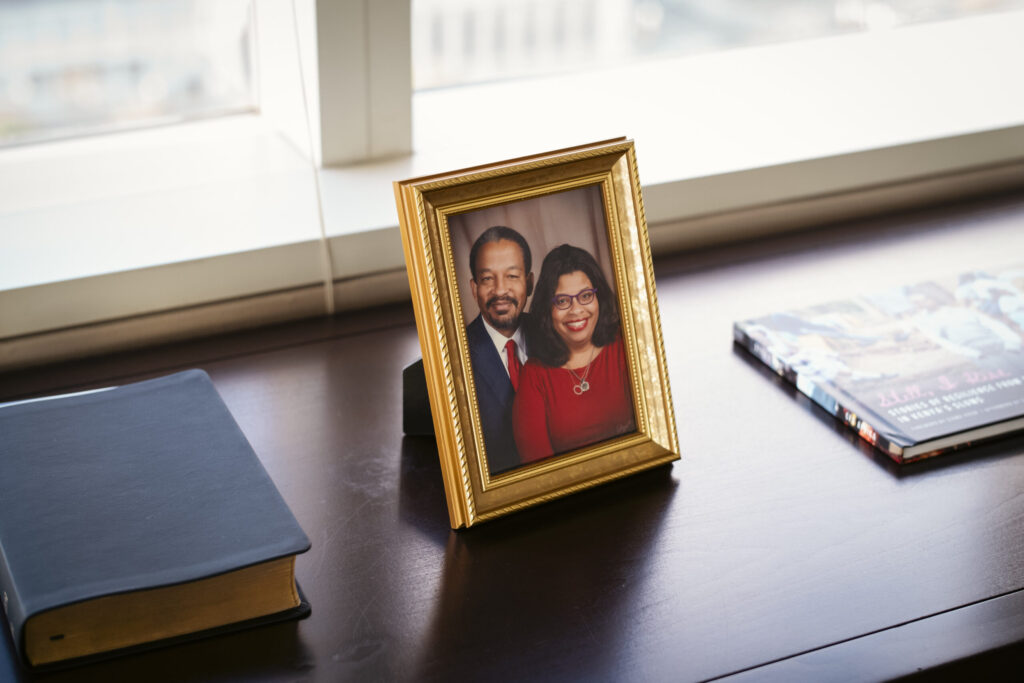
On Friday, I asked Sharon about the handkerchiefs. Rob had joked about them with me. Sharon didn’t.
The first time she saw him ironing them, she suggested he could save himself time by sending them to the cleaners.
“And he gave the most heartfelt, meaningful response,” she told me. “Doing that little simple chore reminds him and reinforces and channels his dad, and the values that were instilled as he was growing up in their household: this discipline and organization and what a gentleman always has.”
James Harrington died in 1987, during Rob’s third year of law school, the same year he and Sharon met.
A gentleman, Rob told Sharon, always carries a handkerchief. Not for his own sweat, but so he has something to give to a person who’s having a hard day.
“It’s the ability to pull out that handkerchief to show empathy,” Sharon told me.
And if he’s giving it out, I suppose, it had better be pressed.
Editor’s note: We corrected this story to show that the artwork in the mayor’s office came from multiple sources, including ArtPop, not Arts+.