
🎧 Listen to an audio version of this story, as read by Michael.🎧
Back in 2013, I had an assignment to imagine what life in Charlotte will look like in 2058. I spent months interviewing planners, sociologists, academics, and interior designers, and wrote my best predictions for the future.
During my research, I watched the 2011 documentary Urbanized, which opens with a line from former New York City planning director Amanda Burden: “Urban design is really the language of the city. When you walk down the street, everything you see has been designed.”
Charlotte is easily the largest city I’ve ever called home. Where I come from, nature is the only landscape designer. So Burden’s words were, to my ignorant ears, a revelation.
Behind everything in the city are people who designed the routes we walk, the signs that draw our attention, the roundabouts and four-way stops that keep us from crashing into each other. And the better and more thoughtful the design, the healthier the communities within that city.
Once you see that, you can’t stop seeing it.
I’ve had a similar awakening since launching The Charlotte Optimist about another force that shapes the city: communication.
Behind everything you learn about Charlotte — breaking crime news, medical breakthroughs, a brewery’s response to a scandal, economic development victories, the Interstate 77 toll lanes controversy — is a person or group of people who decide that you should hear it, shape how you will, and decide what you won’t. Even silence, like in the case of the school board’s approach to talking about superintendent Crystal Hill’s summer suspension, is a choice made by people.
There are more of those people than you may realize. We have about 2,470 public relations specialists working in the Charlotte metro area, according to the most recent federal employment data. We have only 360 news reporters, a number so small that the government’s own uncertainty estimate says it could be as many as 440 or as few as 280. Either way, it’s safe to assume there are around seven PR pros for every journalist in one of the fastest-growing cities in America.
Of course I have feelings about this. But as an observer, I’m mostly fascinated by what it means about how we talk to each other and what we know about each other.
You would think that with a ratio like that, brands and businesses and governments would feel freer to run whatever messaging they want, true or otherwise. Instead, messaging fiascos persist, and often communication becomes not a vehicle for a story but the story itself.
Last year around this time, in then-Mayor Vi Lyles’ first statement about the killing of Iryna Zarutska on the light rail, she centered mental health and mentioned the victim only once, opening the floodgates for weeks of criticism targeting her and the city. The arrangement of her words mattered more than the merit of them.
This past spring, N.C. DOT’s insufficient communication on the I-77 toll lanes project contributed to council pulling its support.
And just two weeks ago, reporters greeted a school board member outside of a public event to ask questions about the superintendent’s investigation. In the 90-second interaction, Cynthia Stone turned back and forth to escape the reporters. As WSOC’s Joe Bruno pressed her on whether she thought the superintendent was doing a good job, Stone said, “Y’all make your own decisions.” No matter your opinion on the controversy, the clip was a signature moment in a larger communications mess.
“Those jam-ups are always a last resort,” Bruno told me, when I asked him about the value of a filmed interaction like that. “No politician looks good running away from the media. The media rarely gets an insightful answer having to chase someone down the hallway. As a reporter, I would much rather have a civilized conversation with someone.”
This all left me with questions. Why does a booming city that is well-resourced with communicators struggle with communicating? And what role does that play in the trust crisis?
Well, after talking with about a dozen people in and around the profession over the past few weeks, I’ve come to believe that I might’ve been asking the wrong questions. It’s not that Charlotte’s necessarily bad at communicating; it’s just unevenly good at it. And the nature of communication is changing so quickly, with the rise of artificial intelligence and the shrinking of original journalism, that the gap between organizations that invest in meaningful comms and those that don’t is one of the driving stories in the city.
Communicators now sit in executive roles, not simply behind press releases and podiums. And for the everyday citizen, media literacy is an increasingly critical skill, and it’s more complicated than just understanding which way your local paper’s editorial page leans.
Let Anna Stallmann, founder and CEO of Ascent Strategic Communications, explain: “If you realize you’re being sold and marketed to 24/7, and you can call spin when it’s spin, and know when you need to dig deeper, and you can understand how they’re framing a message for their audiences, then we can all be better empowered to make decisions on how we interpret information being thrown at us.”
Storytellers didn’t leave Charlotte. They just moved.
Jason Schneider was fishing through old boxes from his career recently when he discovered 20-year-old clips from his time as a reporter for the St. Pete Times, the Associated Press, and the Florida Times-Union — three outlets that were once coveted landing spots for young reporters. He read a few and thought, Hey, this isn’t bad. Some of these stories are pretty good.
Before he could get too high on himself, his 10-year-old son walked into the room and said, “What are those?”
“Oh,” Jason told his kid, “this is a newspaper.”
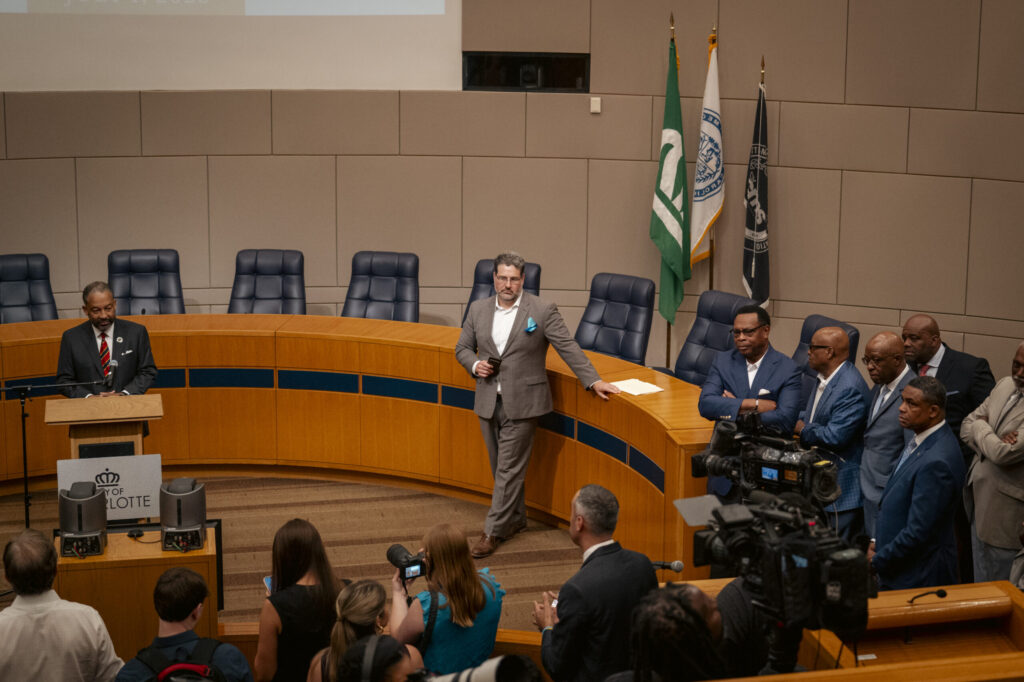
Schneider now is the City of Charlotte’s communications director, overseeing a team of about 30. But before this job, he spent about seven years on Atrium Health’s comms team.
He was in that job when he first understood where this all was headed. One day he called up the new healthcare reporter at The Charlotte Observer, just to make an introduction. For three decades, the Observer had a defined healthcare reporter in Karen Garloch, who covered Charlotte’s two large hospital systems and other issues.
But during a downsizing in 2017, the paper told Garloch it would eliminate the health beat as a standalone job, so she retired. The editors merged the health beat with others. And that day on the phone, Schneider said, the new healthcare reporter told him he’d been handed the beat despite already overseeing coverage of banking and energy. Three of Charlotte’s largest and most important industries, for one reporter.
“[The reporter] was like, ‘Look, man. Unless you guys really screw something up royally, I’m not covering you. I’m not going to do the stories about this cool healthcare innovation, and I’m not doing the feel-good patient stories,’” Schneider remembers. “So it was like, alright, we’ll tell those stories. We’ve got social media. We’ve got a bunch of former journalists on the team. We know how to tell stories, so we’ll tell those stories. It wasn’t about trying to put spin on something. It was just, these are cool, good stories, and if they’re not going to tell them, we will.”
Today, Atrium Health (now Advocate) has a comms team with more than 60 people, and about 20 in North Carolina, which makes it one of the larger “newsrooms” in the state. It’s true across town. Many of the people who filled storytelling gaps like the one Schneider saw came from outlets that left them open. Several of the city’s most experienced reporters joined the communications and storytelling teams at banks, healthcare systems, and Duke Energy.
Cristina Bolling has watched the shift from both sides. She spent nearly two decades at the Observer, then helped build The Charlotte Ledger as its managing editor. In June 2025, she left the Ledger, and she now runs Novant’s brand journalism department, assigning stories to freelancers and staffers.
Bolling oversees Novant’s Healthy Headlines website, which mixes useful content like “Want healthier kids this school year? Follow these 5 tips,” and human stories like one about a girl who’s lived with epilepsy. Bolling tells me she still wakes up each day trying to find the most interesting stories that will connect with an audience. After Senator Lindsey Graham died suddenly this summer, Novant published a piece about aortic dissection, the heart condition that took Graham’s life.
“In the old days, companies would put out press releases about themselves. Like, General Motors would put out a new car, and say, ‘This is our future, and we have this many people working on it,’” Bolling told me. “But now I’m pretty sure General Motors has a team that is telling you ways to optimize your fuel efficiency, and what’s the best way to get salt off your car in the middle of winter. … because their local newspaper might not have an automotive writer that they used to have in 1980.”
Schneider loves hiring journalists. “The things that would make someone a good journalist make them a good communications professional,” he said. “The curiosity, the work ethic, the passion. I can teach them communications.”
There’s also a less sentimental reason for why the people who used to tell stories about Charlotte’s companies and institutions went to work for them. They can make more money. That BLS survey also shows that Charlotte PR pros earn about 23% more annually than our local journalists.
The downside is that veteran reporters sit on the institutional side, while Charlotte has become a pass-through market for young reporters. People in Schneider’s position, then, become victims of their own hiring success. They build out a big bullpen of institutional knowledge at the expense of the outlets that cover them.
Interactions with journalists become transactional, and trust suffers, not only between the institutions and media outlets, but between the general public and the information they receive.
“When it’s more transient, it’s just different when you’re trying to build relationships,” Schneider said. “If your plan [as a reporter] is to be in a market for a couple of years, build your book of clips, and then move on, your whole approach to how you work with people is different.”
Access to leaders is more available than ever, but less examined
One of the most inflated words in public discourse these days is “transparency.” It’s become the umbrella term for anything we want to know but don’t.
Schneider and the city are consistently blasted by reporters and the general public. So are most local governments, healthcare systems, and large corporations. The irony here is that many of these organizations are more prolific than ever. Novant and Atrium, for instance, pump out more stories and information about healthcare than even the most well-staffed newspapers or television stations in the 1990s.
And at the government level?
“We broadcast all of our meetings. We broadcast all of our committee meetings. It’s on YouTube. It’s on the government channel. It’s on the website,” Schneider says. “Our council members all have social media. … We’re putting out more information than we ever have before. … But there’s also more noise out there. So it’s like, if the tree falls in a forest — or if a news story runs and no one watches it or tweets about it — did it happen?”
Public records are another issue; governments and institutions respond to more of them than ever, but the process is slow and can seem guarded. Schneider and the city found themselves in a firestorm over transparency in May 2025, after council met in closed session to agree on a retirement settlement package for CMPD chief Johnny Jennings. The chief ultimately released the details of the $305,000 package, but by law it was his choice to do so.
“One thing that I think about, particularly on HR stuff and personnel stuff, is there’s a human being on the other end of that file,” Schneider says. “Yes, there is public information and public records, and the public has a right to know some stuff. But I always try to put myself in that position of like, ‘Alright, John Q Public, if that was your personnel record, what if there’s a false accusation in there, and an investigation found that it’s a false accusation? Would you want that out there?’”
The stories you never read

On March 3, 2020, Atrium Health infectious disease specialist Katie Passaretti put on a white coat and stood in front of a Rosie the Riveter print to directly deliver news about COVID-19: “It won’t be that long before we see cases in the Charlotte area. That’s not something that should cause people to freak out.”
Over the next two years, Passaretti became the face and voice of Charlotte’s response to the pandemic. She held dozens of briefings and always took reporters’ calls. Charlotte magazine named her a 2020 Charlottean of the Year.
And that was all an intentional result of Atrium’s communications shop.
“Very, very purposeful,” Atrium senior vice president of communications Chris Berger told me recently. “She was such a credible voice and believable, and that’s just who she is in general. So it wasn’t putting on an act.”
Before coming to Atrium in 2017, Berger had a long career in comms, including a senior role at Walmart. Today he oversees a team of about 60 across eight states. He sits on Advocate’s senior executive team, which is important, he says, because, “if you don’t have a seat at the table, you’re just an order-taker.”
In 2021, Passaretti was the first person in North Carolina to receive the COVID vaccine. That’s also about the time public sentiment shifted. By 2023, and especially during the 2024 presidential election year, conversations became about the mistakes made during the pandemic response, and who was responsible. Artificial intelligence entered the chat around the same time, and patients suddenly were showing up to ordinary doctor’s visits armed with “I did my own research.”
“We went from saving the world, we’re healthcare heroes and all these things, and there was a tangible switch,” Berger says. “Hospitals were immediately switched into this bad-guy mode.”
He says 98% of the coverage Advocate receives today is positive, but the 2% gets most of the attention. That’s long been true — “if it bleeds it leads” isn’t just a saying — but the modern information environment has made it more pronounced.
I’ve spent the past two months talking with anyone who’ll listen to me about a conversation writer and podcaster Derek Thompson had with philosopher Agnes Callard, around her theory of the “uni-context.” Essentially it’s the idea that we all now speak and act in one universal room, where our grandparents and bosses and children can see anything we post, rather than in the separate rooms humans lived in for most of history. And a universal room, Callard argues, is much more likely to agree on what’s bad than what’s good.
“In general, goodness is more context-dependent than badness,” Callard said in the interview. “Happiness depends on your context and who you are. There isn’t anything that will always make a person happy. But there are reliable ways to make people unhappy. There’s a set of evils that are close to universal: death, pain, illness, violence.”
Berger and Atrium’s comms team have adjusted to the new reality, working harder to get out in front of negative stories.
One example: In 2023, The Guardian was working on a story about the methods Atrium once used to collect medical debt, including seeking liens on property. Atrium stopped collecting about a year earlier, and it was canceling all of those old judgments and liens, forgiving some that were 20 years old. Berger flew to New York to meet with The Guardian’s editors to provide more context and offer the reporter a chance to spend more time with them. The piece still ran, but Berger says it was better because of the interaction.
On that, Berger’s team now keeps stats on stories that aren’t published, “because that’s just as important as what makes the news.”
You might call it a “kill metric,” but Berger says it’s not as unsavory as that term might sound. His job is to protect Advocate’s brand, for sure, but he says the larger goal is that he wants people to trust the system enough to come in for care when they need it.
“Let’s say a reporter reaches out and says, ‘I heard about this,’ and we’re able to show them that their premise is not factual, and we tell them what we’re actually doing,” he says, “it is so much better than that story hitting the air.”
The thing I’ve kept coming back to is that the problem with communications in Charlotte is not necessarily cold, hard lies. Most communicators I encounter value integrity first. The trouble is that most communications operations, especially shoestring operations, are not incentivized to investigate themselves.
Go back to Schneider’s tree-falls-in-the-forest line. He’s right in that the city broadcasts more than it ever has. But is a four-hour YouTube stream “transparency” if nobody watches it? And whose responsibility is that? Just last week, we wrote about how Queen City Nerve’s closure meant that it would no longer publish “Council Quickies,” a human-produced newsletter that broke down the long meetings into digestible bites.
Charlotte’s information landscape has several levels of things that go unsaid: there are the stories that never make it to press, like the ones Berger mentioned, and the public record fewer journalists are paid to watch.
At each point in my reporting on this story, I went back to Anna Stallmann, who studies this from inside the profession. She recently published an essay about “communications slop,” amid the rise of AI. She told me AI only puts more of a premium on genuine communication.
“We can make a message sound better,” she wrote in that essay. “We cannot make actions say something they don’t. When the two are in conflict, the actions win every time.”
“Page five of the PowerPoint”

I should be honest about how I’ve played a role in this sometimes. Last year, Scout Motors announced that it would bring its headquarters to Plaza Midwood. It was big news for the company, the neighborhood, and the state. I knew the announcement was coming a week ahead of time. And I knew a great deal about the comms plan.
The Charlotte Business Journal would break the news at 2 p.m. that day, only after (and if) the state passed the incentives package. And I was offered a longer interview with the company’s CEO; I could do whatever I wanted with it, as long as it didn’t jump in line.
I put it through the only filter that matters to me — would a fuller story, with an interview with the CEO, be valuable to the community and you as Optimist readers? I ultimately decided yes.
I mentioned this story to Bolling, the former Ledger editor who’s now at Novant, and she had a clear perspective: “You realized you’re probably on a spreadsheet. You’re page five of the PowerPoint. … The central question is, ‘Does this serve a reader, my readers? Will I be able to tell them something true and authentic?’ And if the answer is yes, then I can understand why you would go ahead with it.”
AI just made journalism more valuable
When I worked in management at Axios and Axios Charlotte, formerly Charlotte Agenda, I saw first-hand how the hospitality PR playbook changed.
When a new restaurant opens, chefs and owners often give a first look to Axios Charlotte. Both sides benefit. Axios stays out front on food news, and the restaurants get visibility with Axios Charlotte’s massive audience of 450,000 Instagram followers and more than 100,000 newsletter subscribers.
What’s interesting now, though, is that the placement has become more than a nice-to-have. Artificial intelligence platforms prefer to cite journalism outlets, making them more valuable at a time when there are fewer of them.
Rachel Sutherland and I talked about this. She founded her own firm 16 years ago, after taking a buyout from the Observer in 2009. She works with several hospitality clients and prominent local institutions. Sutherland told me she went to a conference earlier this year and expected to sit there and gripe about AI. Instead she came home with a light-bulb moment about GEO, or generative engine optimization.
“Anything that AI can verify as true or real — like placements in Southern Living, or mentions in the Observer — are helping boost [my clients’] ranking in AI searches,” Sutherland told me.
Muck Rack, a PR software company, recently analyzed more than 25 million links cited by ChatGPT, Claude, and Gemini in answers. More than 80% of the citations went to earned media. Paid content accounted for 0.3%.
It’s kinda wild to think about the progression! In the past 25 years, traditional outlets began to decline with the loss of classified revenue so they cut cut editorial staff, and then those editorial staffers went into communications, and then marketing dollars moved from larger advertisements to public relations firms that could help businesses garner earned media hits and boost their rankings on Google search. So every buck that, say, a restaurant spent on a publicist is one that it didn’t spend in a magazine or newspaper. That shift contributed to the advertising decline at those outlets, and they shrunk and shuttered. Now artificial intelligence cites those strained outlets’ work, while sending almost nothing back to them in terms of traffic or compensation. Only 4% of people click links in chatbots. In other words, newsrooms create answers, but rarely see the value. And in that equation, it makes sense that journalism outlets have turned more toward scandals and conflicts to differentiate themselves.
The Columbia Journalism Review mapped Charlotte’s local news ecosystem this spring and found that of Mecklenburg County’s 183 Census tracts, 52 received 10 or fewer mentions in local news coverage. Meanwhile, Uptown got 487. The report also showed that crime stories are most prevalent in coverage, especially in outlets with out-of-town owners. Take those facts, and put them together with the rise of news deserts in rural areas, and crime near Charlotte’s center city may be among the most-visible news in North Carolina.
Those stories also make for the most shareable ones in the “uni-context.” One example: In August, when a video went viral of a man assaulting a woman in Dilworth, Schneider’s tracking tools showed that 80% of the conversation occurred on X.
“Anytime anything happens in uptown, it gets reported on,” Schneider told me. “The exact same thing can happen in Hidden Valley, or on the west side, or another part of town, and no one’s talking about it.”
The parking lot
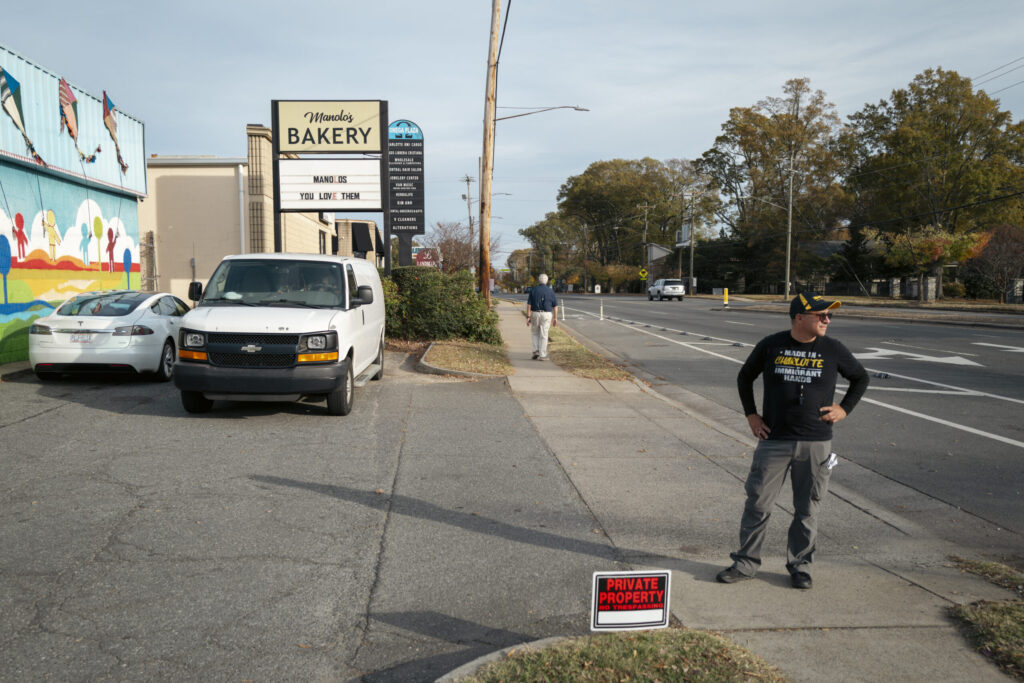
Just last Sunday, Gregory Bovino, the former border patrol official who led last November’s immigration operation in Charlotte, pulled into a parking lot along Central Avenue, the immigrant corridor where he’s most despised. He had a videographer with him.
When bakery owner Manolo Betancur, a Colombia native who’s been a U.S. citizen for nearly 20 years, saw Bovino, “I started shaking,” he told me. His bakery had been the hub of opposition to the raids, with people gathering and waving flags each night.
Manolo pulled out his phone, pointed it at Bovino, and shouted, “You’re not welcome here in Charlotte.” Bovino later told me in a message that he’d come to show that the businesses his operation touched were now “flourishing,” to signal to the president’s administration that they aren’t deporting enough people.
Bovino’s cameraman filmed the nearly 20-minute conversation that followed, in which Betancur unknowingly ceded control. Bovino asked all the questions, leaving Betancur on defense. It’s a basic, if counterintuitive, rule of communication that the person asking the questions has the power.
Manolo told me later he knew immediately that he’d said things in the heat of the moment that Bovino could use against him. And Bovino did, saying when he posted the video that Manolo “treats prioritizing Americans as the extreme position.”
Knowing this would come, Manolo sought to get out in front of the story. Immediately after Bovino left, Manolo called to tell me what happened, about 20 minutes before we went to press with last Sunday’s edition. Then Manolo worked with his team to draft a press release that highlighted the version of interaction that would resonate with his audience: “Manolo Betancur Denies Former U.S. Border Patrol Commander Gregory Bovino Entry to Manolo’s Bakery.”
Nearly every television station in town had a story up for their 10 p.m. or 11 p.m. shows that night.
I’ve spent a great deal of time thinking about the event. Bovino, who retired last spring, is no longer in any real position of authority. He can’t enforce laws. He does, however, have the power of a large audience, including the White House. So he took that audience to the parking lot to square off with a man who makes bread for a living. Manolo’s Bakery was flooded with negative online reviews early last week.
All of that is true. But was it real?
This parking lot confrontation was completely manufactured. Both men understood that. Bovino had a videographer and his audience. Manolo had his phone, his press release, and a friendly reporter he trusted in me. This reminded me of something Anna Stallmann told me just days earlier, about how in a crisis situation, newsmakers and communicators often go “to the most sympathetic writer or the most critical one.” Clearly Manolo, who’s been a friend of mine for years, started with a sympathetic one.
Remember Urbanized and those lines about how design shapes everything? The same principle applies in the parking lot incident, and to news and information and videos and all the other messages we receive daily. Media literacy is, more and more, not just a skill for those in the media.
I’m not saying you should be skeptical of everything. Much of what you see from professional reporters and communicators is — believe it or not! — true. Seriously — hand to heart! — most of us crave truth. The questions I wrestle with, whether it’s the parking lot story or the school board, are more about who designed the message and what they left out, and who didn’t have anyone to design their message at all …
… and how that all adds up to one person’s reality being another person’s fiction.
Editor’s note: This story has been updated to clarify the timeline of the Observer’s elimination of the health beat as a standalone job.