
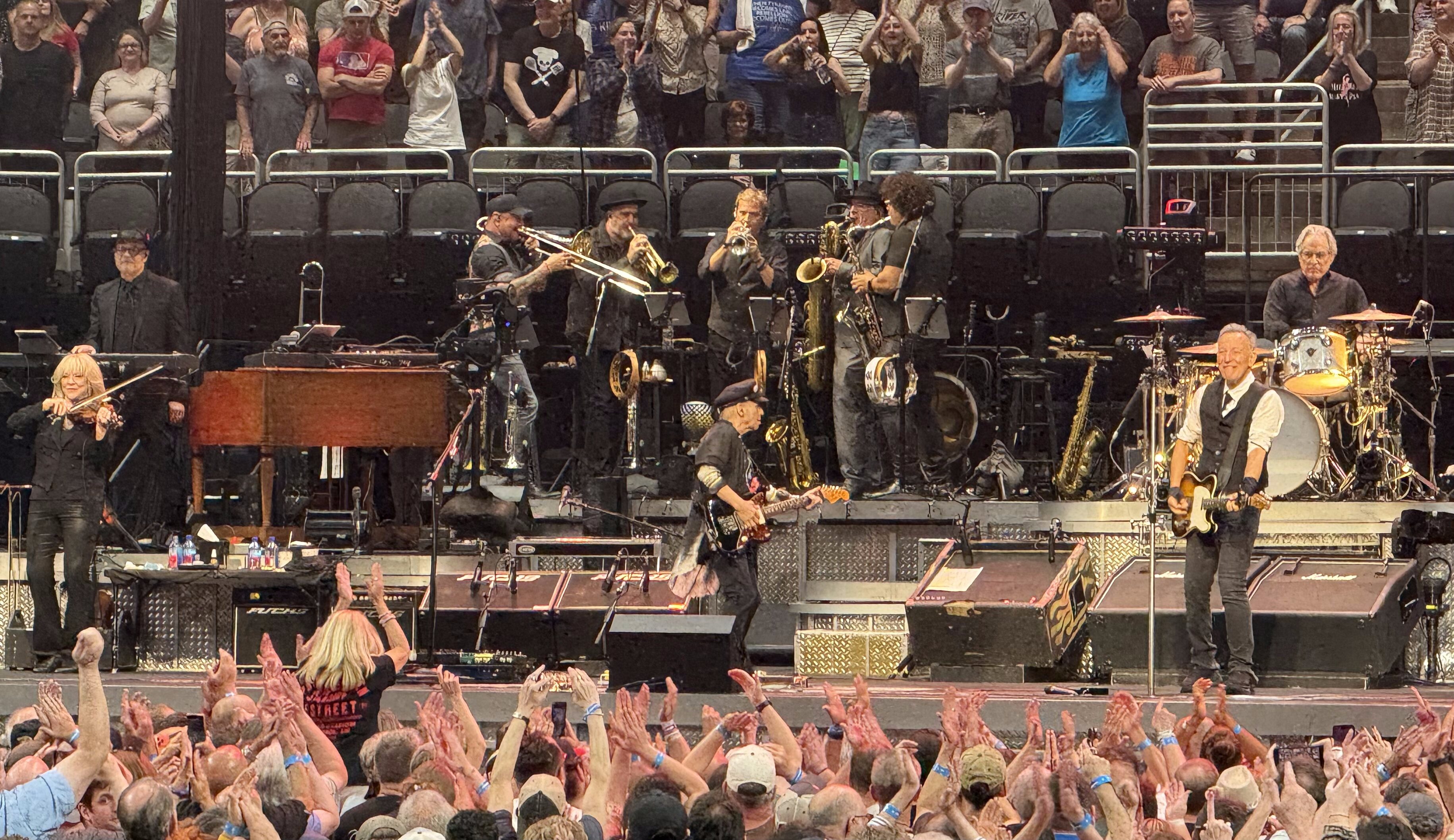
“Truth, compassion, humanity, thoughtfulness, morality, true strength, and decency — don’t let anybody tell you that these things don’t matter anymore, because they do.” -Bruce Springsteen, Pittsburgh, May 19, 2026
I wasn’t sure if I wanted to see him this way.
Bruce Springsteen has been part of my life since my mom first spun the new Born in the USA record when I was four years old in 1984. At the most recent concert I attended, in February 2023 in Atlanta, he was 74 and singing about coming to terms with aging. It was fine, but in a celebration-of-life way.
Now, though, he’s on what people keep calling a “protest” tour. He’s made enemies all the way up to the president, who blasts him regularly. Did I really want to sit for three hours with America’s illnesses and faults while watching my favorite artist potentially spiral into the rock equivalent of someone standing on a corner with a sign that tells me to honk if I like freedom?
I bought tickets to last week’s show in Pittsburgh anyhow, and went with my brother and our friends Alex and Sammy. This was my 11th Bruce show, which gives me some license to rank them, and boy was I wrong to doubt this one. He’s 76 years old, and I promise, rumors of his demise are false.
This was the most memorable concert of all 11, largely because it was much more than a “protest.” It was three-hour map for a comeback. If the 2023 show was “wise and reflective Bruce,” this one was a splash of cold water to the face, as if he realized wisdom ain’t worth a damn if you don’t put it to work. And standing there in section 104, 500 miles from home, listening to him sing 27 songs about the America he wants to see, I thought about our city and the current debates over what we want it to be.
I have to be honest: The time I’ve spent diving into the debate over the I-77 toll lanes — and city politics on the whole — has been less than pleasant. Not necessarily the outcome itself, but the trouble it took to get there. The regional transportation board held a surprise vote last week that rescinded support for good. This could be a good thing for Charlotte, or a bad thing, or something in between. Decent people can disagree decently. Along the way, though, we saw hurt feelings, surprise maps, broken friendships, political posturing and retribution, performative public comment, and hyperbolic op-eds and social posts that read a little too “touched-by-AI” for my taste.
Look, AI can be world-changing in areas like healthcare. And I have no problem with using it as an aide to boost your life’s output. But the act of using it to articulate opinions on a generational decision skips a pretty important step for a leader: showing others how you think critically in critical times.
Charlotte’s politics could accelerate in this direction over the next 18 months. The U.S. Senate race will heat up, and operatives will find ways to use the state’s largest city as a talking point. The mayoral vacuum, both for interim mayor and for the elected replacement in 2027, will challenge this city council’s values: Will they make the best decisions for Charlotte, or for their own political future? In a different time, maybe the answer would be an easy “both.” And maybe it can be again.
Observer columnist Andrew Dunn suggested last week that the I-77 vote, when linked to Vi Lyles’ departure as mayor, could be a tipping point for Charlotte politics, away from a pragmatic and business-friendly approach to a style that’s more aligned with blowing things up. I do think it’ll be a test of “The Charlotte Way,” the public-private partnership ethos that helped drive 15 years of exceptional growth. (The U.S. Census Bureau recently said that Charlotte added more people than any other city from 2024 to 2025.) But there are reasonable arguments that it’s time for a shift away from growth, too.
The trouble is trust. Last week, the writer Derek Thompson described what he sees as the “post-virtue” style of politics. “The moral blank check of ‘we don’t have to argue for our cause, so long as we can argue that our counterparty is worse’ might prove too tantalizing for the next generation of conservatives, centrists, liberals, and leftists to resist when they hold the reins of power.”
Which is why that quote I posted at the top of this column connected with me. Clearly, if 20,000 people in western Pennsylvania rise to their feet upon hearing that things as basic as “decency” still matter, this is worth fixing.
The Springsteen “protest” tour shows do start in the brokenness tearing towns and people and cultures apart: The opener was a cover of the Vietnam-era Edwin Starr song “War,” which gave way immediately into “Born in the USA,” about the consequences of war, and then “Death to My Hometown.” About an hour in, the mood bottomed out in darkness, with “Murder, Inc.,” about the ways inequality can foster a violent soul, and then “American Skin,” about the police shooting of an unarmed Black man in New York in 1999.
Then, though, Bruce pulled us up off the mat, saying, “This is a prayer for our country,” before the gentle opening of “Long Walk Home.” I’ve breezed past this tune for years, but in this setting and context, it became the most meaningful song of the night to me, because it was the moment things pivoted.
From there, like Rocky, Springsteen brought us to our feet for the rest of the night. Former Rage Against the Machine guitarist Tom Morello went berserk in “The Ghost of Tom Joad.” And “American Land,” the celtic song which for years was where Bruce would introduce the E Street Band members, this time stood alone as a celebration of immigrants’ contributions over the country’s 250 years.
The second-to-last song was “Tenth Avenue Freeze-Out,” an extended version where he walked through the crowd and built up to the most joyful line of the night: “Oh yeahhhh, oh yeahhh, it’s alrighhhtt.” Then he let us breathe before leaving with a benediction-like “Chimes of Freedom.”
As we return from the holiday weekend with a big week and month ahead for our city, I write this only in hopes that our leaders — elected and philanthropic and business — realize that we’re at a pivot point, locally and nationally. People from city council chambers to the rafters at a rock concert arena in Pennsylvania are expressing their feelings of powerlessness in all different ways, and the carpe diem strain of populism is mounting.
A hopeful leader in these times does more than win votes by portraying the “others” as “worse” options. They don’t stop at “stopping” a toll road; they present a solution. Charlotte, our on-fire city, deserves a well-articulated vision.
Hell, it can be something as simple as what Bruce did at the pivot point of his concert, with “Long Walk Home.”
Here everybody has a neighbor
Everybody has a friend
Everybody has a reason to begin again.
My father said, ‘Son, we’re lucky in this town.
It’s a beautiful place to be born.
It just wraps its arms around you.
Nobody crowds you and nobody goes it alone
Your flag flyin’ over the courthouse
means certain things are set in stone:
Who we are, what we’ll do, and what we won’t.”
Who we are, what we’ll do, and what we won’t.