

Editor’s note: Six weeks ago, we had a tremendous response to our collection of vignettes from around Charlotte, titled “What’s Going On With Charlotte,” so we’ll make it an occasional series.
ONE
Kirk Cobb, a former national merit scholar candidate at Charlotte Latin, took a swallow of Pabst and rolled his eyes when his mother told him not to hurt himself jumping off the stage.
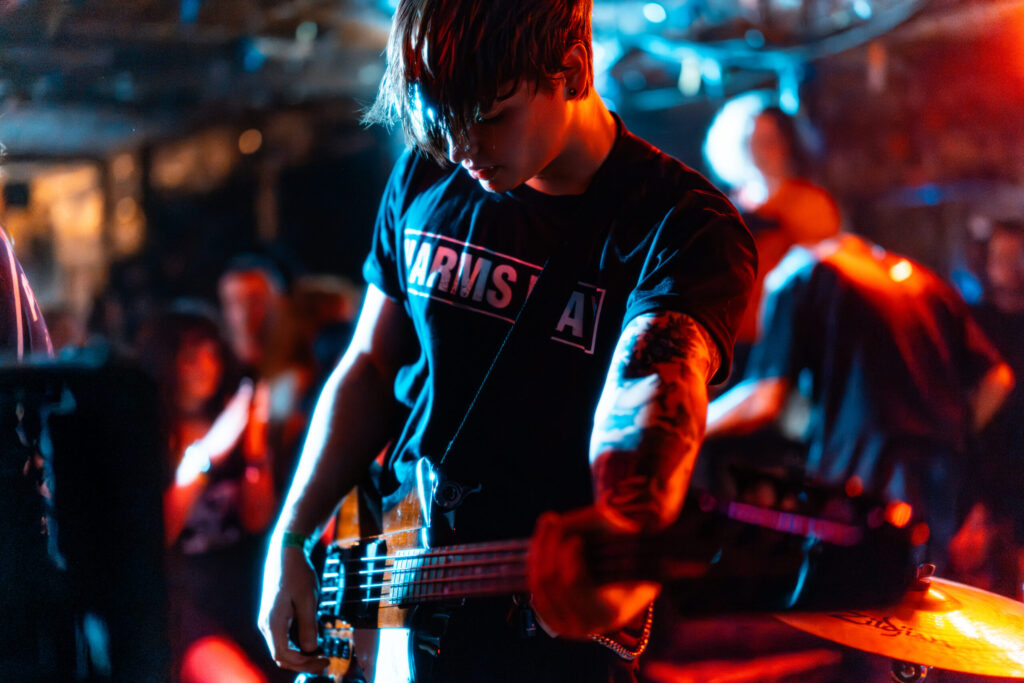
At 27, Kirk has a sleeve of tattoos down his left arm and a tight-fitting T-shirt that reads “Harms Way” across the chest. He’s maybe the most clean-cut member of the hardcore punk band Wastoid — a word made famous 40 years ago in The Breakfast Club — whose latest album includes a track titled “My Brother Was Eaten By Wolves On the Connecticut Turnpike.”
Around 11 p.m. on April 2, an hour before Good Friday, Wastoid took the stage at The Milestone Club, Charlotte’s treasure chest of the underground, and lead vocalist Michael Smith told the sold-out crowd he was recovering from food poisoning.
A fan snatched the mic from him and shouted into it: “Yeah, from eating too much ass.”
Next to me, Kirk’s mom, Kim, an accomplished lawyer who in the 1990s worked with the Republican Senate leadership in D.C., chuckled.
Then Wastoid ripped into the next song, stirring a crowd of 20-somethings in a small mosh pit. They were from all races and genders and backgrounds; a white guy in a white tank top was indented by a rough shoulder block from a Black guy with free-flowing hair, and then the two slapped hands and hugged. The music was nothing I’d play around the house — I didn’t understand a lyric all night — but the atmosphere was familiar.
It resembled the 1990s, when punk and grunge-fueled alternative music gave young people an angsty counterpoint to a mess of cultural forces: the glam rock and hair metal of the 1980s, the green CNN images of the first Gulf War in the early 1990s, and the economic fallout that followed. One of the first people I saw at the Milestone on this night in 2026 was a young guy who looked like Chris Cornell. I called Kirk Cobb a few days later and mentioned I saw a reincarnation of the Soundgarden singer, and Kirk said, “I know exactly who you’re talking about. His name’s actually Chris.”
As it happens, numerous bands from that era — Nirvana, the Violent Femmes, Henry Rollins — performed at The Milestone Club on their way to stardom. It’s all documented in the 2024 film How to Save a Milestone.
From the outside, The Milestone looks like it’s a good huff and a puff from being blown down out there on Tuckaseegee Road. The building’s more than 100 years old, and it’s been a home for rebel musicians for more than 50. Inside, the walls are covered with stickers and signatures of the artists who’ve come through. R.E.M. was here before they were R.E.M. The Go-Go’s. But unlike many old venues, the Milestone doesn’t wallow in nostalgia and demand you call it sacred. Instead, its strength is that it’s constantly, generation after generation, replenished with young people who are pretty sure it’s the end of the world as they know it, and they come here to feel fine.
Let’s face it: This is a suffocating time to be young. Your free speech is socially taxed. Politicians are sending your generation into another war in the Middle East. Your job prospects are being eaten up by robots created by people who haul in billions off your unfortunate born date. Social media companies have exploited your mental health throughout your lives. And if that weren’t enough, four Gen Xers just beat you around the dark side of the moon, which surely means millennials will soon be posting selfies with avocado toast in space.
The Milestone, with its rickety floors and stage and hit-or-miss plumbing, kinda gives young people a place to congregate under an umbrella of middle fingers pointed toward the sky.
“A lot of young people feel like they’re being left behind,” Kirk Cobb told me. “With the Internet age it’s so hard to feel a sense of connection in the real world. When you’re able to find a space like that, where you can see other people in front of you that look and think like you, and are OK with whatever you look and think like, that’s like striking gold.”
Cobb’s journey here was a trek toward better mental health. He’s brilliant, speaks like a writer, and works as a software analyst from his NoDa apartment by day. When he went to college at Lehigh in Pennsylvania after graduating from Latin in 2017, he sank into depression. He had a time-consuming major and ADHD. Then COVID forced him into isolation for his final few semesters. He took a job in New York after that, but worked all day from a shoebox apartment. When his lease ran out, he came back to Charlotte to reset and go somewhere else.
Then he found the Milestone. He started playing music. Within a year back home, he’d gone from a couch guitarist to a band member on stage. And looking out into the crowds of dozens, watching people like him let loose in one of the few spaces in Charlotte that allows them to be exactly who they are, he found happiness.
“I almost get emotional,” Kirk said when I asked him what it’s like to walk into the Milestone. “It’s like going to your parents’ house for a family cookout. You don’t live there anymore. Maybe you’re not the best of friends with every single person who’s going to be there. But you all have this mutual understanding of how important it is that we’re all able to be there together.”
TWO
Earlier that same evening, April 2, I wore a suit and tie to the Charlotte Center City Partners Vision Awards at the convention center. It’s one of the city’s most inspiring annual banquets, with presentations from business and government and philanthropic leaders. Mayor Vi Lyles was there. Police chief Estella Patterson was, too, accepting an award on behalf of CMPD in her solid blue uniform. Bank CEOs, developers, and lots of people with names on buildings or foundations or other city markers were, too.
The president and CEO of Center City Partners is also named Michael Smith. No relation, that I know of, to the lead vocalist who’d be screaming himself hoarse at the Milestone later that evening. This Michael Smith opened the seated-dinner event with a state of uptown address, citing lots of big numbers: the $25 billion transportation referendum that passed last year, the $850 million in office acquisitions since 2024, the new innovation district called the Pearl, the North Tryon tech hub, and how Charlotte’s central activity district — Uptown, South End, and Midtown — generates about $62 billion in GDP.
He was talking about the hardware of the city. Then Bill Rogers, CEO of Truist, stepped up to accept the big Vision Award and talked about the software. Rogers is, if you will, the establishment. But his words could’ve easily come out of Kirk Cobb’s mouth, about his friends at the Milestone.
Rogers talked about how when BB&T and SunTrust were set to merge and headquarter in Charlotte in 2019, he and his wife, Ashley, received personal invites into the homes of business and philanthropic leaders. Influential developer Johnny Harris called him and said, “Hey, Podna, what can I do for you?”
“Ashley and I felt rooted in Charlotte, sort of immediately,” Rogers said. “And we had friends; we didn’t have business associates. I don’t think that happens by accident. I think that’s intentional, and it’s built one relationship at a time.”
Then Rogers challenged the room: “Let’s not lose this. Let’s make sure we build on what makes Charlotte truly unique. … What makes this community special is not what’s built in it, but what’s built between us, and that’s a community that not only will flourish, but that’s one that will endure, and that’s something worth building together.”
I sped out of the convention center and found an empty parking lot on the west side, where I changed out of my suit and into jeans. Sometime after midnight, my ears still ringing, I drove home thinking about how the 27-year-old in the Harms Way T-shirt and the 67-year-old bank CEO have both reached, from opposite ends of the city, for the people who made them feel less like strangers.
THREE
On Easter morning at Myers Park Presbyterian Church, where my wife grew up going and where our oldest child spent four years in daycare, Pastor Joe Clifford opened with one of the few upbeat news stories of the year: the Artemis II mission around the moon. Watching the spacecraft take off reminded Clifford of how the Apollo program defined his childhood in the late 1960s and early ‘70s.
“The vast majority of novels and TV shows and movies that were set in the future imagined a better world,” he said. “My generation’s storytellers imagined a better future. That’s certainly not the case today.”
Popular media, Clifford said, has gone from the Jetsons and Star Trek to apocalypse movies and zombies. He mentioned a young couple who told him they have a plan for where to meet if the world ends.
“For all of our younger generations, people under 45, the world has always been ending,” Clifford said.
At about that point in the sermon, our 3-year-old hopped down from his seat to pick up a penny from under a chair in front of him. As he sprinted back to his seat, his rarely worn loafers got caught on the carpet and he tripped, slamming his head into a chair, causing a rush of tears and leaving a marble-sized purple knot.
“What if it always is?” Clifford said of the end of the world ending.
FOUR
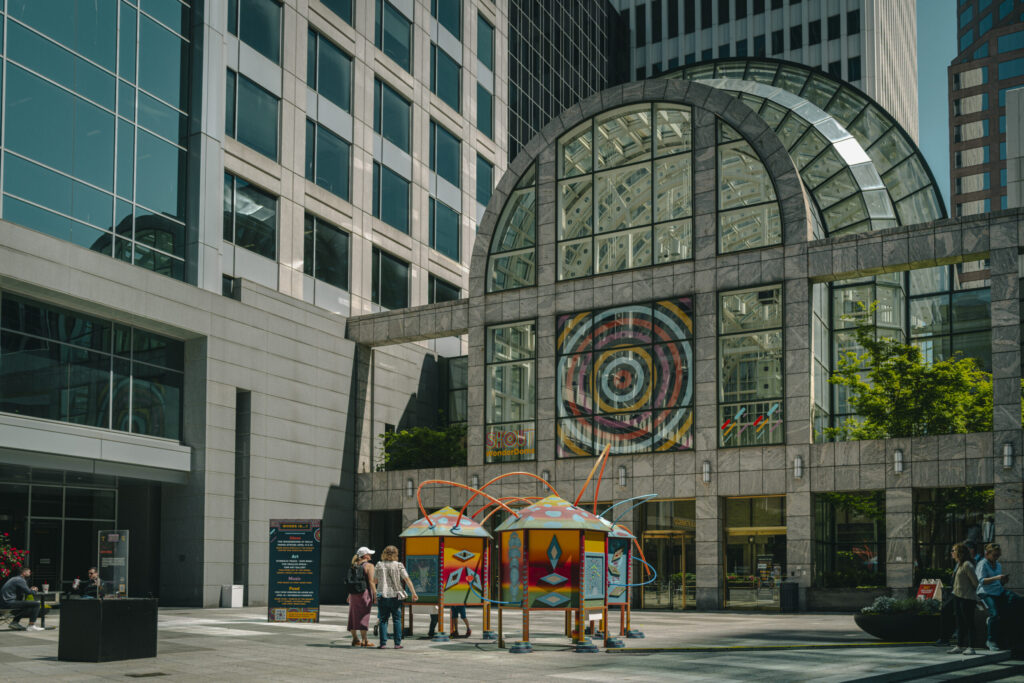
A few days later, I was on a prep call with three people for a panel discussion at the Charlotte Ideas Festival. Our topic was Charlotte’s story: What is it? Who gets to tell it? Who’s missing?
The call itself offered an answer. Tom Hanchett moved here in 1981 and has spent decades becoming one of the city’s most noted historians. Julian Berger is in his 20s, a WFAE immigration reporter and proud Puerto Rican who moved to the Charlotte area from New York when he was 6. He grew up in Harrisburg and considers Charlotte his hometown. Cheryse Terry grew up off Hoskins Road, became a mother of two before she turned 20, didn’t visit SouthPark Mall until she was 21, and now runs Archive CLT — a cafe off of Beatties Ford Road dedicated to preserving Black history and culture. Three people, three generations, three Charlottes, all on the same call trying to figure out how to describe one city.
We settled nothing, which was, we figured, correct. We agreed instead that Charlotte’s story is maybe a million individual stories, collected in slightly larger rooms.
At yesterday’s panel, when Ideas Festival founder Mark Peres asked us to consider what’s wrong with Charlotte — how its story doesn’t suit some people — and we listed affordability and all the other concerns. Bigger picture, the best answer I could give was that Charlotte isn’t a place for people who don’t like change, or who can’t be at peace with others changing it into something else.
All around us, uptown’s streets were full. Charlotte SHOUT!, our two-week celebration of arts and culture, is in its second weekend; Charlotte FC fans in blue jerseys were migrating toward Bank of America Stadium for last night’s match against Nashville. Neither of those things existed a decade ago. After a quiet few days at the coast with our kids for spring break, the city’s energy was a jolt, and a good one.
The news from the break had a through-line I didn’t expect to notice. Sil Ganzó, who built the nonprofit organization OurBRIDGE for Kids, became the first Latina to win Charlotte’s Woman of the Year award. A Japanese financial institution announced it would bring 2,000 high-paying jobs here. Wells Fargo announced $6 million in investments to support west side efforts, including $1.5 million to support the establishment of Three Sisters Market, the first grocery store in the West Boulevard corridor in more than three decades.
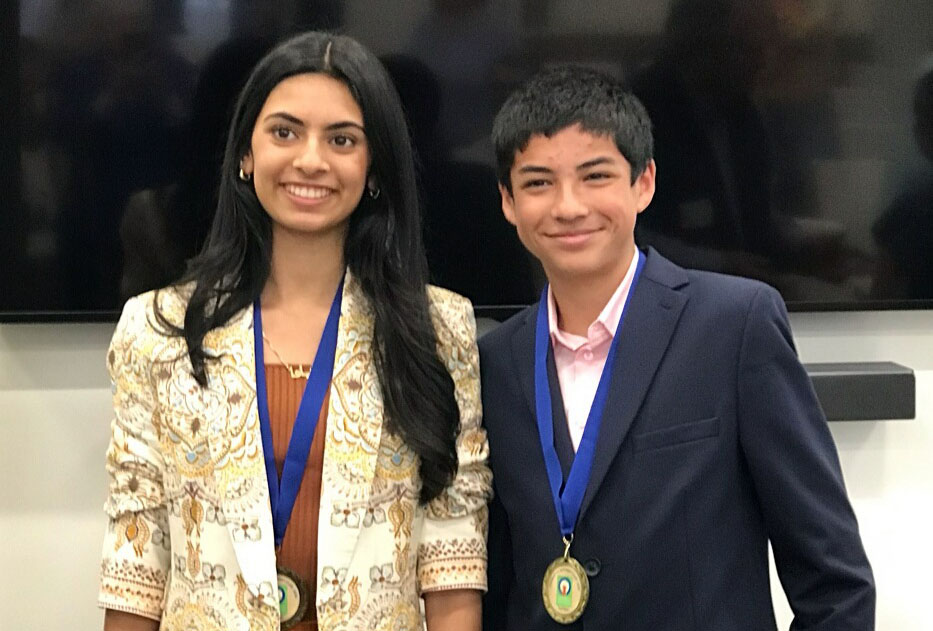
And The Charlotte Optimist Club held its 59th annual oratorical competition for eighth-graders, attracting nearly 400 participants to speak for five minutes. The field was trimmed to a half-dozen by late March for the final round, and the winners were Ayana Mahmud and Cameron Raven.
All 400 students presented on the topic: “The moment I realized I belonged. My definition of community.”
FIVE
Which brings us back to the Milestone.
I met Kirk Cobb’s dad, Jack, last year when I wrote for The Assembly about his nonsensical firing from the Consumer Financial Protection Bureau. We’ve stayed in good touch since, and Jack’s been telling me I should do a story on the Milestone since last summer. Finally, he tossed out a date that worked for me to join him, April 2.
“You made it!” he said when I walked in. The Atlanta-based band Squeamish was already on stage, shirtless and flinging sweat from wall to wall. Later, Japanese artist Kenmujo crowd-surfed before handing out nearly all of his instruments to the crowd and inviting them on stage to rage.
In between, we went outside to the fenced-in courtyard to cool off and, you know, hear each other. The yard was packed with young people, and more wanted to get in. A bouncer sprinted past us to the wooden fence, where he pushed two people trying to climb in from the outside.
“Underage kids, probably,” Kirk Cobb said. “They can’t come in because they serve alcohol here.”
That prompted Kirk to bring up a relatively new gathering. The Diamond, Plaza Midwood’s 80-year-old burger and fried pickles joint, recently began hosting all-ages gatherings for bands like Wastoid, outside on its patio and parking lot.
The headlines involving teenagers have been breathless this year: “New Birkdale Village curfew in place after mass gatherings of teenagers,” read one WBTV story’s title, followed days later by “Teens flock to different locations across Charlotte after Birkdale Village curfew.” Last week, the Ledger posted video of council member Ed Driggs saying he’s received “frequent complaints” from business owners and residents in Waverly that it’s become a “destination for a whole bunch of young people to sort of descend and hang out and ride around on scooters and stuff.”
Kirk Cobb and his friends would argue the complaints make a good case for creating more spaces for young people to be the young people they want to be. When I suggested to him that going to the Milestone and moshing was a better way to release frustration than “punching a hole in the wall,” he responded, “Or, you know, worse.”
Cobb’s almost certain the all-ages gatherings at the Diamond will be a source of discontent some day, and might make for another “teenagers were here” headline. But he hopes it lasts as long as possible.
“It’s awesome, especially because it’s an all ages thing, which is probably the most precious and hard to find venue option, where kids under the age of 18 can go,” he said. “Because those are probably the ones who need it most. It’s awesome that we have it now, but something like that is probably not going to exist forever.”