

Editor’s note: This story discusses mental health and suicide. If you or someone you know is in crisis, Santé’s 24-hour line is 704-566-3410. You can also call or text 988 from anywhere in the U.S. to reach the suicide and crisis hotline.
He parked in front of a home in an upscale Charlotte neighborhood and gave a soft fist-bump to a CMPD officer, who shared the bare details: A woman had found her spouse dead by suicide.
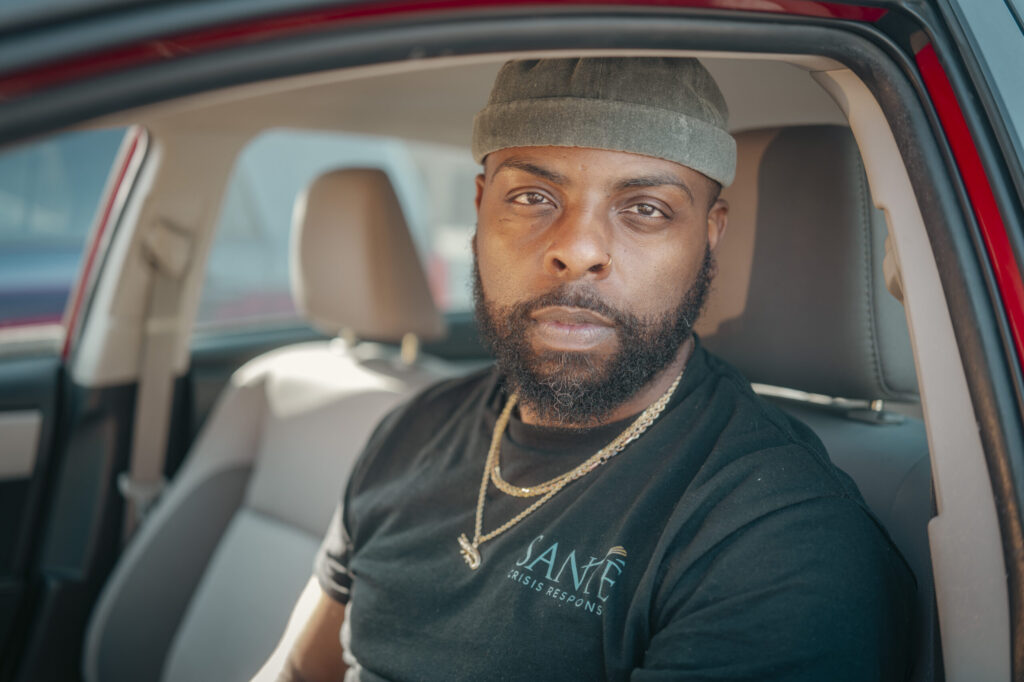
It was a little after 9 p.m., and Jeremy Floyd was in the last hour of his shift as a clinician with Mecklenburg’s mobile crisis unit. He could’ve passed the call to the overnight clinician, who comes on at 10 p.m., but he didn’t want the widow to wait.
She was vomiting in the bushes when he arrived. Family and friends were on their way, but in that first hour, she was alone. Except for Floyd. He took a breath and told her, “I’m Jeremy from mobile crisis.”
Soon they were sitting in the open hatch of an SUV. For an hour, they talked, two strangers. One with the life she knew shattered, the other making his first “grief call.”
“We’re gonna cry. We’re gonna laugh,” Floyd remembers thinking as they sat. “We’re gonna talk about the answers. We’re gonna talk about not having the answers.”
Floyd is one of about 10 employees at Santé, Mecklenburg’s longtime provider for mental health crisis response. It operates 24 hours a day, seven days a week, and never turns anyone away. They work sort of like EMS for mental health — fielding dozens of calls a day, easing people through crises, and driving to all corners of the county to meet clients who show signs of being a danger to themselves or others.
We spent the better part of two days with the Santé team over the past month, enough time to come to the startling realization that each hour of each day in our county — while the rest of us are at work or parks or concerts or sporting events — someone is in a crisis. The more effective Floyd and his coworkers are at their job, the more likely some of them won’t wind up in jail or the emergency room or, well, worse.
The county averages about 110 suicide deaths a year, or one every three days, according to state DHHS statistics. But that number doesn’t include thousands of interventions that help thousands of unfinished lives carry on.
In 2025 alone, Santé’s small team fielded 9,735 crisis phone calls and served 1,765 unique individuals (people who’ve never used the hotline before). And at a time when involuntary commitment — in which a mentally ill person is detained and sent to a facility — is a prominent topic among city and state leaders, Santé diverted 76 percent of the individuals they encountered from being the next number in the justice system.
Like emergency responders, they’re not here to provide long-term care. Instead they stabilize the immediate crisis and connect the individual with the resources available throughout the county. They’ve memorized the names and numbers for organizations that work in everything from substance abuse to childhood mental illness. And when their clinical assessment deems more help is necessary, they’re on a first-name basis with the magistrate’s office.
After Floyd helped the new widow that night, the CMPD officer he knew said, “See you at the next one.”
In a single shift, a clinician here might intervene in a suicide, encounter a child who’s threatening their family, and speak the first words to a grieving spouse. “I have stories for days,” Floyd says.
Many of them would be the most traumatic story any of the rest of us might deal with in a lifetime.
“We don’t have the opportunity,” Floyd says, “to speak to anybody on their good days.”
***
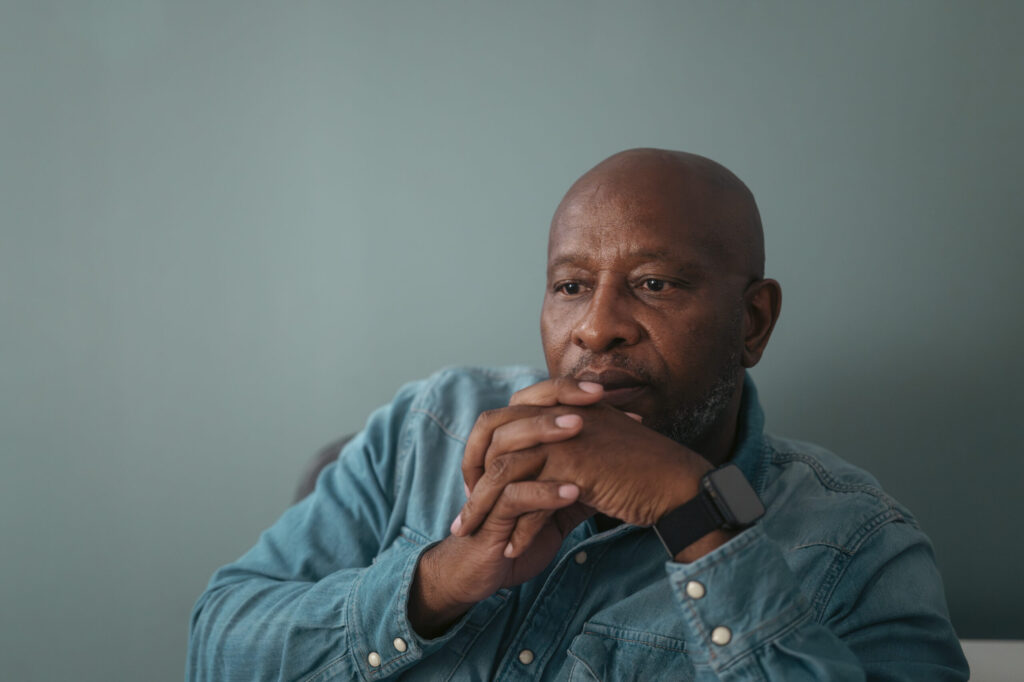
“Did you get a call?” executive director Rebecca Peacock said from her office chair on one of our visits. In the doorway, Kayla Meyers, who joined Santé last year, nodded with an uncomfortable smile.
“We’ve been out there before,” Meyers told her boss. “Basically they said they were going to kill themselves at a park outside of Mecklenburg County.”
“Did they have a plan?” Peacock responded. It’s standard practice to assess first whether the person has a plan and access to the weapon they might use.
This is just a Tuesday morning here.
Meyers said yes, and described two methods that contradicted each other. “I didn’t really understand the logistics,” Meyers said. “But then they just said they were gonna get in an Uber.”
Meyers had spoken with this person the previous week and visited them, only to find the situation wasn’t as serious as the person indicated on the phone. This time she kept them on the phone for about 15 minutes. “They agreed to a callback in 30 minutes because they wanted to get off the phone and drink,” Meyers said.
Thirty minutes later, Meyers called back, and the person was more relaxed and agreed to being connected with a local service provider. She made a note to call the person back the next day to ensure they’d actually received the services.
This work is Peacock’s purpose. Her dad was a firefighter, mom was an ER nurse, and her sister became an ER nurse. The family spent holidays at the fire station. Responding is, she says, sort of in her blood. She finished a master’s degree in social work from Columbia University in 2016, and has worked in crisis response ever since. She once dated a guy who worked in sales who couldn’t understand why she was so quick to jump to return to work when the phone rang. It didn’t last. They split and she married an ER doctor.
Peacock is one of Mecklenburg’s most important and knowledgeable mental health professionals, and very few people even know she and her team exist. She’s worked in all the settings where people need help, as a social worker and in a hospital’s emergency department. She became executive director of Santé’s North Carolina operation last year, and has spent the past six months trying to raise awareness about the organization that saves lives in the shadows.
She’s met with city council members and county commissioners this year, many of whom were unfamiliar with their work. Commission chairman Mark Jerrell visited Santé’s Tyvola Road offices this year and told me last week, “I didn’t even know about them. I was shocked. They’re doing incredible work.”
One thing Peacock hopes comes from the discussions is an additional option on 911 calls, for people to press 4 to be transferred directly to the mobile crisis unit instead of having to go through CMPD. (Earlier in 2025, CMPD had moved its crisis response team completely in-house, after years of partnering with Santé. There are no hard feelings over the move, but Santé’s team argues people in a mental health crisis respond better to them than an officer in uniform.) Currently, the only way to reach mobile crisis is by calling the 10-digit number 704-566-3410.
Peacock spent the first years of her career in New York. When she moved to Charlotte in 2022, she said, “I felt like I went back in time. It’s just not as structured.”
One issue is Santé’s funding model. State law requires mobile crisis management be available across North Carolina, 24/7/365. Medicaid funds the units via a third-party provider, Alliance Health, and that creates some obvious flaws. To receive reimbursement for an encounter, Santé must be able to document an individual’s name and spend more than eight minutes with the person, among other documentation requirements. If a call lasts seven minutes, it’s not billable. If they drive to a house and nobody answers the door, it’s not billable. If a person calls and talks to them for an hour but never shares their name, it’s not billable. They have a regular caller they know only as Radio because he has a booming voice. He’ll dial in and talk to them for a half-hour, asking for their opinions on news events and then talking about his childhood trauma, but he never gives his name. They’re required to take every call, even Radio’s, even if it’s bad for business.
Peacock says Santé, which is headquartered in Maryland, was on the hook for about $650,000 in unbillable services in Mecklenburg County in 2025. To put the shortcomings of the financial model in perspective, she asks whether the fire department should be funded the same way.
“They’re here, 24/7/365, and they respond to every single call they get — car accidents, cats in trees, all these things — but they only get paid when there’s actual flames,” she told me. “We don’t want it to be busy, because we don’t want people to be unwell. But like, right now, for example, they’ve had a few phone calls this morning, but now we’re just sitting here not getting any money.”
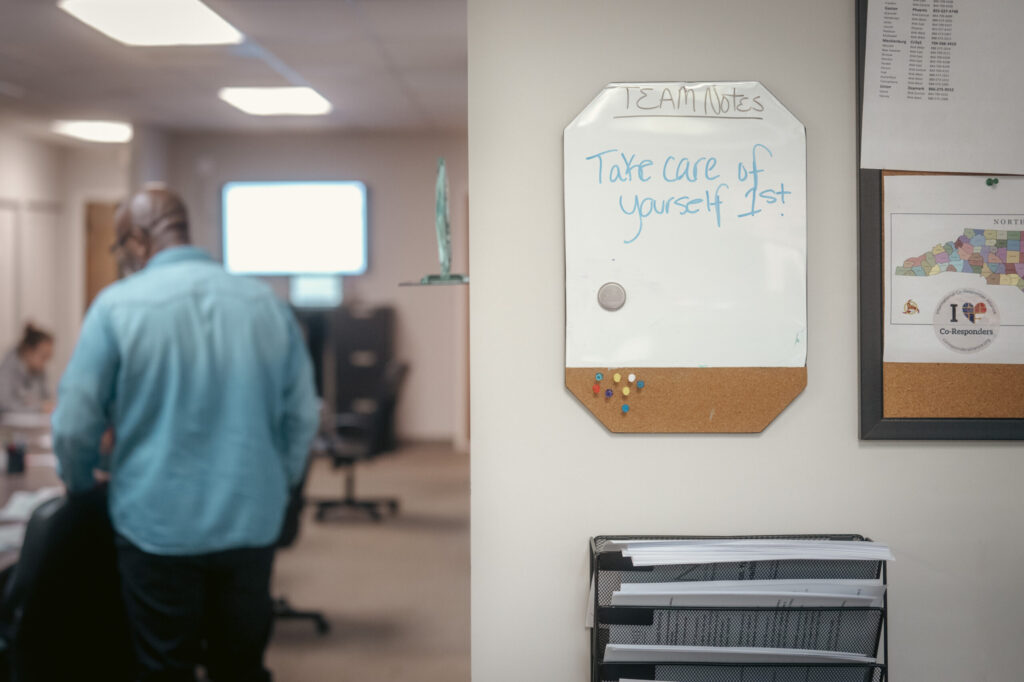
That creates an uncomfortable tension between the big-hearted work they do and the cold-blooded reality of spreadsheets. On a whiteboard in the office, Rebecca writes their monthly billing goal ($83,330) and the number of billable units, or interactions, they need to reach the goal (842). They fell short in January and February, but surpassed the goal in March and April.
It reminded me of a car dealership and its monthly sales goals, only with people’s lives.
Peacock argues that a better-funded mobile crisis unit actually saves the community money while preserving its health. By diverting 558 people from involuntary commitment last year, Santé estimates it saved the IVC system $1.7 million. By diverting 524 from the emergency room, they estimate they saved healthcare systems $786,000. And diverting 130 people from the criminal justice system saved the city and county about $290,000, by Santé’s estimates.
Peacock says she wants her team to be aware of the financial goals, but not let them drive any decisions. The finances are her troubles, she says. The clinicians have enough others to deal with.
Floyd, the clinician, says the whiteboard serves as a reminder to make follow-up calls with clients they’ve promised follow-up calls to, even when they’re tired at the end of a shift. “It’s not the focus, and it’s hardly ever spoken about,” Floyd says of the monthly goals. “It’s pretty much, like, don’t leave money on the table. This is already the service. We’re already going to follow up. Make sure you do your follow ups.”
***
In January 2025, CMPD officers were called to Novant Presbyterian, where a man was telling anyone who would listen that someone had implanted manmade material in his body and was using it to control him. He wanted an investigation. He insisted he wasn’t sick. “I’m mentally perfect,” DeCarlos Brown Jr. told officers, according to bodycam footage. “My body got exposed to something.”
Brown had been diagnosed with schizophrenia the year before. Santé wasn’t called that night. Officers eventually arrested him for misusing 911, and a magistrate released him on a promise to appear, a routine outcome for a nonviolent offense.
Eight months later, video shows Brown standing up on a light rail train and stabbing Iryna Zarutska, a Ukrainian immigrant seated in front of him, in the neck. She died on the train. The murder became the biggest story in the city, and the fierce political response often conflated mental illness with violence.
The General Assembly quickly passed Iryna’s Law, which focused on tightening restrictions on pretrial release. It will also require mental-health evaluations for more arrestees. But the law didn’t include money for more mental health resources, as NC Health News has noted. The state has hundreds of beds in psychiatric hospitals going unused because of staffing shortages. House Speaker Destin Hall has suggested lowering the standard for involuntary commitment, according to Axios.
Earlier this year, a House select committee heard testimony recommending mobile crisis units like Santé should be the default front door for involuntary commitment assessments, according to the Carolina Journal. Hospital leaders, separately, have argued that emergency departments shouldn’t be the default site either.
There isn’t a single cure. From Peacock’s perspective, the things that would help most don’t exactly make good campaign slogans. She says that Mecklenburg County actually has enough organizations and laws around mental health, but those organizations need better funding for staffing and enhanced communication with each other.
Meanwhile, Brown was found incapable of proceeding to trial, according to a motion filed by his attorney. A judge still must decide whether to accept that finding.
“It sounds like he was one of those people that really needed more support than what is here,” Peacock told me of Brown. “Not just in Mecklenburg County. In the country.”
She paused on the diagnosis itself; she’s focused much of her clinical work on people with schizophrenia. “People assume that if you have schizophrenia, you’re automatically dangerous, violent, homeless. That’s just not true. There are a lot of people who have that diagnosis walking around in this world, and you wouldn’t even know. They have it managed.”
***
A few weeks ago, longtime Charlotte writer Ken Garfield published a gut-punch of an op-ed in The Observer, noting that eight Myers Park High students had died by suicide since 2021, and the programs principal Bob Folk has developed to help.
In 2025, zip code 28209 (Myers Park, Madison Park, and Sedgefield) was among the three highest-volume zip codes for Santé’s clinicians. The others were 28203 (South End and Dilworth) and 28216 (Beatties Ford Road corridor). Three of the most significant Charlotte neighborhoods.
The Observer op-ed noted that the National Alliance on Mental Illness recently gave a presentation to 200 Myers Park students, and NAMI executive director Kate Weaver said the message was, “mental health challenges are common, treatable, and nothing to be ashamed of.”
That message rings true in Santé’s office. They share stories with a certain ease that’s almost uncomfortable to the senses. There was a troubling tale of a teenager who was sexually abused by their father, another teen who wouldn’t speak to one of Santé’s Black female clinicians because they’d been abused by Black women, a person who threw a rake down the stairs at Peacock, and a bipolar client who’d filled their bathtub and let it run while dancing around the house.
Shortly after clinician Miguel Garcia joined the Santé team, he picked up a call, transferred from the suicide hotline 988, from a person who was on the edge of an airport parking deck. The first things Garcia heard were the wind blowing and airplanes taking off. The sounds raised the stakes. He talked to the person while CMPD was en route. At one point, though, he slipped and said, “OK, calm down.” It’s an instruction that makes therapists cringe, because it has the opposite effect. On people in crisis. On you. On me. On everybody. Nobody likes to be told to calm down. Garcia immediately regretted it.
The person stayed on the line anyway. And at one point they said, with an alarming peace, “The skyline’s beautiful.” Garcia thought those might be their last words. But moments later, CMPD arrived and the person stepped down.
After the call, Garcia went into Peacock’s office to download with her. When he mentioned he’d said, “calm down,” her eyes widened. A teachable moment, thankfully, and not a tragedy.
Now, months later, when Garcia tells his teammates about a call, they rib him by saying, “Did you tell them to calm down?”
One of the most striking things about the Santé team is their ability to joke and stay light. Sometimes they’ll go home and hear family members gripe about difficult days and laugh. They see political divides as trivial.
At the end of one of our visits I went around the table and asked everyone what they did before joining Santé. Most went through humble versions of a resume, from social work to hospital experience to outpatient counseling. Then clinician Elizabeth White looked at me with a flat face and said, “I was breaking people illegally into the United States.”
I held her eyes and she held mine. For a heartbeat, I wasn’t sure. Then she burst out laughing, and everybody else did, too.
“No,” she said, “I was in outpatient treatment for substance abuse.”
Humor remains undefeated. It’s frankly the one constant here. On their communications platform, which they use to note who took a call and what it was, they share jokes and memes. On one of our visits we saw a Beyoncé gif.
“I think sometimes people can misunderstand the humor for like, not caring,” Peacock says. “No, we just have to laugh. But we cry sometimes.”
She added, “You can’t really be a bleeding heart, because it’s not sustainable.”
***
Two Mondays ago, just after 9 a.m., clinician Jessie Williams asked his colleagues to write down the 10 morals and values they hold most dear. After they did, he asked them to eliminate three. Easy enough.
Then he asked them to eliminate three more.
“It’s taking away from who I am,” one of his colleagues said.
Williams smiled, and asked them to cross off three more.
That, he explained, is something close to what people in a mental health crisis are enduring — a stripping away of what they hold dear. The exercise’s other purpose was to help each clinician identify the one value they couldn’t live without. For some it was faith. For Williams and a few others, it was hope.
“We are meeting people on the worst day, sometimes, of their lives,” Williams said. “So I’ll always go into that space with some hope. That I believe there’s a positive outcome. And they get that energy from us.”
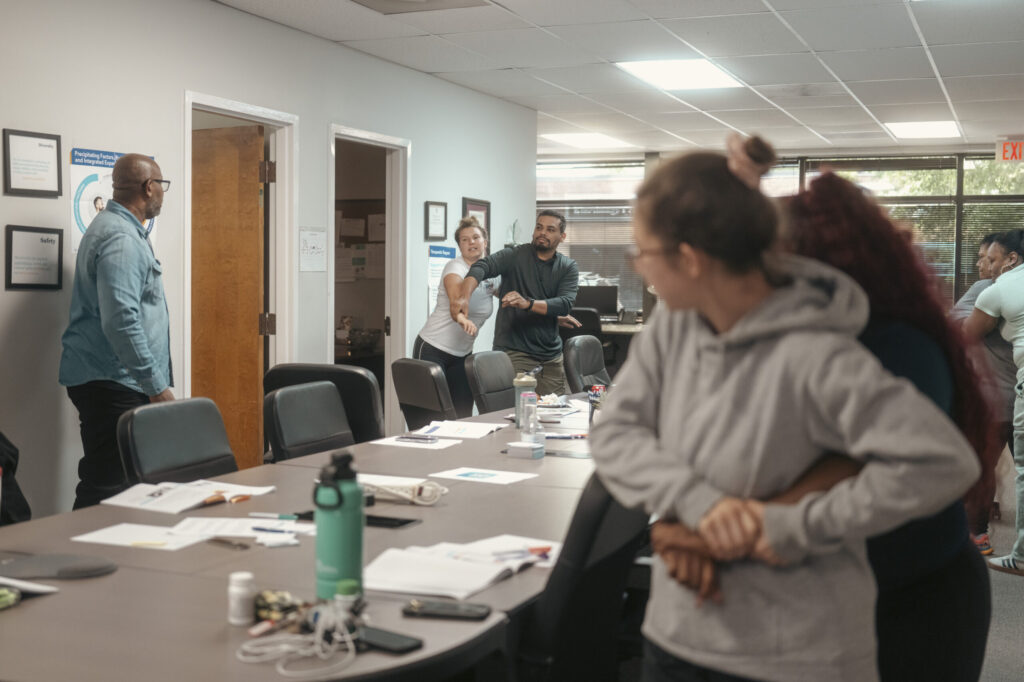
We stayed through the six-hour training, as they talked about lessons and fears and best practices. Meyers told a story about a man in crisis who grilled her about whether she paid her taxes, and how she regretted snapping back, “Do you pay yours?!?” That’s not the preferred answer! But the story was a reminder that the people answering these calls are people. After lunch, they split into pairs and ran drills on how to physically defend themselves if a client attacked them. Because the team is so small, clinicians usually go out alone. Peacock did the drills with everyone else, highlighting one trait her team loves about her — she never asks them to do something she wouldn’t also do herself.
In another exercise, they asked each other how you can tell, in the moment, when a situation is about to turn dangerous.
“You can see it in their eyes,” Lindsi Woods said. “When they’re going to do something, there’s nothing there.”
Williams, who led the training, has become a mentor to the team. He works 10 p.m. to 6 a.m. and rarely takes a day off. (“That’s not ideal!” his boss, Peacock, told me.) In a previous life Williams was a police officer in Milwaukee, and his colleagues often ribbed him about the way he approached people and told him he should’ve gone into social services. So he did.
Williams’ biggest fear on a call, he told his team, is naked people. Then he reconsidered. “At least then I know they don’t have a gun.”
Each clinician has their own way of staying calm on the drive to a scene. Meyers listens to audiobooks. Garcia turns on the news and listens to religious debates. Fatima Lewis listens to gospel music.
Williams, on the overnight shift, says he likes to mix up his routes if the call isn’t extremely urgent, so that he can take the roads that give him a view of the skyline, all lit up while the rest of us are sleeping.
If you or someone you love is in a mental health crisis, Santé’s 24-hour line is 704-566-3410.
Editor’s note: We updated this story after it was published to remove protected information.