
In the weeks after the 2020 election, 15-year-old Casey Scheiner was scrolling through YouTube. Because of the pandemic, the internet became a third place for kids like him. Because of politics, it became a place where kids like him could spiral.
Scheiner, an earnest kid from California who once won an award for most philanthropic hours served in his community, kept clicking on the outrage, signaling to the algorithm that he wanted more. He was in the comments before long, his developing brain awash in conspiracy theories and insults.
“That was probably, like, my first months or years of being politically conscious, so I’m sure I was so immature,” he told me recently. “I’d see these people spreading misinformation. … At first it very much upset me. And I kind of tried to have conversations with them.”
No personal attacks, just information as he believed it to be true, and his viewpoint. Something encouraging happened: a few commenters engaged and had a decent conversation with him.
“Never were they like, ‘Gosh you really fully convinced me,’” he remembers. “But what I got a lot was like, ‘Wow, I wish more people were willing to have this kind of exchange.’”
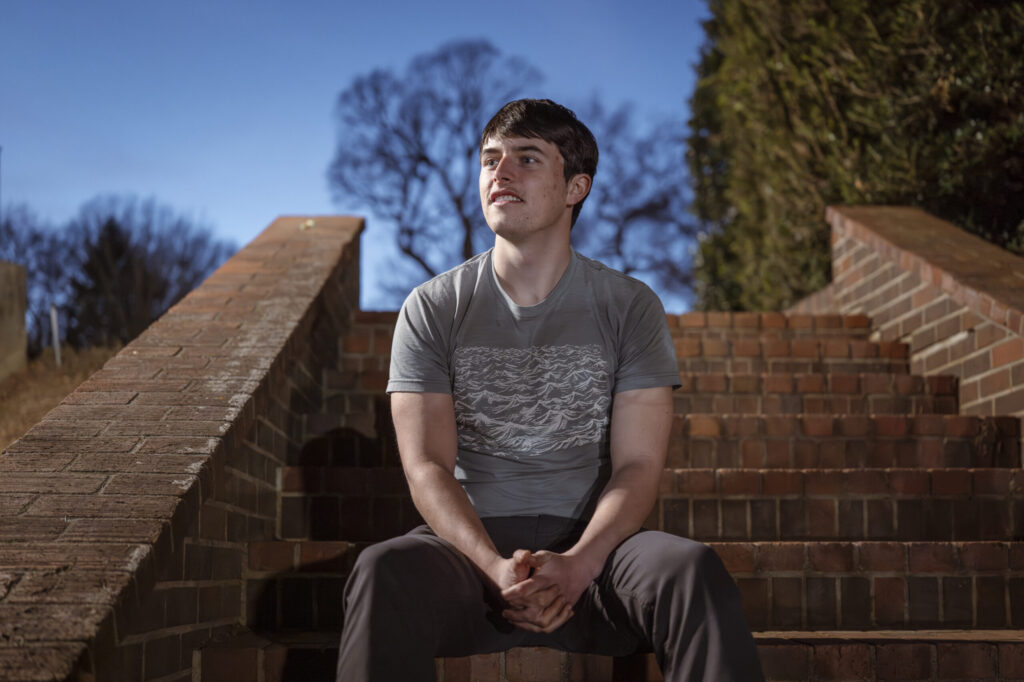
Scheiner is a sophomore at Davidson College now, and he’s spending his one college life trying to help facilitate better conversations. He’s a senior fellow in Davidson’s Deliberative Citizenship Initiative. DCI is one of a handful of programs that feed into Davidson’s larger Institute for Public Good.
On Thursday last week, former U.S. Transportation Secretary and current Davidson board of trustees chair Anthony Foxx joined a few dozen dignitaries and funders on campus to announce that Davidson had raised $47 million to support embedding the Institute’s work in every student’s college experience. The money endows five pillar programs and faculty positions, and helps restore a pair of 150-year-old debate halls.
At a time when trust in institutions is bottoming out, and during a week that began with debates over standing or not standing at the State of the Union and ended with people professing to be instant experts on Iran, Davidson invested in a different sort of discourse. Their bet is that if they equip Scheiner and his generation of students with tools to deliberate — something on a higher plane than debate or agreement — they might help preserve the values of engaged citizenship for future generations.
For its part, the Deliberative Citizenship Initiative is going on the road. The program in January received a $4 million federal grant, at a time when federal grants aren’t exactly raining from the bureaucratic heavens, to expand to 100 colleges and universities around the country.
“It’s like the pebble in the water that ripples all the way around the world,” Jay Malick, a retired bank executive and Davidson community member who’s a regular participant in DCI’s discussions, told me. Malick says he leans conservative on many issues, but that the conversations he’s had through DCI have broadened his views on a number of topics. It’s like, he says, “coming to a problem with a hammer versus coming to it with a full toolkit. … If the whole country was like this, yeah, wow: What a country we could be.”
That’s a mountain of an “if,” of course.
Davidson graduates 500 people with bachelor’s degrees into the world each year, a fraction of the 2.1 million in the U.S. And even on this leafy campus, some students say that, while Davidson is on the right path to be a beacon of free speech, there’s room to improve: A controversial survey last year indicated that a large share of students still feel uncomfortable sharing their views in class. And a recent national study shows that efforts to reduce animosity are up against “the powerful, unending tide” of political and media systems that reward outrage.
Still, history suggests polarization in America has ebbed and flowed, and if we agree that the U.S. is currently in a period of extremes, Davidson’s investment is an emphatic counterpoint to resignation that we’re simply too divided to bounce back. I visited the campus three times in February to see a deliberative discussion in action, and to talk with various community members and students. A world of angst spun around us: There was the theatrical hearing in Raleigh with our sheriff, the cosmetic discussions and coverage of the State of the Union, and an infinite number of headlines that talked about this “fight” or that one, or of one individual “slamming” another over comments, or any number of other things the college’s newly named D.G. and Harriet Wall Martin Institute for Public Good aims to change.
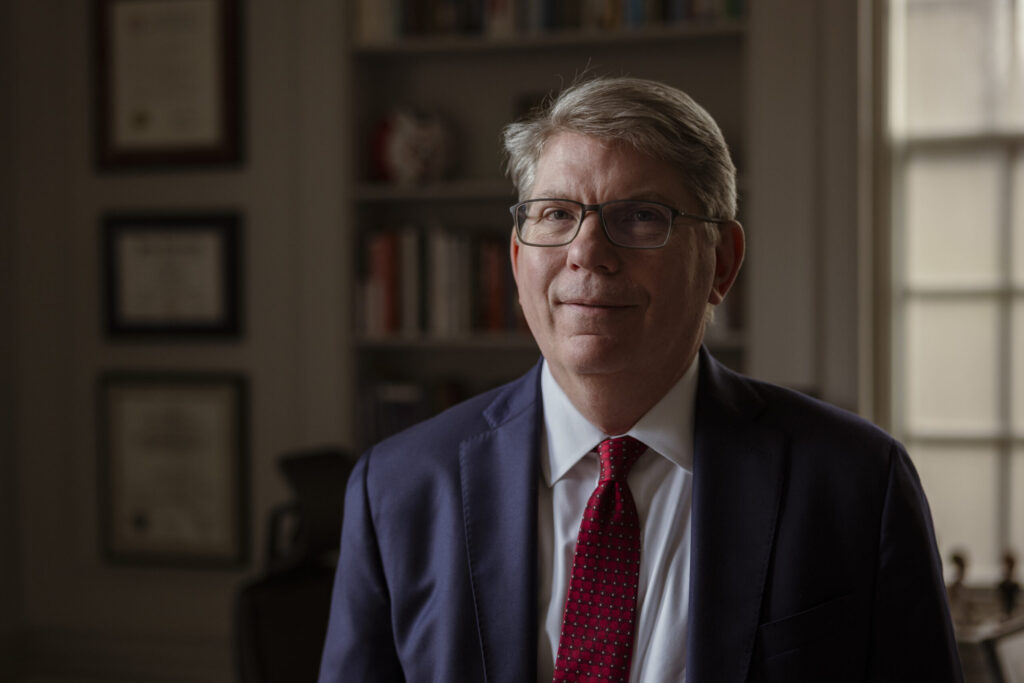
“I think lots of people are like, ‘Yeah, I wish public life were kinder, or more grace-filled, or more respectful,’” Davidson president Doug Hicks told me while we sat in his office.
“But if you don’t build infrastructure to teach people to do that, or to model that, the change doesn’t happen.”

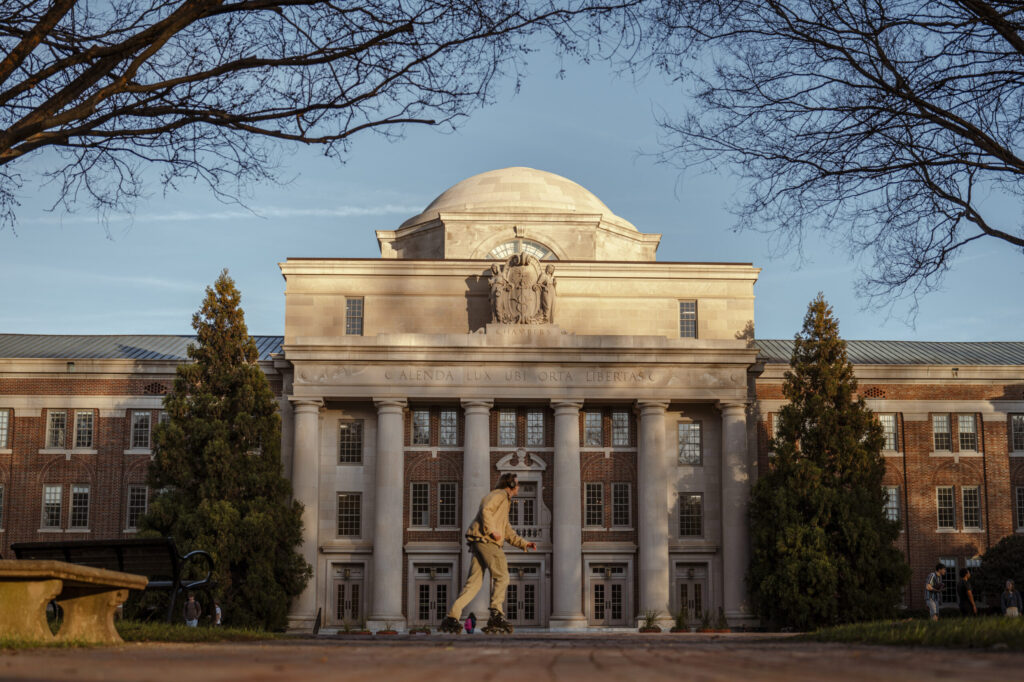
When Hicks, who graduated in 1990, was a Davidson student, he and his classmates walked every day along a diagonal path through the campus’s front lawn. From Chambers Hall to Main Street, the green space is shaded by a range of oaks, elms, and maples.
It’s beautiful, but that’s not why Hicks walked it back then. The student mailboxes were at the town’s post office at the time, before moving to an on-campus building around 2000.
With fewer students on the diagonal path, fewer people were passing between two old buildings that Hicks and others believe tell an important story: Philanthropic and Eumenean halls, or Phi and Eu, were constructed in the mid-1800s for the purpose of debates. They’re made of 250,000 bricks created by enslaved people, a history Davidson acknowledges and memorialized last fall with the unveiling of its With These Hands sculpture.
Phi and Eu halls have front porches that face each other, about 25 yards apart, and for decades students held public gatherings to challenge the views from the other porch. Only about four pairs of similar debate halls remain on college campuses today, Hicks told me. The others are at Princeton, Emory, and Georgia.
When Hicks returned to his alma mater to become president in 2022, he walked along the diagonal path daily, and eventually those walks inspired an idea to renovate those old debate halls. In August last year, Hicks announced the formation of the Institute for Public Good as an umbrella for five program areas: arts and public life; civic engagement; deliberation and free expression (including DCI); ethics, honor and leadership; and public policy and research.
The two old debate halls will house the Initiative.
Associate professor Chris Marsicano — whose father, Michael, left an indelible imprint on Charlotte as the longtime CEO of the Foundation For the Carolinas — was named the institute’s director.
“It is not simply a collection of programs, but a proving ground for what we believe to be true,” Chris Marsicano said in a passionate speech at last week’s announcement. “That character still matters, that the truth is worth seeking, that disagreement does not mean division, that humane instincts are not a weakness but a strength, that creative and disciplined minds turn possibility into progress, that leadership is not about prominence but about service to one another.”
In other words, the goal is not to come to an agreement or find the unstable “common ground,” or about proving a right or wrong. It’s just to come to a better and deeper understanding.
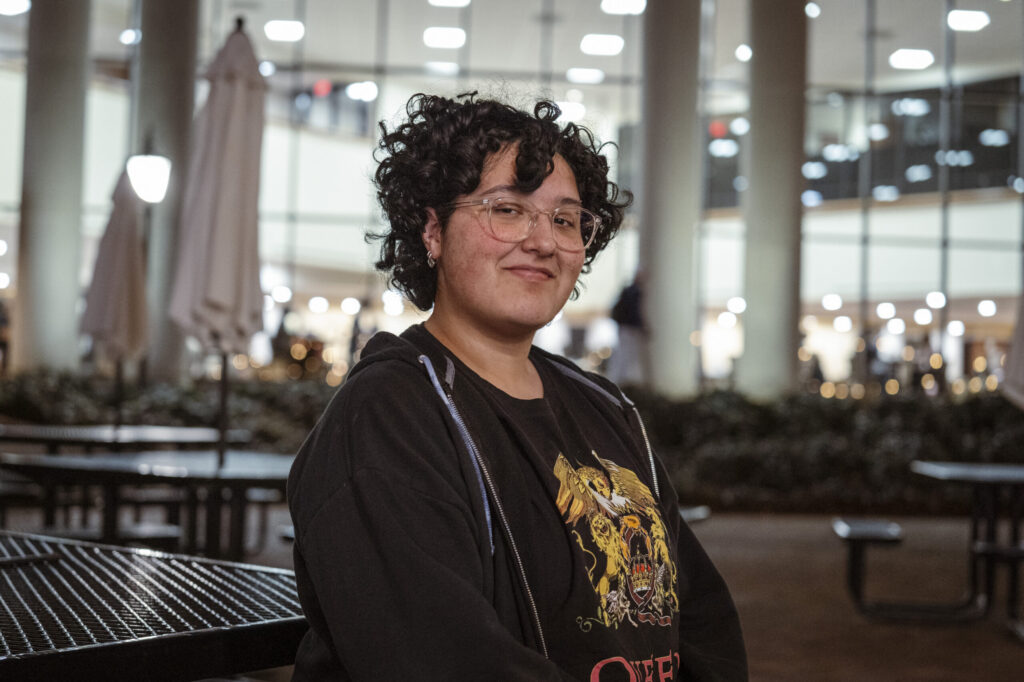
As junior Isabella Neri, who grew up in Concord and now is a facilitator for the deliberative discussions, put it: “You might not necessarily change my point of view 100 percent, but I can expand how I think about it. And I think that’s pretty valuable for me, just hearing what people have to say and taking that into account when I’m talking.”
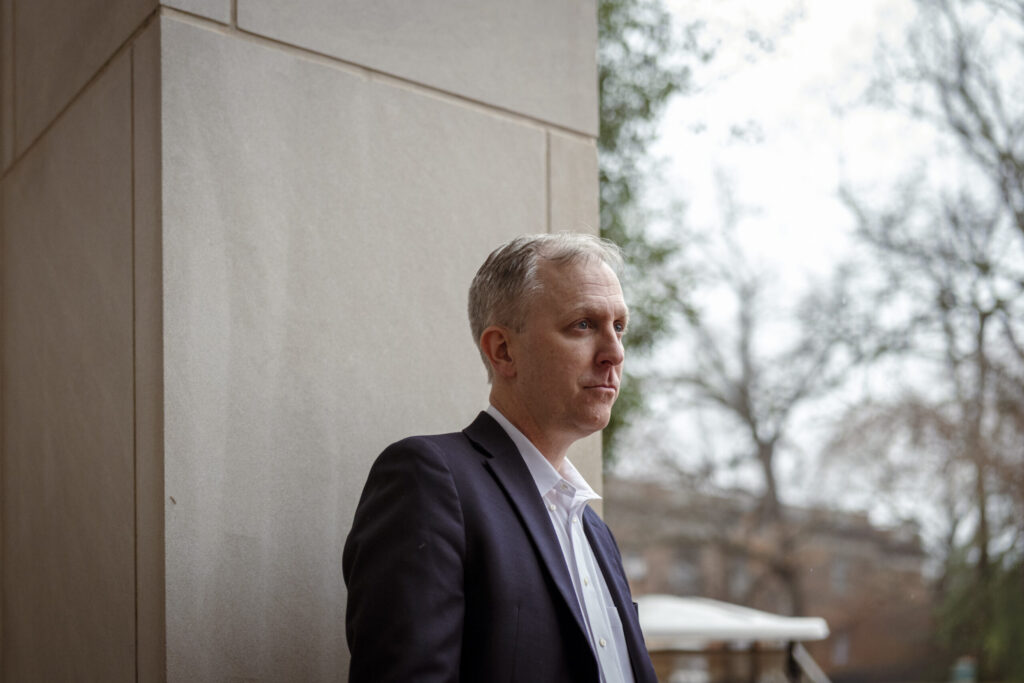
Growing up in Washington, D.C., Graham Bullock was around polarization constantly. In high school, he founded a program that brought students together to talk about issues facing the school and the world. He went on to college at Princeton, then earned a masters from Harvard and a doctorate from Cal-Berkeley.
He was a professor at Davidson in 2016, and he watched as the U.S. electorate divided around the presidential election.
“A lot of people were facing a choice, across the spectrum,” he told me. “Do you engage with this other side that you really don’t understand, that you’re really frustrated with, and you have a lot of anger about? … Or do you just kind of retreat into your silo, into your bunker, and decide to not engage?”
He thought about ways to bring student organizations together to discuss the issues of the moment. Dozens of coffees and lunches later, the Duke Endowment provided funding to launch the Deliberative Citizenship Initiative. It started with a few workshops in late 2019. In early 2020, DCI held its first training for conversation facilitators. Then came the pandemic pause, and the summer of 2020, spurring more discussions.
“We have this pandemic, all these tensions around race, the George Floyd murder — and what do we do?” Bullock remembers his team saying. “Do we continue or not? And we decided: yes, because of all of that, we need to.”
A simple and reductive description of how DCI works: Students and community members sign up to take part in “D Teams,” or smaller groups, and they give demographic and political background information, all off the record, to ensure a diversity of backgrounds. DCI leadership comes up with discussion areas — this year’s overarching topic is American values, in concert with the 250th anniversary of the signing of the Declaration of Independence. They schedule speakers and public forums, with experts from across the political landscape. (Last fall, Davidson had Democratic Sen. Amy Klobuchar and Republican Sen. Thom Tillis on the same stage.) Meanwhile, D Teams have their own, smaller discussions.
A February roundtable discussion was titled, “Liberty and General Welfare: The Case of Social Safety Nets.” The panel of professionals included a policy professor from Duke, another from UNC, along with a business professor from West Virginia, and a director from the Cato Institute.
The conversation never got heated, but positions on things like Social Security were more complex than you usually encounter in public forums. At one point two panelists debated the merits of a universal basic income as an alternative to current safety nets.
But the real magic, everybody I talked to agreed, happens in the smaller group discussions, those D Teams. They’re groups made of 8 or 12 people, from students to retired community members of different races and political beliefs. Ahead of each discussion, the D Teams receive information packets that share a range of viewpoints on an issue, and the history behind it. Then the small teams come together to discuss, while a trained facilitator steers the conversation.
Neri, the Davidson junior from Concord, says she’s used the skills she’s learned as a facilitator when she goes home for holidays and sees her family.
“When I first told them, and I kind of walked them through what we do, they were like, ‘Oh so, you debate and you argue with people?’” Neri said. “And I was like, ‘No, that’s not it.’”
That’s not to say debates don’t have a place. It’s just that Bullock and his Davidson peers want the default discourse to evolve beyond mudslinging and viral clips.
One national event last year challenged Davidson, and all college campuses, more than most.
In September, political figure and Turning Point USA founder Charlie Kirk was shot and killed during an on-campus event in Utah. The public bloodshed was unavoidable for anyone with a phone. The social media discourse quickly shifted from mourning Kirk to calling out people who criticized him.
The presidents for the Davidson College Democratic, Republican, and Libertarian clubs co-authored an editorial in the student newspaper, The Davidsonian, denouncing political violence in all forms.
In December, Davidson’s Turning Point USA chapter hosted its first event. Some campus groups boycotted, but others said they’d give it a chance. One student told The Davidsonian it was “entertaining” but “not very useful.” Still, he added, “It’s interesting seeing other people’s opinions. You always learn something.”
When I read the coverage, I thought about something Jay Malick, the retired bank executive and father of three, said to me about the Deliberative Citizenship Initiative.
“I think it’s a very bad idea when a college excludes a group of people just because of the way they think,” Malick said. “I can’t win a debate with you unless I really know your side better than you know your side, and then I’ve got a good chance of winning it. But if I refuse to even try and open my mind to your side, we’re not gonna get anywhere. I think that’s the key. And this (DCI) forces you to hear it.”
The reporter covering that Turning Point USA event for the school paper was, as it happens, Casey Scheiner, the sophomore from California who debated people on YouTube six years ago.
Scheiner also worked with Bullock and professor Ike Bailey on a November campus conversation about discourse in the era of political violence.
“It doesn’t matter if you’re the College Democrats, or ping pong club or whatever,” Scheiner told me. “We all agree this is, like, a good baseline standard, because free expression and communication … it really matters.”
Scheiner said he hasn’t debated people online in years, in part because he’s not looking to win arguments. He’s looking to expand them. Whether he and his generation of Davidson students can help change our howling country is unclear. But now, on a campus where two 150-year-old debate halls still face each other, they are endowed with the chance to try.