
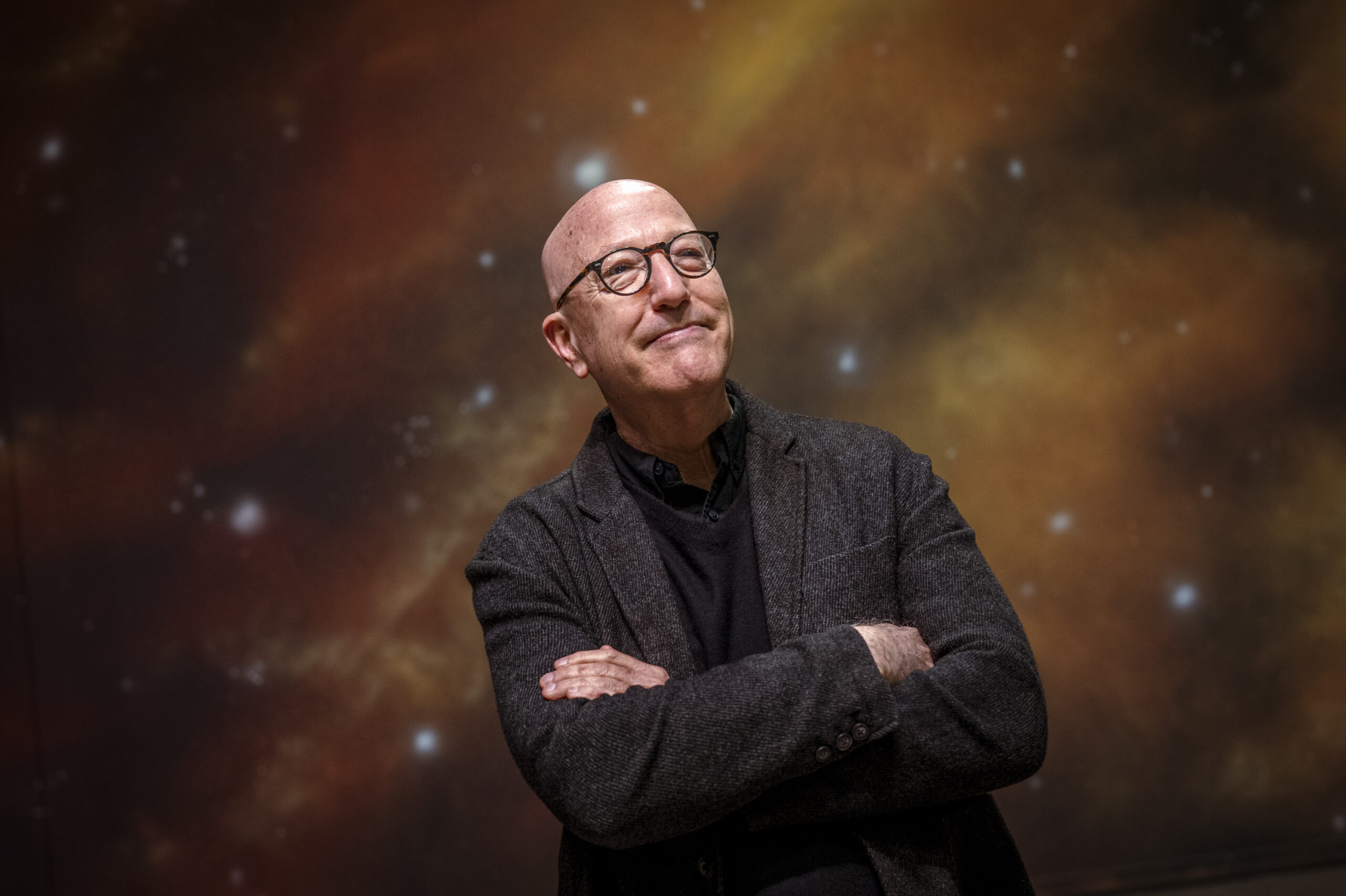
The world-traveling, Tony-voting, Broadway-defining Tom Gabbard can’t find the light switch in his own studio.
“Let’s see if we can figure this out,” he says, sweeping his hand along the wall of a dark room built for hocus pocus. We’re in Stage 2 of Blume Studios, the immersive arts venue Gabbard and his Blumenthal Arts team created, somehow, out of an old pipe factory site.
It’s a little before noon in late January, hours before performers and audiences will return to this room for another night of The Magician’s Table, a small, interactive show Gabbard helped import from London.
“I was just in here and they came right on,” Sean Phaler, Blumenthal’s chief marketing officer, says as he joins Gabbard in trying to solve the light mystery.
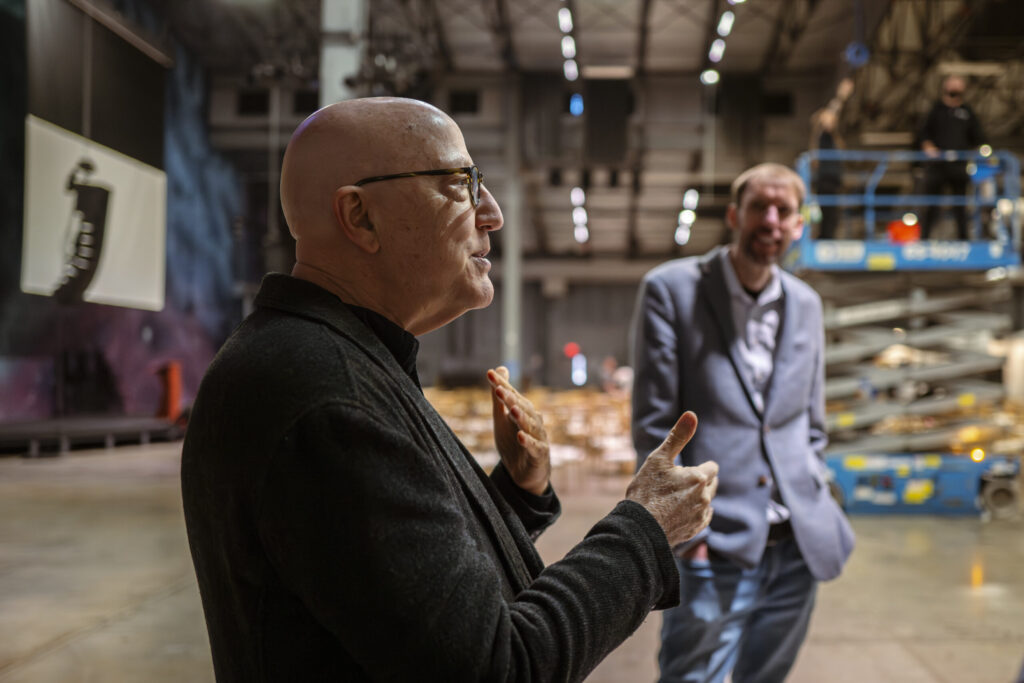
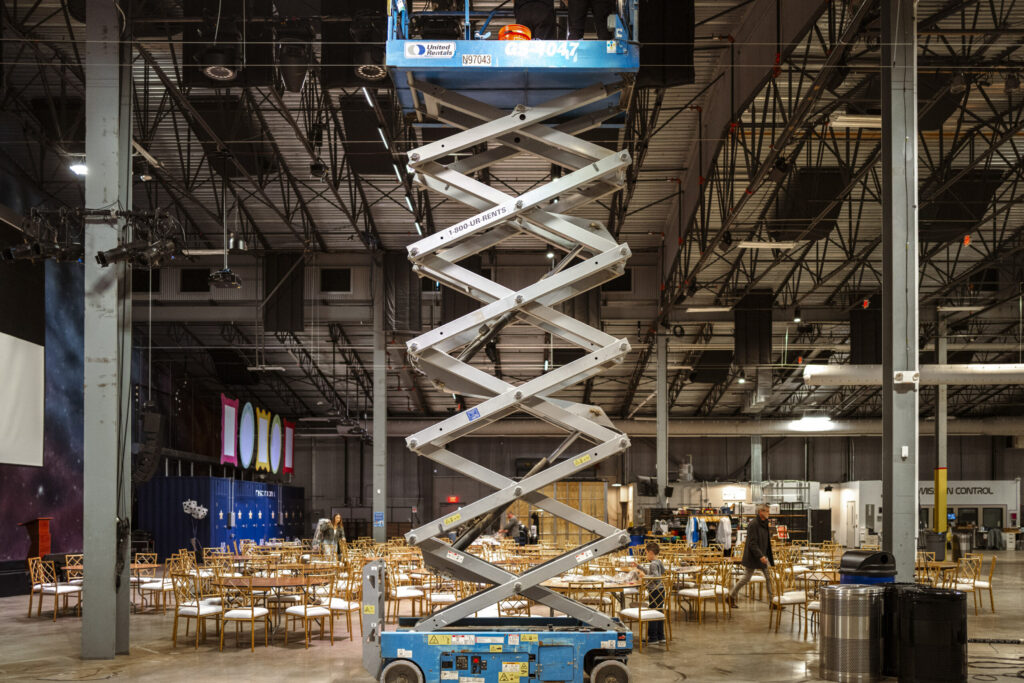
Next door, in the cavernous warehouse that’s Stage 1, the Blumenthal team is building the set for In Pour Taste, a buzzy and buzz-inducing comedy show.
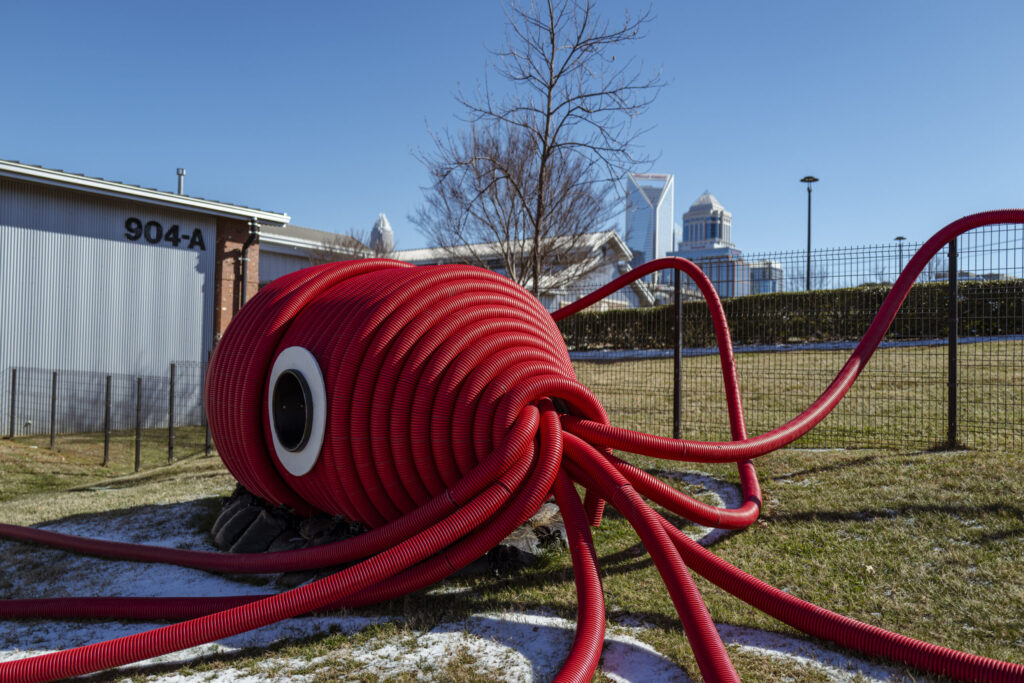
Gabbard has spent the morning explaining to me how he transformed these industrial buildings into the envy of arts leaders around the country: how the main entrance of Stage 1 sits on casters and can roll away in minutes for shipments, how the bathrooms are built from an old shipping container, how the HVAC system is moveable fabric, and how an artist spray-painted a warehouse wall in just three days.
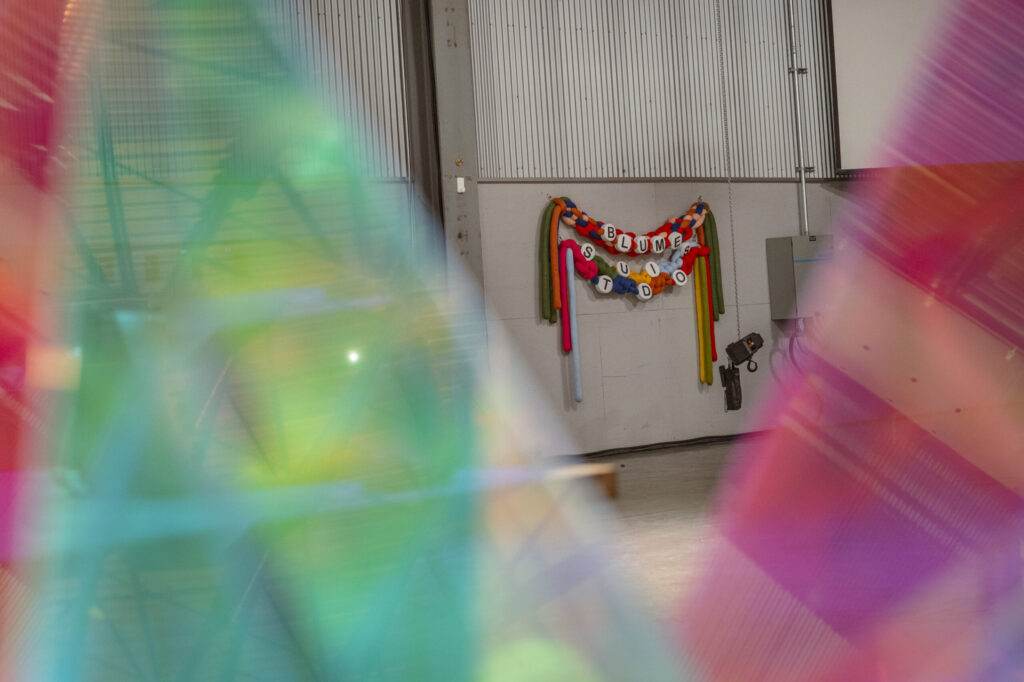
More than 150,000 people have experienced Blume Studios since it opened in September 2024, taking in everything from a virtual reality space exhibit to life-sized Monopoly — shows that wouldn’t be possible in a traditional theater setting. And while Blume remains a curiosity for many audiences and funders locally, it’s shaping the future of performing arts in the United States, as organizations try to reach younger audiences.
“I’m not sure it exists anywhere else in the world,” Magician’s Table co-producer Justin Sudds, who lives in Canada, told me. “He is by far leading this whole thing for all American performing arts centers. A 22-year-old or 25-year-old they’re not going to buy a Broadway season. You have to program your arts organization to create longevity. And he is at least three to five years ahead of anybody else in the country.”
Blume became a popular board game destination during the Monopoly Lifesized run last year. Paying customers experienced the big game, but other crowds returned just to sit in corners and play checkers and chess and “the Chinese thing — is it ‘mohjong’?” Gabbard says, spelling it with an “o.” It was one of the few moments in my weeks of reporting this story when I knew of something he didn’t. “Mahjong,” Phaler and I corrected him.
The 32,000-square-foot, always-in-flux arts space sits on a 55-acre site, and it’s a lot to take in. So honestly, by the time we get to The Magician’s Table set, I don’t mind the few seconds in the dark and quiet.
Eventually Gabbard and Phaler locate the sensor and, abracadabra, the room comes to life. Tables roll out before me, awaiting tonight’s guests and another chance to show them magic in ways they never imagined.

Imagine, now, our city without Tom Gabbard.
For this exercise, we start in another city, Boston, and another dark room.
It’s 2003, and the lights go down at Wang Theatre just before a concert. Gabbard runs an arts center in Green Bay, Wisconsin, and he’s flown to Boston for meetings with other arts executives. At the concert, he sits beside longtime Blumenthal president Judith Allen.
Allen leans over and says, “I’m retiring. I haven’t told anybody. But I want you to take my job.”
Imagine if he hadn’t said yes.
Hamilton might’ve skipped Charlotte in 2018.
The Levine Center for the Arts — Knight Theater, the Mint, the Gantt Center, the Bechtler — might be something else entirely.
The Blumey Awards program that’s helped launch future stars like Reneé Rapp might not exist. (Mean Girls just got less spicy.)
And what about Immersive Van Gogh in 2021, the blockbuster that drew 300,000 people out of their homes? It’s hard to imagine how Charlotte hatches from the pandemic without it.
I started thinking about these alternate city realities after Mark Peres, the founder of The Charlotte Center, said something to me last week: “There’s a Charlotte with Tom Gabbard — and there’s a Charlotte without Tom Gabbard.”
It’s a wonderful Charlotte life Gabbard has made. He came to a city that was all suits and ties in the early 2000s and he’s turned it into a cultural destination.
A great many words have been written about Charlotte’s ever-elusive soul, and this is not a story about that. Gabbard and Blumenthal are not soul-makers. But they have led the way in instilling in Charlotte a key soulful ingredient: Curiosity.
“When I first got here, I said, ‘Boy, there’s just kind of a lack of curiosity here,’ that these are people that ran past the humanities building on the way to law school,” he says as we stand in rooms that stage magic. “We had to work on that cultural curiosity piece to make people interested in the arts, beyond just the well branded things. That has changed, I’d say, in the last 10 or 12 years. That cultural curiosity that, from my vantage, is defining our city in an entirely different way.”
A few months after he moved to Charlotte, Gabbard was at a performance, standing in the aisle before the show began, when an usher approached him and said, “Thank you for coming to the ballet tonight.” She had no idea she was speaking with the new president.
Since then he’s become one of the most sought-after guests in the city. Blumenthal supporters who give at a certain level can have dinner with him and his wife, Vickie.
“Our donors absolutely love them and clamor to be near them,” Kristen Miranda, a former WBTV anchor who now oversees Blumenthal’s community engagement, told a visiting arts group from Minneapolis earlier this month.
The Minneapolis group, Hennepin Arts, brought 20 or so staff and board members to town just to have that table with Gabbard. On their first night they went to Blume Studios and split up in two groups, half to In Pour Taste and half to The Magician’s Table. The next morning they shuffled into the Belk Theater’s VIP lounge and, over Krispy Kreme and coffee, sat down to take lessons from Gabbard. It was an eye-opening moment for me, to see people from elsewhere listening to Gabbard like he’s Yoda.
This was, of course, during the immigration raids and backlash in Minneapolis that shuttered businesses, rattled neighborhoods, and stirred ordinary citizens into action. A couple of the Hennepin visitors told me how strange it was to be in Charlotte, away from their frightened and frustrated city.
I asked Hennepin’s executive director, Todd Duesing, how the events have affected Hennepin, and he hesitated to answer. The raids were deeply personal to the city, he said, and he didn’t want to make news. Most of the conflicts were outside of downtown, so Hennepin’s signature performances mostly went on as scheduled. But the audiences became noticeably less diverse, he said. Point being, the arts played a role in the city’s response — but mostly at the street level, with group singalongs and other forms of activism.
“Those are organic for the moment,” he said. “They’re singing from their souls.”
What large groups like Hennepin were focused on, he said, was “the forward.”
He found one idea at Blume Studios in Charlotte, when he saw In Pour Taste.
He loved it. Laughed like he hadn’t laughed in weeks, he said.
He approached the performers after the show and told them without hesitation, “We want to bring you to our city. But it’ll be a little bit of time, because a show like yours … is the type of thing we need after this trauma. Being in that room last night, everyone was laughing. The sense of community there was just phenomenal.”
Duesing’s responses reinforced something Gabbard hinted at during our conversations over the past few weeks: Yes, Blume Studios is different and maybe more lighthearted than traditional theater, but it’s more than a “nice to have.” It’s essential at the moment for arts organizations to explore new programs and spaces to bring people together.
And Blumenthal is well ahead of other cities. “Among my peers around the country, when we get together, it’s about catching up,” Duesing said.
Really? I said. To Charlotte?
“Yeah,” he said. “I mean, the idea of having this site that has these very flexible spaces that can do all kinds of things, and you can be completely out of the box, is energizing. And it’s a great way to bring new audiences, new arts lovers, and redefine what is art?”
Gabbard tells the story of his beginnings in the arts almost exactly the same way, with the same details, every time.
He was in the fourth grade, growing up in California, when he went to the San Jose Civic Auditorium to hear the U.S. Marine Corps band. That night he decided he wanted to make a professional life in the arts world. He later returned to the venue and snuck backstage at a Peter, Paul, and Mary concert, at 10 years old.
He played French horn and thought he’d be a performer. But after college, he realized he could take his imagination and use it in service of other performers. Without tedious things like infrastructure and business models, of course, arts are just hobbies. He wanted to help people make careers.
He started at his alma mater, Pepperdine University in California, where he was the founding director of the university’s arts center. He earned an MBA and even did a year at law school. In the mid-1990s, after a stop in Colorado, he became the executive director of the Weidner Center in Green Bay, Wisconsin. He dove into Packers’ football history and used the franchise’s community roots as inspiration for strengthening the arts. He wound up building a Broadway touring lineup that rivaled ones in much larger cities.
Meanwhile he became a member of Broadway’s Board of Governors, a Tonys voter, and helped form the Independent Presenters Network.
To go back to imagining things “without Tom Gabbard” for a moment: It’s hard to fathom what Broadway’s tours would look like without him.
In the late 1990s, a media entrepreneur wanted to consolidate Broadway tours and large music concert tours. Gabbard and other leaders in performance arts resisted, telling the entrepreneur: “Hold up. We’re not ready — especially those of us that were community based — we’re not ready to give up decision making for our local markets.”
While they held on to their independence, music producers gave in. They joined a larger company, which was then sold to an even larger company, and now is called Live Nation.
Yes, if Tom Gabbard had chosen another career path, Broadway’s tours might have gone the way of Live Nation.
Let’s go back to the warehouse.
“Give me a woo if you’ve ever dropped less than $5 on a bottle of wine,” the comedian says to the crowd of about 200 people, and nearly everyone woos.
It’s one of the last nights of In Pour Taste’s Charlotte stop, and my belly hurts. The “plot” is this: The audience is at a wine-tasting event, and two comedians narrate and crack jokes with a local sommelier on stage. They pour a handful of rounds of wine while the sommelier explains the notes and tannins and whatnot. Laughs fill the room. I even notice former county manager Dena Diorio in the front row, laughing hysterically and enjoying the best retirement life.
“Give us a woo if you’ve ever dropped less than $3 on a bottle,” and a few people woo, including some folks in the front. “Oh, the VIP section?!?” the performers say. “All the VIPs are the weird, nasty people in this room. I love it.”
It’s an adults-only show, of course, due to the language. The performers hand out something they call a “bullshit bell” to an audience member. It comes with great responsibility: the bell-holder is instructed to ring loudly whenever they’re unconvinced by something a performer or audience member says. Like when the performers said, “Last year, we started doing this show for bachelorette parties, mainly because they pay us loads of fucking money,” ding went the bell.
A short walk from In Pour Taste, another 200 or so people are in the room for The Magician’s Table, drinking craft cocktails. That show has been so successful that it’s been extended here multiple times, and now will run through March 15. It’s an actual financial success, Gabbard says, generating more ticket revenue in its first week of sales than most one-week Broadway shows.
It’s been so popular I asked to be connected with one of its creators.
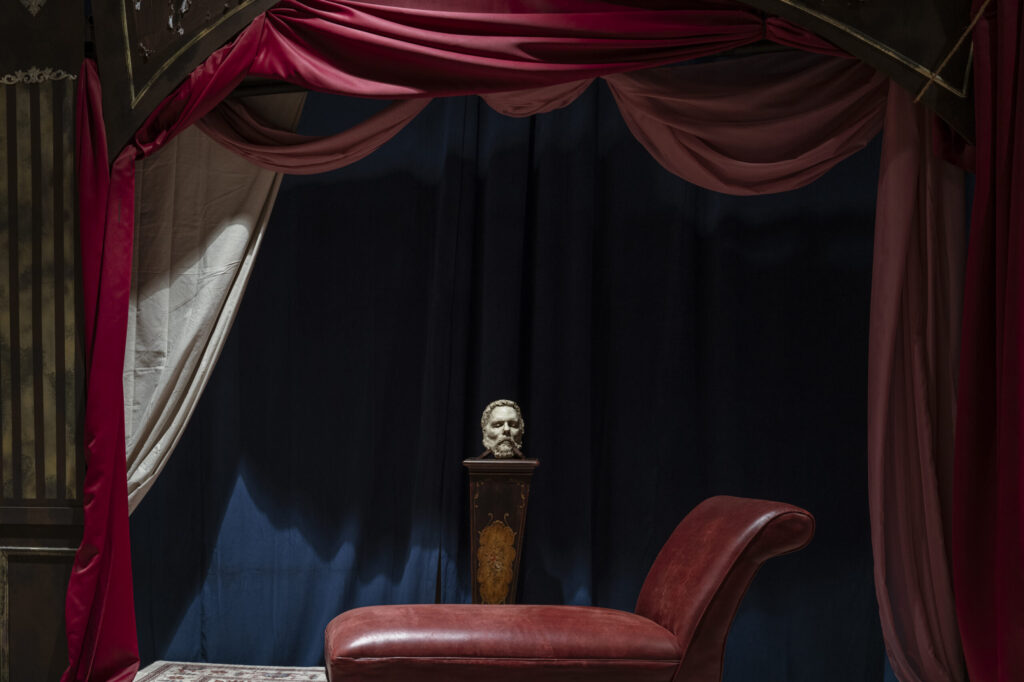
Justin Sudds lives a short 4,500 miles northwest of Charlotte, in Vancouver, Canada. (If you’re driving, head toward Lincoln County and keep going.)
Sudds and his Right Angle Entertainment produced The Magician’s Table. The show launched in London, and one day last year, Sudds and his team learned that Gabbard happened to be there. Travel is a big part of Blumenthal’s budget, as is investing in shows and other arts centers as a way of ensuring big tours come to Charlotte. Gabbard and the Blumenthal board think of these investments as a “mutual fund” that pays dividends years from now.
While in London, Gabbard got a message from Sudds, suggesting he check out the magic show. They’ve known each other for about a dozen years, so Gabbard said yes. And he loved it.
The next day, Gabbard called Sudds and said, “How can I help you bring this to North America?”
Blume Studios was just an infant at the time, and crowds were still trying to understand it. But Gabbard — who says, “if I make errors, it’s usually that I forecast things a little too early” — had believed in the project for years.
The project was born at a dinner table. Around 2022, Tom and Vickie were eating with a few other power players: Charlotte Pipe owner Hooper Hardison and his wife, Lucy; and longtime arts champion Deborah Harris and her husband, the prominent Charlotte developer Johnny Harris.
Hardison had recently announced that Charlotte Pipe intended to move its facility to Stanly County, and Gabbard was riding the high of his Immersive Van Gogh bet.
If you weren’t here for that show’s run in summer 2021, you’ll have a difficult time understanding how big it was. Blumenthal had seen its revenue cut in half during the pandemic. In early 2021, Gabbard proposed to his board that they bring the tech-driven Van Gogh exhibit to Charlotte — to a leaky old Ford Building in Camp North End, in the summer, with no air conditioning. Arts people are nuts, okay. But Gabbard operates with a risk management mindset of “What’s the worst that could happen?”
The board approved investing $2 million to bring the show here. It was a viral sensation. It produced $20 million in ticket sales, and an estimated $39 million economic impact for Charlotte. I worked at Axios at the time, and any time our Charlotte team posted about the exhibit, it was guaranteed to reach a lot of people.
Nearly 80 percent of the Van Gogh guests were new to Blumenthal’s list, meaning it was their first show.
Arts organizations in similarly sized cities crawled all over each other to get a Van Gogh show after that. None could replicate Charlotte’s success. For Gabbard, who turned 70 last year, it was a confirmation of his hunch that younger audiences were craving a more experiential kind of performance.
At that dinner table with the Harrises and Hardisons, he shared his vision for creating a space that could house those experiences full-time. After a little back and forth, Johnny Harris blurted out (as Johnny Harris does), “Hooper, what about that warehouse?” Hardison sat on the idea, while the larger plan for a new residential and entertainment district on the old Charlotte Pipe site came into focus.
A year and a half later, Hardison called Gabbard and asked him to have coffee. They sat down at the Summit Coffee on Providence Road, surrounded by regular customers tapping away at their emails, and they came to an agreement that would reshape the future for Charlotte’s performing arts scene — and, by extension, the country’s performing arts scene. Blume Studios opened in September 2024, the same month that Charlotte Pipe’s subsidiary, Iron District LLC, selected Trammell Crow Company as the master developer for the larger project. The timing meant that Blume Studios would be the district’s first official tenant, and a key player in marketing and public awareness.
This is where I need to get back to Sudds, The Magician’s Table producer. When Gabbard called to ask how he might help bring the show to North America, Sudds said the answer was obvious: Bring it to Charlotte and Blume Studios first.
“Tom’s just head and shoulders above where anybody else is in terms of performing arts centers,” Sudds told me last week. “It doesn’t make any sense that Charlotte is this incredible place for not just launching shows, but to have any show. Tickets sell well in Charlotte. If you compare it to other similar-size markets, Charlotte way overperforms.”
When Gabbard told peers about The Magician’s Table, he said they responded, “This sounds really cool. You go first!” He laughs at that now. “We have, when it’s appropriate, been willing to be the first at being first.”
Sudds told me the U.S. has several venues that would suit experience-driven shows like his, but none that fall within an arts center’s portfolio. That’s what makes Blume special, he says — it’s a flexible venue supported by a foundation of Blumenthal’s history and audience reach.
“You’ve got to really have that long view,” Sudds said. “It’s not hard for an individual to have that long view, but it’s very hard to have an entire arts organization, a board, and a city to come along with you.”
Trust and a track record help, of course, I replied.
He laughed and said, “Tom’s got a long career of being right in the end.”
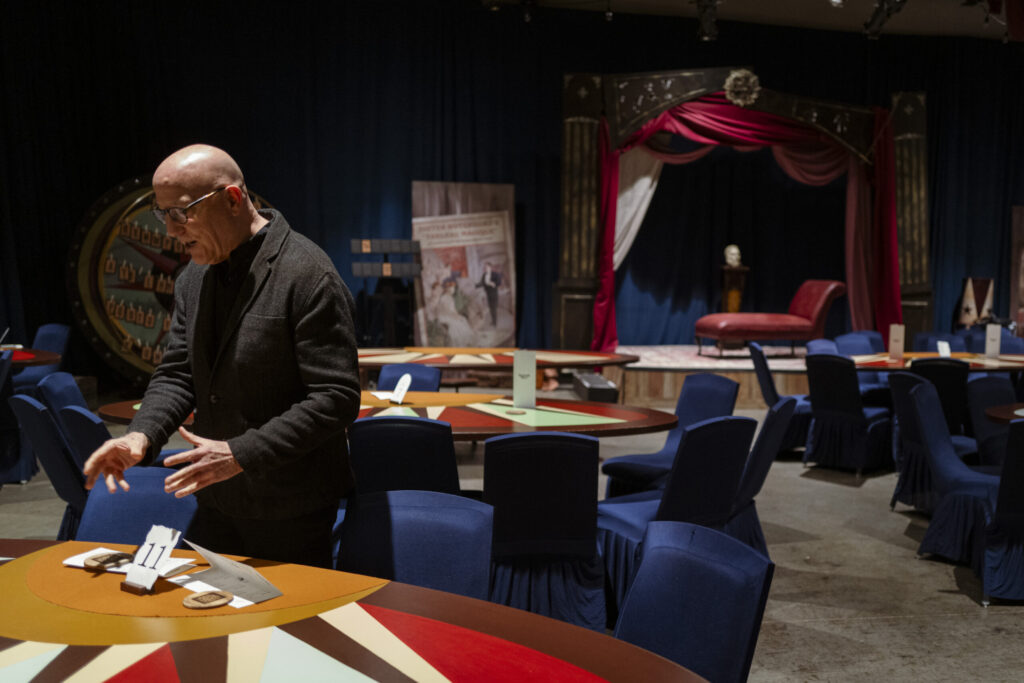
At the end of one of my visits with Gabbard, I noticed that when a conversation is winding down and about to end, he says, “Okay.” He said it three times at the end of the visit. He often finishes meetings with his staff by saying, “onward and upward.”
Rarely, “Goodbye.”
It’s a little awkward, but it’s also a fitting tic for a person with a mind like his. Imagination doesn’t have a period. It’s a long run-on sentence.
That’s why he keeps doing this, and why he’s stayed for 23 years. From those early days when he wasn’t recognized by his own usher to now, he says Charlotte has kept giving him reasons to keep going, and to keep investing elsewhere in ways that eventually circle back to Charlotte.
“Yeah, it’s personal relationships, but it’s a business relationship,” Gabbard told me of the network he’s built over decades. “People aren’t friends with me because I’m the most charming. It’s because I can say, ‘How can I help you?’ And then you’ll help me, too. What are the business elements that we need to do to figure out a way to do something good for each other?”
Take Jonzi D. In the early 2010s, Gabbard invited the creator of Breakin’ Convention, the international hip-hop dance theatre festival, to spend a week here. They started at breakfast in uptown, and Jonzi D was unimpressed by the towers of finance. But by the end of the week, he found himself at Snug Harbor in Plaza Midwood at 2 a.m., fully convinced. The festival came here in 2015.
“These people are all in the shadows,” Jonzi D said, according to Gabbard’s retelling. “And you have the opportunity to push a bright light on them and give them the recognition that they deserve.”
And that might be the central theme for Gabbard’s own evolution over the past decade. He still loves bringing in big Broadway productions. “But frankly, that I could almost do in my sleep,” he says.
Blume Studios, though, is part of what he calls his “creative renewal” — a former factory where a city that once preferred guarantees now comes to practice curiosity in public. All he had to do was turn the lights on.