
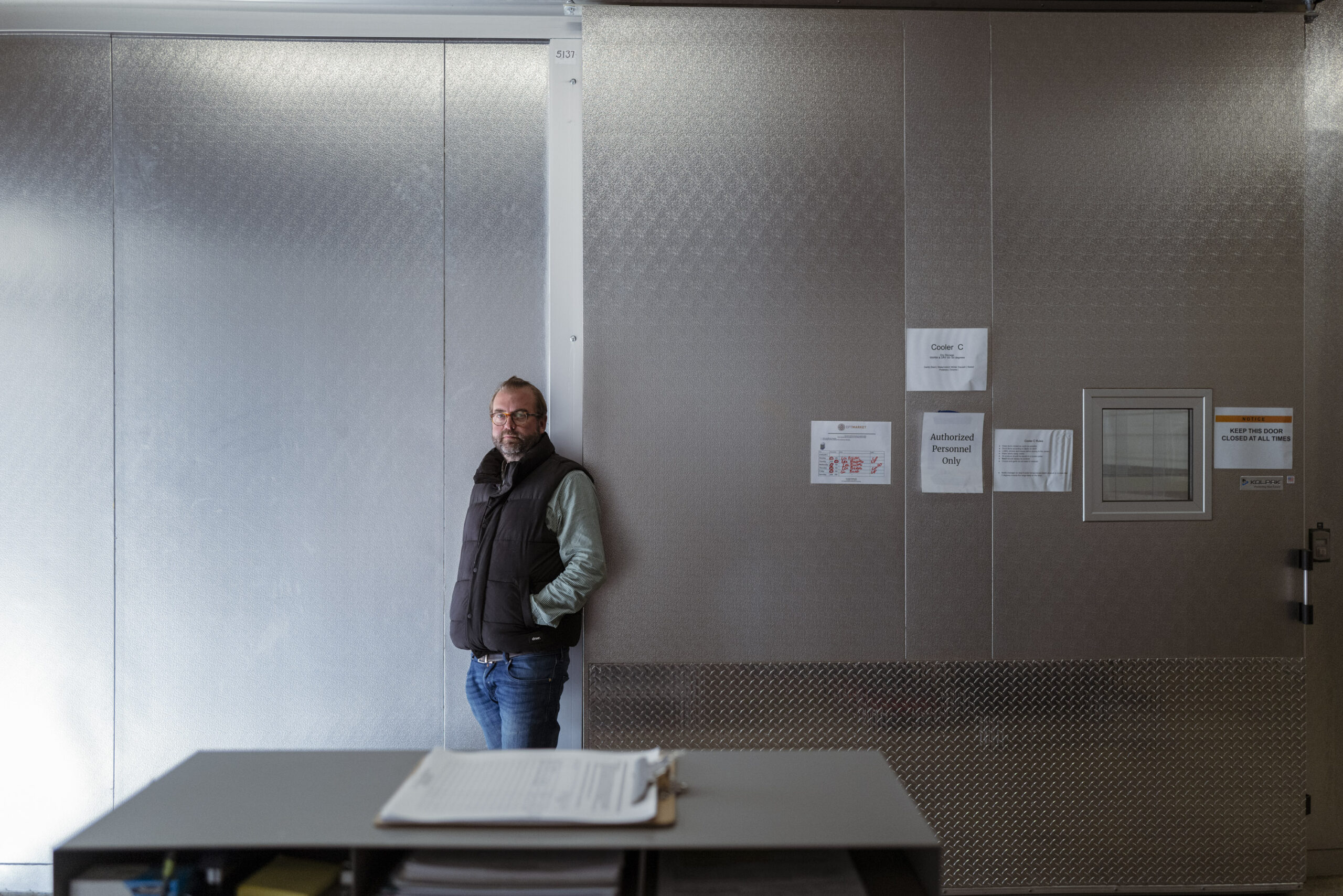
When Charlotte organizations mobilized last month to feed people through back-to-back crises — first a pause on SNAP benefits, then a wave of U.S. Customs and Border Protection operations that left citizens and noncitizens alike afraid to leave their homes — one nonprofit built to help meet such moments was mostly on the sidelines.
Carolina Farm Trust, founded in 2015 to reshape the region’s food system and help address food insecurity on the west side, had laid off half its staff weeks earlier. Its 23,000-square-foot market and distribution center, built with the help of more than $7 million in American Rescue Plan dollars, was only operating at about five percent of its capacity.
Then, in mid-November, the county commission that helped fund the project grilled CEO Zack Wyatt in a public meeting, confirming what he already sensed: that he’d become an outsider in the local food scene he’d hoped to unite.
Meanwhile, food banks were running at full sprint. Even organizations such as OurBRIDGE, whose core mission is to educate immigrant and refugee children, shifted into food-distribution mode.
The patchwork response underscored one of Wyatt’s main arguments — that the food system is fractured. And CFT’s absence gave his critics proof for what they’d been thinking about him — that he received a bunch of taxpayer money, with limited results so far.
“It doesn’t feel good not being able to do something,” Wyatt texted on November 20, five days into CBP’s operations.
I’d been talking to Wyatt since summer and toured the market in late July. But when I started calling others, I heard odd responses.
“You don’t want to do a story on them,” one person told me.
I still wanted to highlight work being done in the local food scene — there’s a ton of good stuff! — but CFT was a perplexing outlier rather than a celebrated centerpiece.
Wyatt is almost evangelical about his work: “Every problem we have is food and ag-related,“ he told me. And later, “Food is a national security issue.”
Most agree on the stakes. The Charlotte region stands to lose about 20,000 acres of farmland by 2040, according to some estimates, unless development trends shift.
All around the region, people are building new systems in small, hopeful ways.
Davidson and Matthews have crown-jewel farmers’ markets that support farmers within a tight radius. Davidson’s market recently published a spectacular cookbook highlighting the farmers who set up there. The West Boulevard Neighborhood Coalition is making progress on its Three Sisters Co-Op Market. Up the road in Concord, the Barbee family continues to work the land it’s owned for more than 100 years, even though selling it would be exponentially more lucrative. I visited with the Barbees in October, and their story deserves its own telling. I’ll write about it separately, soon. Same for Freshlist, based in the Belmont neighborhood, which connects farmers and restaurants.
And the new Carolina Farms Fund initiative, spearheaded by former Belk CEO Tim Belk, preserved 44 acres in Union County now operated by urban farmers Wisdom and Cherie Jzar, with plans to raise millions more, the Observer reported.
There’s plenty of good work. But whenever I mentioned Carolina Farm Trust, something changed. People shrank and their eyes darted, and conversations went off-record. One person who works in the food space spoke in starkly adversarial terms.
The perceptions clashed some with what I saw. Wyatt was patient, sometimes blunt, but never hostile to me, even as I delayed this story by months. When I presented the critics’ opinions, he offered a modest defense and then praised the others’ work.
CFT’s finances worsened by the month in 2025. About $2.5 million in pledged federal money disappeared with cutbacks to USDA funds. That spooked private funders, Wyatt said. The CFT Market in west Charlotte has cost more than $8 million in public and private money, but it will need at least that much more to be completed, Wyatt said. In October, CFT went down to seven full-time staff members, and only has enough money to keep operating until February 2026.
This is not a typical Optimist story. But it’s an important one, I think. Because underneath it is a cautionary tale about public investment, trust, and how quickly a local darling can become disfavored. It’s not an indictment but a case study in how quickly momentum can evaporate when trust rays and money runs out before the mission is complete.

On January 11, 2022, Mecklenburg commissioners met in the government center to hear a proposal for how to spend some of the county’s $215 million in federal COVID relief dollars.
Food access was on their minds, after seeing grocery shelves empty during the pandemic. So they’d asked then-county manager Dena Diorio for “out-of-the-box” ideas to take a chance on.
Diorio introduced Wyatt at the meeting. Carolina Farm Trust was widely celebrated in the late 2010s for its work developing an urban farm at Aldersgate. It was a favorite of local media, drawn to Wyatt’s “revolutionary” vision to save farmland and solve food deserts by rebuilding a regional food system, and to wrestle the financial levers of the food economy away from corporate grocery chains.
Wyatt projected the total cost would be about $14 million and said he would fundraise the rest.
“I’m not going to lie,” Diorio told the commission, “there’s always risk when you’re doing something that’s a startup, it’s a new venture, [and] we’ve never done it before. But if not us, then who?”
Commissioners approved the funds unanimously the next week.
“Let me say to the board,” commissioner Vilma Leake said. “Your grandchildren may profit from this.”
Wyatt thanked the board for the trust, but before he stepped down from the microphone, he felt uneasy.
“January 11, 2022 — the hull in my stomach started then,” he told me. “This is what my biggest fear was, that we were going to get to a point where it’s not finished — and it was never designed where that money was going to be enough to finish.”
Immediately, peers saw Wyatt as the guy who got millions while others didn’t. Over the years, whispers built into gossip and resentment. And in the local food business, trust is everything.
“The food space is one big popularity contest with one big clique, and if you’re not part of it, you’re shut out,” Wyatt told me. “Not one person called to congratulate me on getting this money to help in this area that we all care about.”
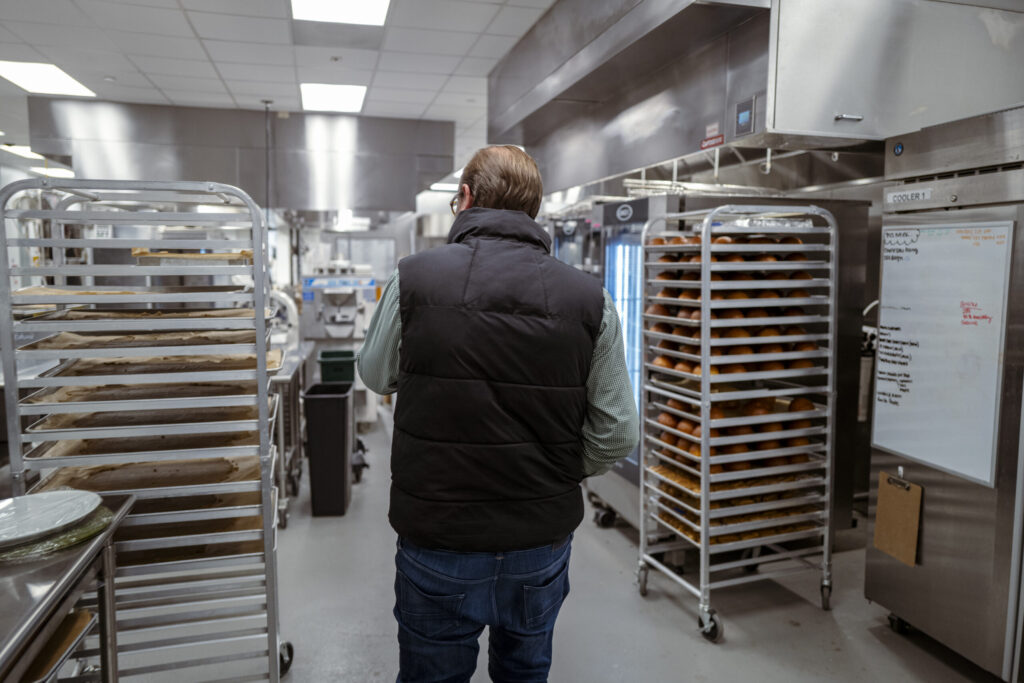
More money followed — another $3 million from the county’s relief funds, $1.5 million from the city’s relief funds, and $4 million in the federal budget secured by Congresswoman Alma Adams, a longtime supporter of CFT. That was basically enough to finish Phase 1 (the coolers and commercial kitchen, and funds to buy food from farmers) and get permitted for Phase 2 (the grocery store, a teaching kitchen, meat processing facility, and event space).
Phase 1 opened in summer 2024. That October, CFT delivered more than 20,000 meals to Hurricane Helene victims with World Central Kitchen. The organization said at the time it was embarking upon a $17 million campaign to finish phase 2.
Meanwhile, CFT used a grant from Trane Technologies to preserve about 28 acres of north Mecklenburg County land to create Free Spirit Farm.
Wyatt’s vision of disrupting the food system by creating a wheel of money was seemingly coming to fruition: Farmers would lease the land from CFT at an affordable rate, then CFT would buy the farmers’ products, bring them to the distribution center, and sell them to customers. Since 2022, CFT says it’s contributed more than $600,000 to local farms.
Then the funding floor dropped in 2025. CFT lost the $2.5 million in the federal budget, and about $800,000 sat in limbo during the government shutdown. “I don’t care what your organization is, when you have a $3.2 million swing, that’s a hard thing to maneuver and manage,” Wyatt told me.
Wyatt turned to private philanthropy. But 2025 brought big changes to the funding landscape, and many shifted to more immediate concerns, such as the closure of childcare and education nonprofits.
In October, after CFT’s layoffs, I suggested to Wyatt that he might’ve been a victim of bad timing, and I got a glimpse of the more arresting side of his personality. Numerous advisers have tried to get him to speak softer, and Wyatt admits he’s heard, “You can’t say that,” more than once.
“I am somewhat disappointed the private philanthropy community didn’t look at the ARPA funds and help us,” he said. “The work we’re doing should not be competing with any of the on-the-ground work that needs to be done now. It’s irresponsible in my opinion. It pits us against each other, and it shouldn’t.”
A few weeks after that conversation, as the SNAP shutdown loomed, Wyatt got a call from the county, asking him to appear at the November 12 commission meeting. He told me it felt like he’d been “called to the principal’s office.”
The meeting had a small audience, because most eyes were on Scout Motors’ announcement that it would set up a corporate headquarters in Plaza Midwood.
But Wyatt still found himself under a hot lamp. At-large member Arthur Griffin grilled him, asking questions that boiled down to whether he’d lived up to the promises he’d made four years ago.
I talked to Griffin the next day, and he was hardly convinced by Wyatt’s responses. CFT should be able to deliver more tangible results with the millions in public dollars it received, he said, and he added that it had fallen “very short of meeting the community’s expectations.”
And the SNAP crisis only amplified his disappointment.
“Here is your defining moment,” Griffin told me of CFT, “and zip.”
At one point during the tense meeting, Wyatt asked for a break to get a sip of water. When I talked to him afterward, he said, “I want everybody to get what they want. I want Arthur Griffin to be happy. I want the county to be happy.”
Either way, Griffin told me he doesn’t speak for everybody on the commission, but that, “Arthur Griffin’s position is to not give [Wyatt] one more cent of taxpayers’ money.”
Conversations with Wyatt about CFT’s tough year have swung between blaming others and blaming himself.
“I feel embarrassed, and I feel small,” he told me in October. “I ultimately have to think, what have I done? … I’ve been begging the last three months for help — help me, help make sure this lives on. And it’s just been a resounding, don’t care. And that I think is what hurts the most.”
When I asked what he thought the issue was, he said, “It’s me. That’s the only thing I can think of.”
I asked: “Who’s in your corner?”
“I don’t know,” he said.
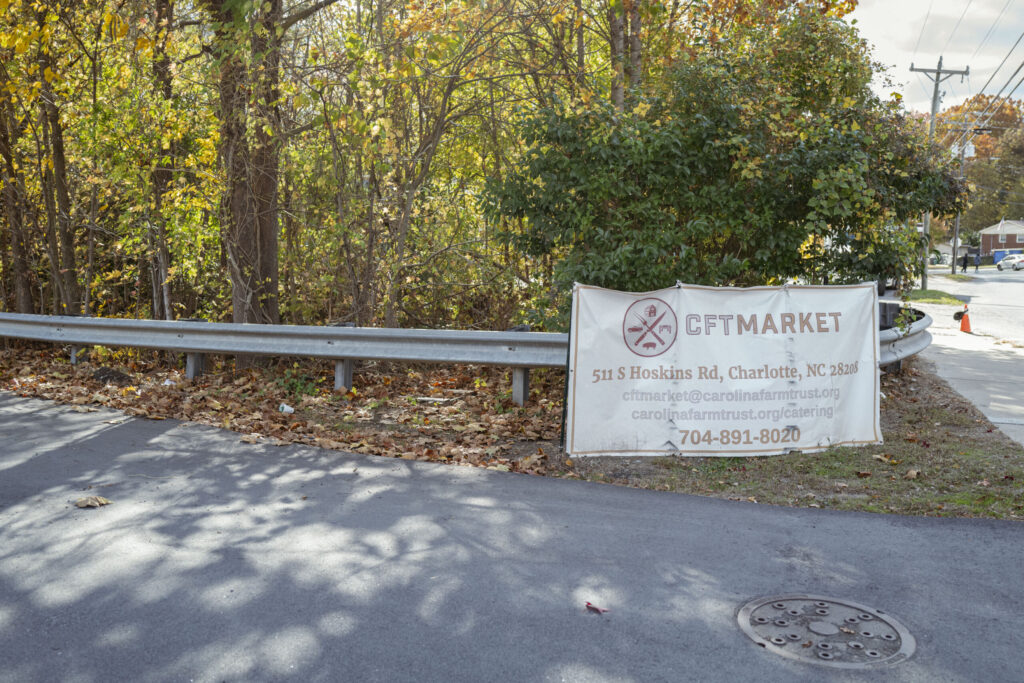
What happens next on Hoskins Road matters beyond one person or nonprofit. Farmland keeps disappearing. Food insecurity worsens, and long-term SNAP cuts loom. A distribution center sits half-functioning with a skeleton staff, with coolers that could serve people tomorrow. Time-consuming and expensive permits are secured for the next phase. It would be a loss, not just for Wyatt, if the work ceased.
So I presented a hypothetical scenario to him: What if he stepped down and turned over the project to someone else?
“Of course I would transfer it over and walk away,” he said, “but it would be devastating.”
For now, CFT is doing small work while Wyatt tries to find a path forward. Over Thanksgiving, it joined with A Brighter Day Outreach, a nonprofit that serves the Thomasboro-Hoskins community and last year launched a food bank of its own, to deliver holiday meals. CFT also partners with Mecklenburg’s senior nutrition program, and this fall, it delivered food boxes to kids at The Pearl during a program there, Wyatt told me.
But as far as the larger vision goes, Wyatt knows he’s on his last chance. When I called him one final time on Friday, he said, “Who knows? Maybe something happens and we can get this done and all come together and sit around a table, even the people who don’t like me, and eat and celebrate what we’ve built together.”
“I have to find a way,” he said in another conversation. “There is no giving up.”