
The old cliché about doctors is true for Jeff Cleveland: he often can’t read his own handwriting.
Computers were a step toward solving that, allowing him to type notes in the exam room. Still, interactions felt cracked, as he looked back and forth between a monitor and the patient. Now, though, new artificial intelligence technology allows him to be present in the moment — and keep the documentation.
Cleveland, a pediatrician and chief medical information officer at Advocate Health, has helped lead the system’s implementation of an ambient voice documentation program from Microsoft, called Dragon Copilot. Advocate is the first healthcare system in the country to use it, and Cleveland was the first doctor in the system to test it, back in 2023. Now Advocate has about 6,000 unique users each month.
The program automatically transcribes conversations with patients, then arranges them into structured notes.
“It unburdens my mind to try to keep up with all the details, because I know that it’s going to remember that the kid’s going to N.C. State to major in engineering, and that he’s got a girlfriend named Emma, or whatever,” Cleveland said. “It remembers that stuff, and so I can just listen to the medical thing, help figure out what I’m doing.”
Ambient voice technology is only one component of what Advocate, or Atrium, is rolling out alongside its “Room of the Future” initiative, which we previewed last month. It’s a notable evolution for the locally based hospital system as it aims to position itself as a proving ground for technology solutions to broader healthcare challenges, from staffing to space.
To an uninitiated writer like me, who spent years sitting in hospital rooms with my late father as he fumbled to change channels while accidentally hitting the call button on a wired remote, the experience is a little strange.
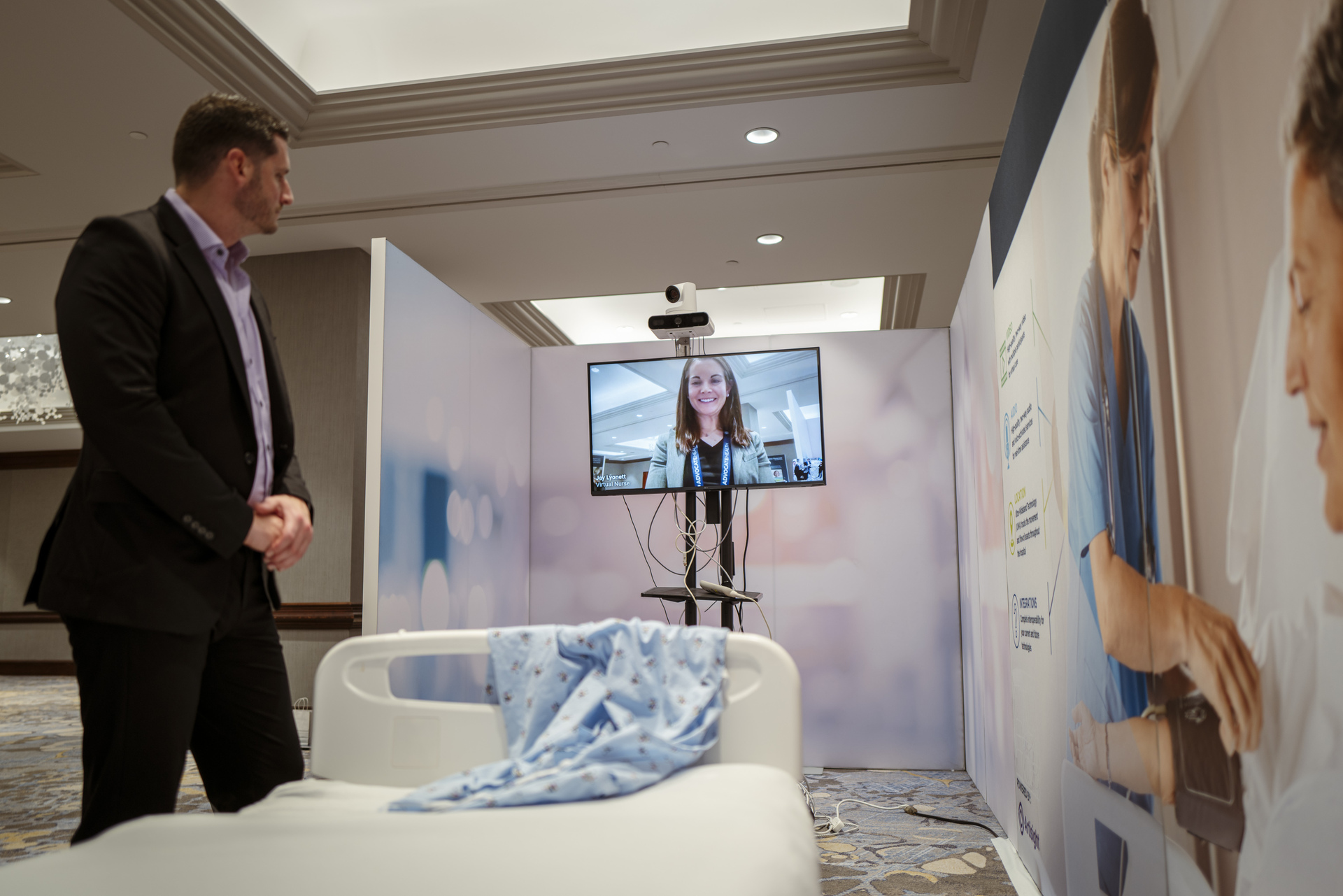
Chicago-based smart hospital platform Artisight is partnering with Advocate on the Room of the Future strategy. Artisight’s technologies include cameras above a smart television that activate upon voice command and allow patients to speak to a nurse or a specialist many miles away. The rooms have sensor networks that determine body weight fluctuations in the bed or other surprise movements, to alert medical teams risks, according to Jay Lyonett, a senior vice president of Artisight.
“We’re opening up the virtual walls, to bring anybody else into their care that you need — a physician, the pharmacist, the dining staff — anybody can use this technology to communicate with the patient, while again, layering in interpreters and family members so that their entire care team is now surrounding them,” Lyonett said. “So as we get to the bedside, we go away from the clicks, and we move to hands-free enablement.”
Advocate spent several years working with Artisight, whose executive team is made of either practicing or former doctors and nurses, on the rooms. The healthcare system launched its virtual nursing program during the pandemic, and now has a centralized location where nurses work to support Advocate’s facilities. Atrium Pineville was a model for that program, and it’s now piloting some of the other Room of the Future work. Atrium Health Lake Norman hospital, which opened in Cornelius this past July, along with a hospital in Illinois, also have some of the technology.
Molly McColl, Advocate’s vice president of virtual health and clinical transformation, says that the system will focus on spreading the tools to rural hospitals across its six-state presence. The goal is to have it in all of Advocate’s hospitals within the next five or so years, McColl says.
They acknowledged the rooms represent a big shift for those of us used to erasable whiteboards and that wired remote that always gets lost in the bedding.
But Russell Tremblay, director for enterprise virtual services for Advocate’s North Carolina and Georgia divisions, says Advocate already has virtual observers or sitters — to be with patients who are flight or fall risks — in nearly all of Advocate’s 69 facilities. Virtual nurses are in about 46 of those facilities.
And the patient response has been, “resoundingly positive,” Tremblay said. “We get comments like, ‘I feel so much more safe. I know that someone’s right there if I need them.’”
It also, they hope, helps address the post-COVID staffing cliff. A recent American Hospital Association report shows that about 100,000 nurses left the workforce during the heart of the pandemic. About 800,000 more reported they plan to leave by 2027, and two out of every three physicians are considering an employment change. That only spirals into more burnout for those who stay.
“Nobody can see 25 patients — you’re just going all day — and at the end of the day remember what happened to the first one you saw,” says Andy McWilliams, an internal medicine doctor at Advocate. “That is one reason I would take notes, so I could log that memory. So if this is happening in real-time, it’s going to invariably get more complete information than either I was going to remember on my own, or reflect from my note-taking.”
Editor’s notes: We updated this story to correct that Artisight is based in Chicago, not Utah; and that virtual nursing is in 46 facilities, not 45.
We also updated to clarify that Room of the Future is an Advocate name for the project, and that Artisight one of several partners; that the ambient voice program is Dragon Copilot, not just Copilot; and that Atrium Health Lake Norman is piloting certain features of the Room of the Future, not the entire thing.